


Description
HIMA F8650E | H51q Safety Central Module
Product Introduction
The F8650E sits at the center of the HIMA H51q architecture. It is the safety-related central module responsible for executing the operating system and configured user application while maintaining synchronized redundant processing.
HIMA’s documentation identifies F8650E as a CPU for H51q, with two clock-synchronized processors and SIL 3 capability. Each processor uses an Intel 386EX 32-bit CPU running at 25 MHz. The documented memory configuration is substantially different from some third-party listings, so procurement should be based on the HIMA-era technical documentation rather than generic reseller specifications.
The suffix matters. F8650E is not simply an F8650 with a cosmetic revision. HIMA documentation and technical references distinguish the E-version from the earlier F8650, including changes to memory capacity and cooling requirements. When replacing an F8650, the rack installation and cooling arrangement must therefore be checked rather than assuming an immediate swap.
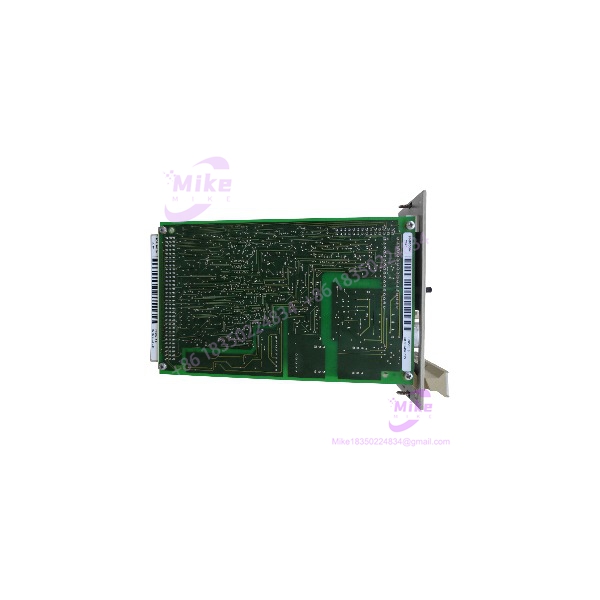
F8650E
Key Technical Specifications
- Manufacturer: HIMA Paul Hildebrandt GmbH + Co. KG
- Model: F8650E
- Product Type: Central Module / Safety CPU
- System: H51q
- Supported H51q Variants: H51q-MS, H51q-HS, H51q-HRS
- Safety Capability: SIL 3
- Processors: 2 × clock-synchronized Intel 386EX
- Processor Architecture: 32-bit
- Clock Frequency: 25 MHz
- Operating-System Memory: 1 MB Flash-EPROM per processor
- User-Program Memory: 1 MB Flash-EPROM per processor*
- Data Memory: 1 MB SRAM per processor*
- Serial Interfaces: 2 × RS-485
- RS-485 Isolation: Electrical isolation
- Diagnostic Display: 4-digit matrix display
- Safety Watchdog: 24 VDC output
- Watchdog Load: Up to 500 mA
- Watchdog Protection: Short-circuit protected
- Rack Space: 8 TE/SU
- Operating Supply: 5 VDC
- Typical Current: 2 A
*Memory utilization depends on the installed operating-system version. HIMA-derived documentation specifically lists 1 MB user-program and data memory for F8650E.
Dual-Processor Safety Architecture
uses two synchronized processors rather than relying on a single conventional PLC CPU.
The architecture continuously compares processor operation and system data to detect discrepancies. This supports fault detection within the central processing path and contributes to the safety architecture required for HIMA’s H51q PES.
The module also provides a safety-related watchdog. Under a detected fault condition, the watchdog provides a 24 VDC safety-related output, rated up to 500 mA and protected against short circuits. This output is part of the system’s fail-safe architecture and should not be treated as an ordinary auxiliary 24 V output.
Communication Interfaces
The incorporates two electrically isolated RS-485 interfaces.
These interfaces support system-level communication appropriate to the H51q architecture, including documented MODBUS-related applications. The RS-485 ports should not be treated as generic serial interfaces without checking the configured protocol, station addressing, transmission rate, and HIMA software environment.
For Ethernet communication, the H51q system uses dedicated communication modules such as the F8627X. itself should therefore not be advertised as an Ethernet CPU merely because the overall H51q installation can communicate over Ethernet.
Diagnostics
provides a four-digit matrix display for diagnostic information.
A proper maintenance procedure should record:
- CPU status
- I/O-area diagnostic status
- Error codes
- Communication status
- Watchdog condition
- Battery-related information where applicable
- Operating-system identification
- Hardware revision
This diagnostic information is valuable when evaluating used modules because a simple power-on test cannot establish compatibility with an existing safety configuration.
F8650 vs.
The distinction is important for replacement procurement.
F8650
- Earlier H51q central module
- Dual Intel 386EX architecture
- 25 MHz processor
- Earlier memory configuration
- 5 VDC / approximately 2 A
- 8 TE
- Later H51q central module variant
- Dual synchronized Intel 386EX processors
- 25 MHz
- 1 MB Flash-EPROM OS memory per processor
- 1 MB Flash-EPROM user-program memory per processor
- 1 MB SRAM per processor
- 5 VDC / approximately 2 A
- 8 TE
HIMA-related documentation specifically notes that upgrading from F8650 to requires attention to the cooling arrangement. This is a practical installation issue and should be checked before treating the E-version as a direct replacement.
Global Sourcing & Live-Test SOP
1. Inbound Verification
- Confirm the front-panel marking is .
- Record serial number, hardware revision, and operating-system version.
- Verify that the module belongs to the H51q family.
- Inspect the module edge connector for oxidation or mechanical damage.
- Check the diagnostic display and front-panel controls.
- Inspect the PCB and battery area for corrosion or unauthorized rework.
- Compare the hardware against the expected configuration.
- Preserve serial-number traceability for the complete procurement record.
2. Live Simulation
A meaningful test requires a compatible H51q test rack.
Recommended checks include:
- Verify the 5 VDC supply.
- Measure module current under the applicable operating condition.
- Perform controlled startup.
- Confirm both synchronized processors reach the expected state.
- Exercise the diagnostic display.
- Test both RS-485 interfaces.
- Verify communication with compatible H51q equipment.
- Exercise the watchdog through the approved test procedure.
- Perform controlled power-cycle testing.
- Where applicable, verify operation in a redundant central-module configuration.
A generic bench power-up should never be represented as a complete safety validation.
3. Diagnostics
- Record all startup diagnostic indications.
- Check CPU and I/O diagnostic states.
- Verify RS-485 communication.
- Check battery status where applicable.
- Monitor for intermittent backplane faults.
- Record firmware/OS information.
- Check for abnormal temperature rise during an extended run.
- Verify that the target system’s software revision supports the module.
4. Final Preparation
- Handle the module using ESD-safe procedures.
- Protect the edge connector during storage and shipment.
- Record serial number and hardware revision.
- Document battery condition.
- Record test results.
- Package in ESD-safe material.
- Keep configuration information with the service record.
Field Engineer’s Pitfall Guide
❗ Do not confuse with HIMax hardware. Some current reseller pages incorrectly label as a HIMax CPU. The technical documentation places in the H51q family. HIMA’s own process-automation material explicitly identifies as a CPU for H51q.
❗ Do not assume and are interchangeable without checking cooling and memory configuration. The E-version has a different documented memory configuration, and technical documentation identifies a cooling modification when upgrading from .
❗ Do not mistake the watchdog output for a general-purpose power output. The 24 VDC, 500 mA output is part of the safety-related watchdog architecture. Its behavior must be validated according to the HIMA system documentation and the application’s safety procedure.
Intent-Driven FAQ
What is HIMA ?
HIMA is a safety-related central module for the H51q programmable electronic safety system. It executes the safety application and provides central diagnostic and communication functions.
What processors are used in ?
The module uses two clock-synchronized Intel 386EX 32-bit processors running at 25 MHz.
How much memory does have?
The documented configuration provides, per processor, 1 MB Flash-EPROM for the operating system, 1 MB Flash-EPROM for the user program, and 1 MB SRAM for data, with utilization depending on the operating-system version.
What communication ports are built into ?
has two electrically isolated RS-485 serial interfaces. Ethernet is handled through separate HIMA communication modules where required.
What is the power requirement?
The documented operating data is 5 VDC / 2 A. System-level power calculations must include the complete H51q rack rather than the CPU alone.
Is SIL 3?
HIMA’s process-automation material identifies as a SIL 3 CPU for H51q. The actual safety capability of an installed system still depends on the complete certified hardware, software, architecture, and application configuration.
Can replace directly?
Not automatically. The two belong to the same H51q central-module family, but the E-version has a different documented memory configuration and may require attention to cooling when upgrading from . Verify the complete rack and system configuration before replacement.
Is an I/O module?
No. It is the central processing module. Field inputs and outputs are handled by separate HIMA I/O modules.





