


Description
HIMA F8627 | H41q H51q Ethernet Communication Module
Product Introduction
A legacy safety system does not become Ethernet-capable simply because an Ethernet cable can be connected to it. The communication module has to handle the protocol stack, safety-related data exchange, configuration path, and the interface between the central HIMA processor and the network.
HIMA F8627 is designed for exactly that role. It is an Ethernet communication module used with H41q/H51q safety-system architectures, providing Ethernet connectivity for safety-related communication and other supported network services.
The original F8627 documentation describes an Ethernet interface supporting 10Base-T or 100Base-TX according to IEEE 802.3, with an RJ-45 connection. The module also includes a high-speed serial interface for communication with the redundant HSR architecture.
For procurement, F8627 should therefore be treated as a communication subsystem, not a safety CPU and not a general-purpose Ethernet adapter.
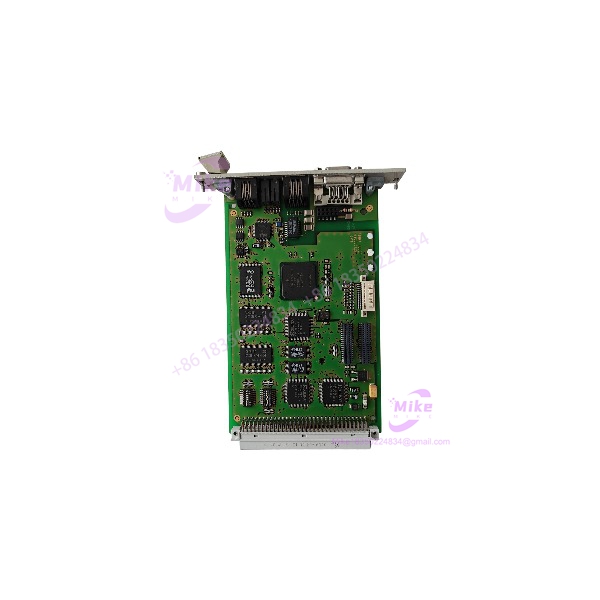
F8627
Key Technical Specifications
- Manufacturer: HIMA Paul Hildebrandt GmbH & Co. KG
- Model: F8627
- Product Type: Ethernet Communication Module
- Application: H41q / H51q safety-system communication
- Ethernet Standard: IEEE 802.3
- Ethernet Interface: 10Base-T / 100Base-TX
- Ethernet Connector: RJ-45
- Processor: 32-bit Motorola MPC860T
- Communication Controller: Integrated RISC communication controller
- Operating Voltage: 5 VDC
- Typical Current: Approximately 1 A
- Module Size: 3 height units × 4 width units
- Mounting: 19-inch HIMA module architecture
- Communication Function: Ethernet communication and supported safety-system networking
- High-Speed Interface: HSR communication interface
- HSR Connector: RJ-12 with applicable HIMA interface hardware
Communication Functions
The F8627 was developed to extend HIMA’s legacy safety architecture into Ethernet-based networks.
Depending on the software and system revision, documented applications include:
- HIMA safeethernet communication
- OPC DA through the HIMA OPC server
- OPC Alarm & Event through applicable HIMA software
- MODBUS-TCP slave functionality on later F8627X-related configurations
- ELOP II programming over Ethernet on supported later configurations
One important procurement distinction: the original and later F8627X should not automatically be considered firmware-identical replacements. HIMA introduced F8627X as a newer communication-module variant with additional Ethernet functions, including MODBUS-TCP slave and Ethernet-based ELOP II programming.
Global Sourcing & Live-Test SOP
1. Inbound Verification
- Confirm the exact front-panel designation: versus F8627X.
- Record serial number, hardware revision, and visible identification markings.
- Check the RJ-45 Ethernet connector for mechanical damage.
- Inspect the HSR/high-speed communication connector and module edge connector.
- Examine the PCB for corrosion, unauthorized rework, damaged components, or contamination.
- Trace available OEM documentation and configuration history before release to inventory.
- Do not use a generic Ethernet test as proof that the module is suitable for safety-related operation.
2. Live Simulation
A proper bench test should use a compatible H41q/H51q test environment.
Recommended checks include:
- Verify stable 5 VDC module supply.
- Measure current consumption against the applicable documentation.
- Establish Ethernet link at the required network speed.
- Verify RJ-45 transmit/receive activity.
- Test communication with an approved compatible HIMA engineering or communication environment.
- Exercise the required safeethernet communication path where the test rack supports it.
- Verify the high-speed communication interface where applicable.
- Confirm communication recovery following controlled network interruption.
3. Diagnostics
- Record startup behavior and diagnostic indications.
- Check Ethernet link negotiation.
- Test repeated power cycles.
- Verify communication error reporting.
- Monitor for intermittent connector or backplane faults.
- Record hardware and firmware identification where accessible.
- Confirm that the installed system software version supports the intended configuration.
4. Final Preparation
- Clean the module using an approved electronics-handling procedure.
- Protect the Ethernet connector and module edge connector against ESD and mechanical damage.
- Package in an ESD-safe enclosure.
- Preserve serial-number traceability.
- Attach the recorded hardware/configuration information to the inspection record.
Field Engineer’s Pitfall Guide
❗ Do not confuse with F8627X. The later F8627X version added communication functions such as MODBUS-TCP slave and ELOP II programming over Ethernet. A physically similar module does not automatically mean configuration compatibility.
❗ Do not treat as a standard Ethernet NIC. The module interfaces with the HIMA safety architecture through the backplane and performs system-specific communication processing. Its purpose is considerably more specialized than simply providing an RJ-45 port.
❗ Check the system software revision before replacement. The original documentation specifies particular H41q/H51q software environments for use. Installing a communication module without checking the CPU, ELOP II, and system revision can create a configuration problem even when the hardware fits.
Intent-Driven FAQ
What is HIMA ?
HIMA is an Ethernet communication module for the H41q/H51q family of HIMA safety systems.
Is a HIMA CPU?
No. is a communication module. It contains its own Motorola MPC860T processor for communication processing, but it is not the primary safety CPU.
What Ethernet interface does use?
The documented interface supports 10Base-T and 100Base-TX Ethernet through an RJ-45 connector.
What is the power requirement?
The documented operating supply is 5 VDC, with approximately 1 A current consumption.
Does support safeethernet?
Yes. The is documented for safety-related Ethernet communication, including HIMA safeethernet applications. HIMA’s own material lists for safeethernet as well as OPC-related communication.
Is the same as ?
No. They are closely related HIMA Ethernet communication modules, but is the later variant with additional functions. The documentation specifically adds MODBUS-TCP slave and ELOP II programming over Ethernet, among other capabilities.
Can be replaced by any Ethernet communication card?
No. Replacement should be based on the complete HIMA system architecture, CPU type, software/ELOP II revision, communication requirements, and the exact / hardware designation.





