


Description
HIMA F3 DIO 8/8 01 | HIMatrix Digital I/O Module
Dynamic Product Introduction
When a HIMatrix remote I/O point fails, the problem is rarely solved by finding another yellow box with the same connector layout. The replacement has to match the safety architecture, engineering environment, firmware expectations, field wiring, and SafeEthernet configuration. The HIMA F3 DIO 8/8 01 is built for that distributed-control role, combining eight digital inputs and eight digital outputs with an integrated safety-related processor and Ethernet switch.
The F3 DIO 8/8 01 provides eight digital inputs, eight standard L+ switching outputs, plus two L- switching outputs that support two-pole applications. The module also provides two pulsed outputs for line-control applications. Its Ethernet interface consists of two RJ-45 ports supporting 10BASE-T/100BASE-TX, with an integrated switch and auto-negotiation. HIMA specifies a response time of at least 10 ms and a nominal operating supply of 24 VDC.
The engineering detail matters. The F3 DIO 8/8 01 communicates with its associated controller using SafeEthernet, and HIMA documentation supports configuration through environments including SILworX and ELOP II Factory depending on the applicable version. This is therefore a safety-system component, not a conventional PLC digital I/O card that can be substituted solely on channel count.
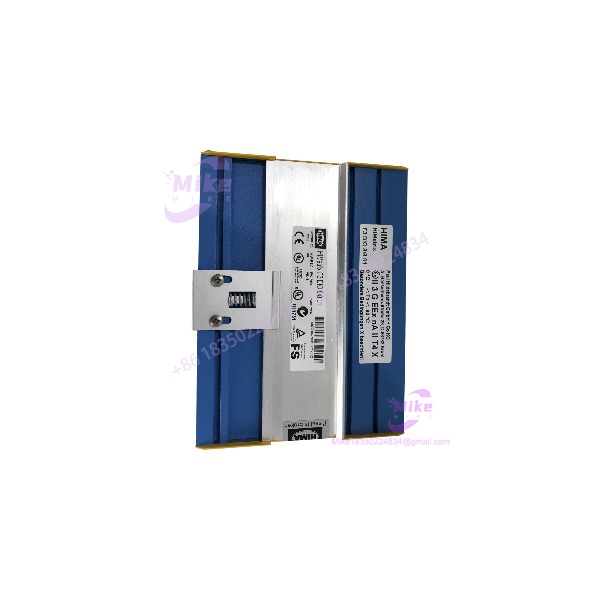
F3 DIO 8/8 01
Key Technical Specifications
- Model: F3 DIO 8/8 01
- Series: HIMatrix
- Function: Safety-related remote digital I/O
- Digital Inputs: 8
- Digital Input Type: Non-galvanically separated
- Input High Level: 15–30 VDC
- Input Low Level: Maximum 5 VDC
- Digital Outputs: 8 DO+ channels
- Additional Outputs: 2 DO- channels
- Pulsed Outputs: 2
- Output Voltage: Supply voltage minus approximately 2 V
- Standard Output Current: Up to 0.5 A on specified channels at ≤60°C
- Ethernet: 2 × RJ-45, 10BASE-T/100BASE-TX
- Communication: SafeEthernet
- Operating Voltage: 24 VDC, -15% to +20%
- Idle Current: Approximately 0.4 A at 24 VDC
- Operating Temperature: 0°C to +60°C
- Storage Temperature: -40°C to +85°C
- Protection: IP20
- Dimensions: Approximately 152 × 114 × 66 mm
- Weight: Approximately 1 kg
- Mounting: 35 mm DIN rail
The output architecture deserves particular attention. The standard F3 DIO 8/8 01 has eight DO+ outputs and two DO- outputs, rather than simply eight identical transistor channels. Channels 4 and 8 have different load-current behavior from the other DO+ channels, so a replacement assessment should include the actual field-load arrangement—not merely the number of outputs.
HIMA’s current technical documentation also identifies the F3 DIO 8/8 01 as an HIMatrix remote I/O with line monitoring and two Ethernet switch ports.
Global Sourcing & Live-Test SOP
For surplus HIMA F3 DIO 8/8 01 inventory, a visual inspection is only the first filter. A working power LED proves very little about the processor, SafeEthernet communication, input diagnostics, or safety output stages.
Inbound Verification
First, verify the complete type designation: F3 DIO 8/8 01.
Record:
- Product name and part number
- Serial number
- Production year
- Hardware revision
- Firmware revision
- Available configuration identity
- Physical condition
The type label itself is useful because HIMA identifies product name, bar code, part number, production year, hardware revision, and firmware revision as identification data.
Inspect the DIN-rail housing, terminal plugs, RJ-45 connectors, grounding point, enclosure screws, and ventilation areas. Check for corrosion, impact damage, contamination, and evidence of previous overheating.
Do not confuse the standard F3 DIO 8/8 01 with F3 DIO 8/8 014. The latter is a railway-oriented variant with different environmental and mechanical requirements.
Live Simulation
A serious test requires a compatible HIMatrix environment.
Power the unit from a controlled 24 VDC supply and monitor current consumption. Establish Ethernet communication through a suitable test setup and verify that the unit’s diagnostic state behaves normally.
Then exercise the I/O:
- Simulate all 8 digital inputs across valid HIGH and LOW conditions.
- Verify input state transitions and diagnostic behavior.
- Exercise all standard digital outputs.
- Test the two L- switching outputs separately.
- Exercise the pulsed-output function where applicable.
- Confirm SafeEthernet communication with the associated controller/test environment.
- Power-cycle the unit repeatedly and check recovery.
For a safety-related device, the test record should identify exactly what was tested. “Power tested” is not an acceptable substitute for an I/O test report.
Diagnostics
Use a calibrated multimeter and appropriate test loads to verify the output stages. Pay particular attention to the channels carrying inductive or higher-current loads.
HIMA documentation specifies line-diagnosis behavior for two-pole operation and describes fault handling in which an affected output is driven to the safe de-energized condition. A device fault can cause the digital outputs to switch off.
Check both Ethernet ports independently. The integrated switch supports 10/100 Mbit/s operation, with LEDs providing link and communication status.
Finally, perform an extended heat run under representative load conditions. The manual notes that enclosure heat dissipation becomes significant when the module is installed in Zone 2; depending on output load and supply voltage, power dissipation can range from approximately 9 W to 27 W.
Final Prep
Before shipment, record the observed firmware/hardware revision and test results. Photograph the identification label internally for traceability, protect the terminal connectors, and package the module against ESD and mechanical impact.
For a safety-system replacement, configuration backup, change approval, proof-test requirements, and final validation remain the customer’s responsibility.
The Field Engineer’s Pitfall Guide
❗ Do not substitute by channel count alone. An eight-input/eight-output device is not automatically equivalent to another eight/eight HIMatrix unit. The F3 DIO 8/8 01 has a specific output architecture, line-monitoring behavior, pulsed outputs, SafeEthernet interface, and safety configuration. HIMA lists other HIMatrix variants such as F3 DIO 16/8 01 and F3 DIO 20/8 02 separately.
❗ Check the hardware and firmware revision before commissioning. The F3 DIO 8/8 01 type label includes both HW and FW revision information. Configuration also differs between supported engineering environments. I’ve seen replacement jobs delayed because the physical replacement was correct but the engineering database, application configuration, or expected firmware did not match.
❗ Do not copy field wiring blindly. The F3 DIO 8/8 01 has conventional DO+ channels, two DO- channels, and pulsed-output functionality. Its output behavior is not equivalent to simply eight identical 24 VDC transistor outputs. HIMA specifies different current characteristics for channels 1–3, 5–7 and channels 4 and 8.
A second practical issue is heat.
If several outputs are carrying substantial current continuously, cabinet temperature and enclosure heat dissipation need to be checked against the installation conditions. A module that passes a bench test at low load can behave differently inside a crowded control cabinet.
Intent-Driven FAQ
Is the HIMA F3 DIO 8/8 01 a safety I/O module?
Yes. HIMA identifies the F3 DIO 8/8 01 as a safety-related remote I/O device. Its digital inputs and outputs are designed for use within the HIMatrix safety architecture, with input information transmitted to the associated controller through SafeEthernet.
How many inputs and outputs does the F3 DIO 8/8 01 have?
The module provides 8 digital inputs and 8 primary digital outputs, plus 2 L- switching outputs and two pulsed-output channels for applicable line-control functions. The distinction between these output types matters when reproducing existing field wiring.
Does the F3 DIO 8/8 01 use Profibus?
No. Its documented communication interface is two RJ-45 Ethernet ports supporting 10BASE-T/100BASE-TX, and the remote I/O communicates with its associated controller through SafeEthernet. It should not be specified as a generic Profibus remote I/O replacement.
Can I replace an F3 DIO 8/8 01 with the F3 DIO 8/8 014?
Not without engineering review. The F3 DIO 8/8 014 is a distinct variant intended for railway applications, with different environmental and mechanical characteristics. The standard F3 DIO 8/8 01 is specified for 0–60°C, while the 014 documentation specifies a different operating range and railway-related vibration/shock requirements.
Does the F3 DIO 8/8 01 support line monitoring?
Yes. HIMA’s technical facts identify the F3 DIO 8/8 01 with line monitoring, and the manual describes line diagnosis for two-pole output operation. This feature needs to be considered when matching the replacement to the original application configuration.
What programming software is used with the F3 DIO 8/8 01?
The manual documents configuration through SILworX and ELOP II Factory, depending on the applicable device/version. Before purchasing surplus inventory, confirm which engineering environment the installed system uses and whether the replacement’s firmware/configuration is compatible.
Is the F3 DIO 8/8 01 hot-swappable?
It should not be treated like a hot-swappable PLC I/O slice. This is a safety-related remote I/O device connected to a live safety system. Follow the site’s approved shutdown, isolation, configuration, proof-test, and functional-safety procedures before removing or installing the unit.
Procurement verdict: The HIMA HIMatrix F3 DIO 8/8 01 is a specialized safety-related remote I/O device with 8 digital inputs, 8 primary digital outputs, additional L- switching capability, pulsed outputs, dual Ethernet ports, and SafeEthernet communication.
For replacement sourcing, the correct purchase specification should be the complete F3 DIO 8/8 01 identity plus hardware/firmware revision and configuration context, not simply “HIMA 8 DI / 8 DO.” That distinction can be the difference between a controlled replacement and a commissioning problem.





