


Description
Triconex 4351B | Communication Module TCM Copper Ethernet TMR
Product Introduction
When safety instrumented systems require robust data exchange with plant-wide DCS and supervisory networks without risking fault-tolerant isolation, standard network cards are insufficient. The Triconex 4351B is not a generic office-grade switch component; it is an advanced Triple Communication Module (TCM) engineered specifically for Tricon v10.0 and later safety architectures. It serves as the primary data exchange bridge between high-integrity safety logic solvers and upper-level supervisory systems.
Featuring two copper Ethernet ports and four configurable serial ports, this module processes multiple industrial communication protocols—including Modbus TCP/IP, SNTP, TSAA, and TriStation. It handles demanding industrial operating thresholds—withstanding ambient temperatures from -40^\circC to +70^\circC—while maintaining strict data segregation to protect safety loops. If you are expanding network integration or replacing legacy communication nodes, this module slips directly into designated Tricon chassis communication slots.
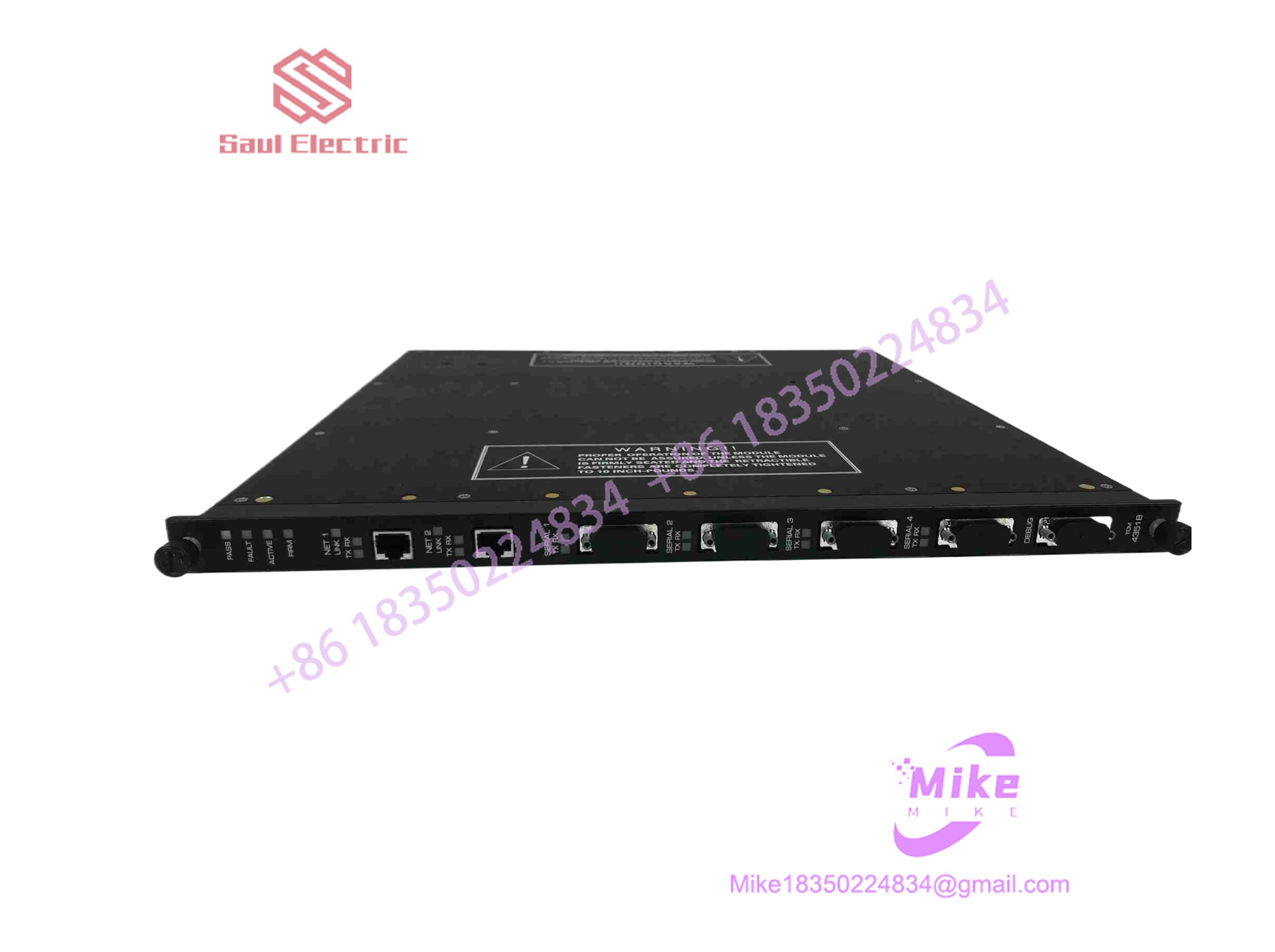
4351B
Key Technical Specifications
| Parameter | Specification Metric |
| Module Type | Triple Communication Module (TCM) |
| System Compatibility | Tricon TMR Safety Systems (v10.0 and later) |
| Network Ports | 2 Copper Ethernet RJ45 ports (10/100 Mbps) |
| Serial Communication | 4 independent RS-232 / RS-485 serial ports (up to 115.2 kbps) |
| Supported Protocols | Modbus TCP/IP, Modbus RTU/ASCII, TSAA, SNTP, TriStation, ICMP |
| Port Isolation | 500 VDC optical/electrical isolation |
| Operating Temperature | -40^\circC to +70^\circC industrial range |
| Backplane Power Draw | Powered via +5 VDC Tricon rack bus |
Application Scenarios & Pain Points
- Refinery Safety-to-DCS Integration: Plant operators require real-time visibility into emergency shutdown (ESD) system states from primary control consoles. The 4351B streams high-speed Modbus TCP data to distributed control systems without jeopardizing safety performance.
- Multi-Vendor Metering and Compressor Skids: Interfacing third-party serial flow computers and variable-speed drives with safety controllers can cause communication latency. The module’s four dedicated serial ports handle independent master/slave polling loops smoothly.
- Plant-Wide Time Synchronization (SNTP): Mismatched sequence-of-events (SOE) logs across isolated skid panels render post-trip fault analysis difficult. The 4351B provides accurate network time synchronization across safety nodes.
QA & Live Testing SOP (Trust Signal)
We don’t warehouse critical safety networking hardware without verifying port performance and data throughput; every 4351B module goes through our rigorous QA protocol:
- Visual & Structural Audit: Inspected under magnification for pin cleanliness, conformal coating integrity, and complete absence of mechanical damage on RJ45 and serial terminal blocks.
- Dynamic Live-Rack Testing: Mounted into an operational Tricon TMR test chassis. We execute high-volume ping sweeps, Modbus polling loops, and TriStation handshakes to confirm zero packet loss.
- Redundant Bus Verification: Tested across internal communication pathways to ensure that network packets route cleanly without causing backplane contention or processor lag.
- Protective Packaging: Sealed inside heavy-duty anti-static barrier bags and packed with high-density structural foam to prevent transit vibration damage.
Field Engineer’s Pitfall Guide
- ❗ Firmware and System Version Constraints: The 4351B requires Tricon system software v10.0 or later. Installing this module into older legacy chassis systems without a proper OS upgrade will result in fatal hardware rejection.
- ❗ Chassis Slot Designation: TCM modules must occupy specialized communication slots within the Tricon rack. Attempting to seat this card into standard I/O card slots will trigger a backplane keying error.
- ❗ IP Address Configuration Overlaps: Always verify network parameters, subnet masks, and node assignments offline before deploying the module into a live plant environment to prevent network token conflicts.
Intent-Driven FAQ
Can I hot-swap the Triconex 4351B without disrupting process safety execution?
Yes. While communication modules do not utilize hot-standby pairs, a faulty TCM module can be pulled and replaced live in an active chassis without shutting down the core TMR safety logic solvers.
Is this unit an authentic OEM part or a third-party clone?
This listing features verified original hardware equipped with factory conformal coating and genuine components, ensuring absolute mechanical and logical drop-in compatibility with your Tricon safety rack.
What causes a “COMM” fault LED to latch upon initial startup?
Usually, this points to an unseated backplane connector, a mismatched configuration tree in TriStation, or an IP address conflict on the network ports. Check your physical seating depth and software project parameters first.
Does the 4351B support both copper and fiber optic connections?
No. The 4351B is specifically configured with copper Ethernet ports (RJ45). If your architecture mandates fiber optic links, look toward companion models like the 4352B instead.
What kind of warranty covers this surplus communication module?
Every unit is backed by our comprehensive replacement guarantee, supported by multi-point pre-shipment bench testing to verify absolute port stability and communication health.





