Description
NI cRIO-9073 | Embedded Real-Time FPGA Controller Unit
Dynamic Product Introduction
Advanced industrial automation, machine control, and test monitoring environments require ruggedized, deterministic computing platforms capable of uncompromised real-time execution. When legacy embedded test setups experience hardware degradation or communication faults, integrating a verified National Instruments cRIO-9073 controller restores absolute stability to the application loop.
Engineered with a fanless, ruggedized profile tailored for harsh operational floors, this integrated system pairs a 266 MHz processor with a high-performance 2M gate FPGA core. Deploying a fresh cRIO-9073 unit ensures seamless C-Series module compatibility, precise timing control, and uninterrupted uptime across critical automation pipelines.
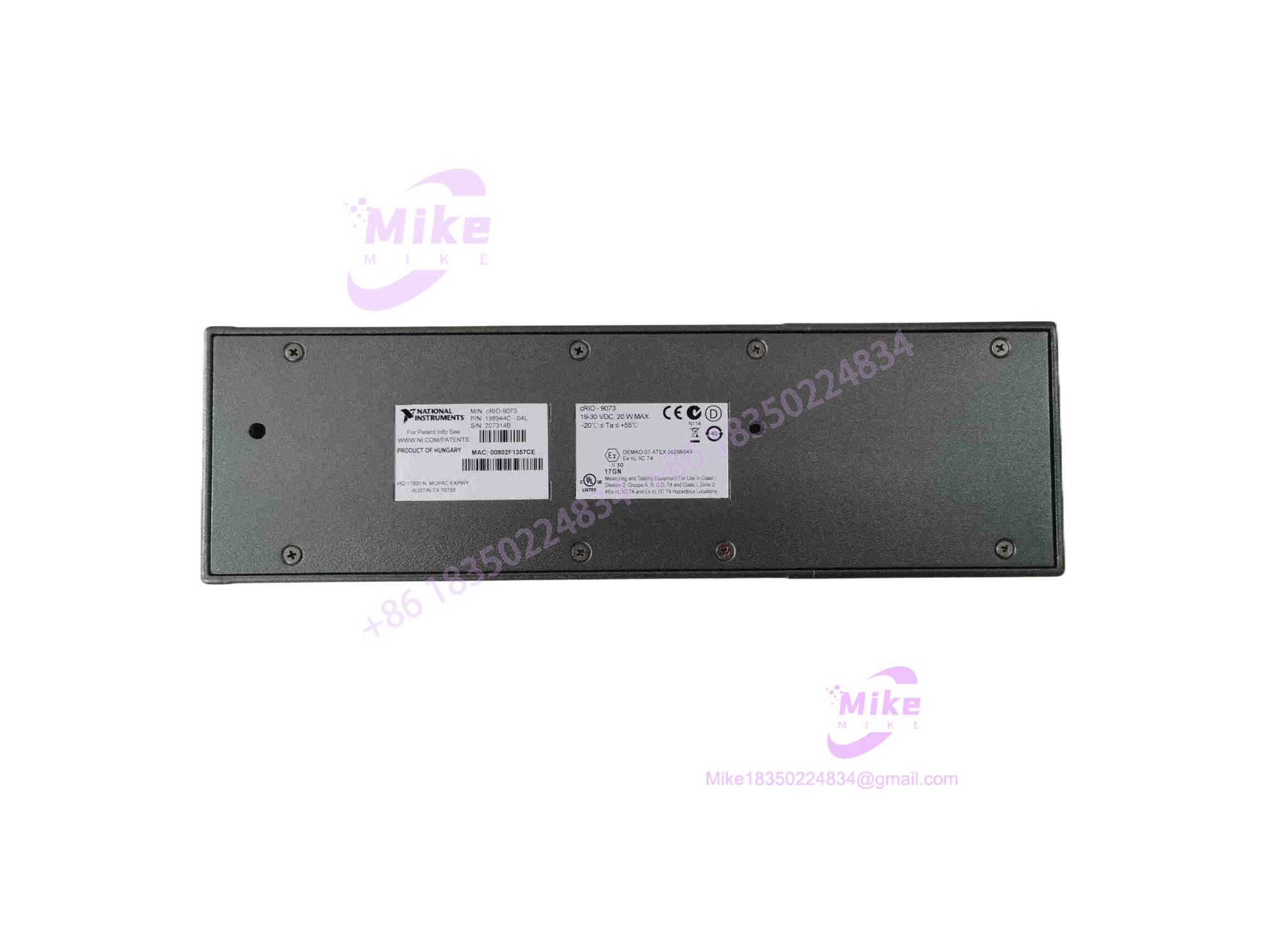
CRIO-9073
Key Technical Specifications
| Core Parameter | Technical Specification |
| Product Model | cRIO-9073 (Manufacturer Part No: 780471-01) |
| Manufacturer | National Instruments (NI) |
| System Architecture | CompactRIO Integrated Embedded Controller & 8-Slot Chassis |
| Processor Core | 266 MHz industrial real-time CPU |
| System Memory | 64 MB DRAM |
| Non-Volatile Storage | 128 MB internal storage capacity |
| FPGA Architecture | Xilinx Spartan-3 2M gate FPGA (720 kb block RAM, 3 DMA channels) |
| Module Slots | 8 physical slots for C-Series I/O modules |
| Communication Ports | 1x 10/100 Mbps Ethernet port, 1x RS-232 serial port |
| Power Requirements | 19 VDC to 30 VDC input range (20 W max consumption) |
| Operating Temperature | -20°C to +55°C industrial threshold |
Global Sourcing & Live-Test SOP (Transparency Core)
Acquiring legacy or surplus modular test hardware through secondary markets requires an exhaustive verification workflow to guarantee backplane integrity and processing reliability.
- Inbound Verification: Incoming cRIO-9073 batches undergo high-magnification optical inspection of C-Series internal bus connector pins, power terminal blocks, and traceability markings against official NI production records.
- Live Simulation: Technicians seat the controller onto a dedicated test bench powered by regulated 24 VDC rails to verify BIOS initialization, NI-RIO driver communication handshakes, and slot enumeration.
- Diagnostics: Engineers execute full-scale memory address sweeps, Ethernet/serial packet transmission tests, FPGA logic compilation checks, and run a 24-hour thermal soak chamber test under load.
- Final Prep: Hardware units receive comprehensive firmware revision logging, protective port capping, and vacuum sealing inside heavy-gauge moisture-barrier ESD shielding bags.
The Field Engineer’s Pitfall Guide
❗ Driver and Software Version Dependencies: Attempting to program or interface with a legacy cRIO-9073 controller using modern, unaligned versions of LabVIEW or NI-RIO drivers can cause communication drops or compilation errors. Always match your development stack to supported legacy version profiles (such as LabVIEW 8.6 / NI-RIO 3.0 baseline compatibility equivalents).
❗ Power Supply Voltage Sags: Failing to use a regulated 24 VDC power supply capable of handling transient current spikes during simultaneous C-Series module activation can cause unexpected processor reboots.
❗ Backplane Insertion Force: Forcing C-Series expansion modules into the 8-slot chassis without aligning the rear guide rails can bend delicate internal connector pins. Always slide modules smoothly until the locking latch engages cleanly.
Intent-Driven FAQ
Will swapping this cRIO-9073 controller erase my LabVIEW Real-Time or FPGA application code?
User applications, startup VIs, and bitfiles are stored on the controller’s internal non-volatile storage or safe boot partitions. Backing up your project files via Measurement & Automation Explorer (MAX) prior to a physical hardware swap is strongly recommended.
Are these units original factory sealed or surplus stock?
Sourced inventory pools span both original factory-sealed packaging and fully certified, tested surplus hardware. Every unit undergoes rigorous bench validation under simulated slot loads prior to dispatch.
Is the onboard FPGA chip user-reprogrammable?
Yes, the cRIO-9073 features an embedded, reconfigurable Xilinx Spartan-3 2M gate FPGA, allowing custom hardware implementation for high-speed control loops and specialized digital protocols.
What software environment is required to configure this system?
Configuration, hardware testing, and deployment are managed via National Instruments software suites, including LabVIEW, the LabVIEW Real-Time Module, and the LabVIEW FPGA Module.
What kind of warranty accompanies a replacement controller?
All supplied units carry a comprehensive 1-year operational warranty covering internal processor health, backplane bus stability, and communication port integrity.
Are you installing this cRIO-9073 controller into an active test automation rig or keeping it on hand as a critical system hot-spare?