

Description
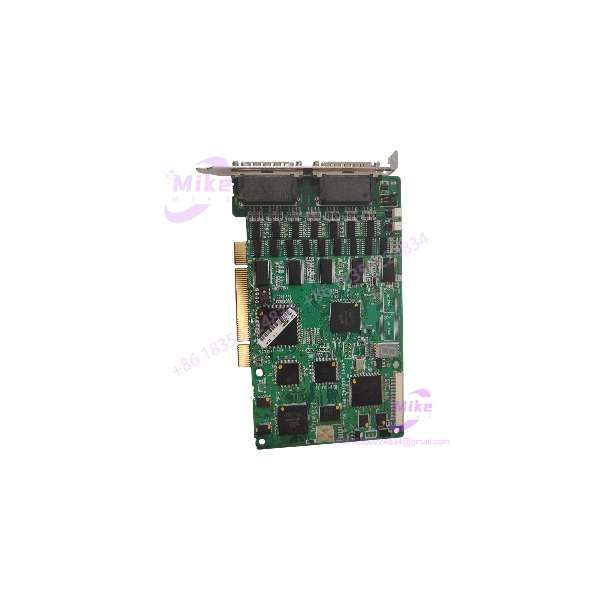
RS Automation MMC-BDP082PNA | 8-Axis PCI Motion Card
Product Introduction
The MMC-BDP082PNA is an RS Automation Half Size PCI motion-control board intended for PC/AT or industrial-computer-based servo motion systems. It provides coordinated control functions for up to eight motion axes and supports point-to-point positioning, linear interpolation, circular interpolation, spline interpolation, and synchronized control. The published MMC specification identifies the BDP082PNA within the Half Size PCI family rather than as a standalone Ethernet or EtherCAT motion controller.
For legacy machine builders and maintenance teams, the board’s useful characteristics are its deterministic motion architecture and direct motion I/O. The controller uses a 128 MHz TMS320VC33 processor, provides a standard 2 ms sampling interval with 0.5–4 ms adjustment, supports 16 MHz maximum pulse output, and accepts position-feedback signals up to 32 MHz.
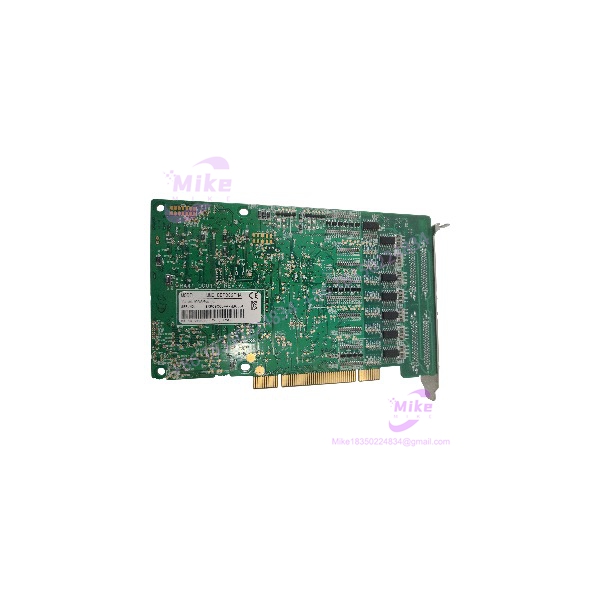
MMC-BDP082PNA
Key Technical Specifications
- Model: MMC-BDP082PNA
- Manufacturer/Brand: RS Automation
- Series: MMC Half Size PCI Series
- Controller Type: PCI motion control board
- Axis Configuration: 8-axis
- CPU: TMS320VC33 DSP
- CPU Frequency: 128 MHz
- Host Interface: PC/AT or industrial computer
- Standard Sampling Rate: 2 ms
- Adjustable Sampling Range: 0.5–4 ms, based on 8-axis operation
- Analog Output: ±10 V, 16-bit resolution
- Pulse Output: Up to 16 MHz, 50% duty cycle
- Position Feedback Input: Up to 32 MHz with digital noise filtering
- User I/O: 20 isolated inputs and 20 isolated outputs
- Position Compare: Up to 4,096 per axis
- Limit Inputs: Positive, negative, and home functions
- Optional Analog Input: 8 channels, 16-bit resolution, 5 µs conversion rate
- Control Power Consumption: +5 V at 2 A; +12 V at 0.5 A; −12 V at 0.5 A maximum control consumption
- Operating Temperature: 0–50°C
- Humidity: 20–90% RH, non-condensing
- Board Dimensions: Approximately 187 × 128 mm
- Board Format: Half Size PCI
- Legacy Status: Verify revision and physical condition before deployment
The published specification explicitly lists MMC-BDP082PNA among the supported MMC Half Size PCI models and identifies the 187 × 128 mm board dimensions.
Application Scenarios & Pain Points
1. Legacy CNC and Multi-Axis Machinery
The eight-axis architecture is applicable where a replacement controller must coordinate several servo axes from an industrial PC.
Engineering pain point: A generic PCI motion card may physically fit while lacking the required feedback, analog, limit, or servo-control interfaces.
Verification point: Confirm the existing machine’s axis count, servo amplifier interface, feedback signal type, and software/driver environment before substitution.
2. Servo Positioning Systems
The MMC-BDP082PNA supports ±10 V analog output at 16-bit resolution and pulse output up to 16 MHz, providing two important motion-interface mechanisms for legacy servo systems.
Engineering pain point: Replacing the card with a newer Ethernet-based controller can require changes to the host software, wiring, drive interface, and motion-control application.
3. Coordinated Interpolation Equipment
PTP, linear interpolation, arc interpolation, spline interpolation, and synchronized control are specified operating modes.
Engineering pain point: A replacement controller that supports only independent axis positioning may not reproduce the original machine’s coordinated trajectory behavior.
4. Obsolete Industrial PC Retrofit
The Half Size PCI form factor is relevant when maintaining older industrial computers where replacing the complete control platform would create a larger integration project.
Engineering pain point: PCI compatibility alone does not establish functional compatibility. The host operating system, motion software, driver layer, I/O wiring, and servo amplifiers must also be checked.
QA & Live Testing SOP
1. Identity Verification
- Photograph the complete board before testing.
- Verify the PCB marking MMC-BDP082PNA.
- Record manufacturer markings, revision identifiers, serial number, and any daughterboard or option-card markings.
- Do not substitute an MMC-BDP042PNA or MMC-BDPV-series board based only on physical similarity.
2. PCB Inspection
- Inspect the PCI connector for bent, oxidized, or contaminated contacts.
- Check electrolytic capacitors, connectors, IC packages, and solder joints.
- Inspect for corrosion, liquid damage, previous repair work, or overheated components.
- Verify that jumpers and option hardware match the intended machine configuration.
3. Controlled Power Test
- Use an ESD-safe bench and current-limited supply arrangement appropriate to the board.
- Verify the required control rails before applying full operating power.
- The published maximum control consumption is +5 V/2 A, +12 V/0.5 A, and −12 V/0.5 A.
- Monitor abnormal current draw, excessive heating, or unstable supply behavior.
4. Host Interface Test
- Install the board in a compatible industrial PC/AT or PCI host platform.
- Confirm that the host detects the PCI hardware correctly.
- Verify the applicable motion-control software and driver environment before attempting machine operation.
5. Motion I/O Verification
- Check axis-related motion I/O.
- Verify analog output where applicable.
- Verify pulse-output operation with suitable test instrumentation.
- Verify feedback input using an appropriate encoder/feedback simulator.
- Check positive, negative, and home limit inputs.
6. Functional Motion Test
- Perform testing with the servo amplifier disconnected or under an approved commissioning setup where practical.
- Confirm command scaling, feedback polarity, position direction, limit logic, and amplifier fault handling.
- Progress from single-axis testing to coordinated multi-axis operation.
7. Packaging
- Package the board in an ESD-safe conductive or static-dissipative bag.
- Protect the PCI connector and exposed components against mechanical impact.
- Use antistatic handling throughout inspection and shipment.
Field Engineer’s Pitfall Guide
❗ Do not confuse with the similarly named BDP042PNA. The published catalog distinguishes the 8-axis from the 4-axis BDP042PNA family. Verify the complete model marking before installation.
❗ Do not assume EtherCAT compatibility. Some current reseller pages incorrectly describe this model as an EtherCAT controller with Ethernet/CANopen interfaces. Those descriptions conflict with the Half Size PCI specification, which identifies PC/AT or industrial-computer interfacing, ±10 V analog output, pulse output, and dedicated motion/feedback I/O.
❗ Sampling rate affects the motion application. The standard rate is 2 ms, with 0.5–4 ms adjustment based on 8-axis operation. Do not assume that every legacy application was configured for the same update interval.
❗ Verify the servo interface before substitution. The board supports ±10 V analog output and high-frequency pulse output, but the required interface depends on the connected servo amplifier and machine architecture.
❗ Feedback compatibility must be checked separately. A maximum 32 MHz position-feedback input specification does not by itself establish compatibility with every encoder or feedback device. Confirm electrical levels, signal format, wiring, and scaling.
❗ Do not ignore host software. A physically compatible PCI slot does not guarantee that the existing industrial PC, operating system, driver, and motion application will recognize and operate the replacement board.
Intent-Driven FAQ
What is the RS Au?
is an eight-axis Half Size PCI motion-control board for PC/AT or industrial-computer-based servo motion applications.
How many a support?
The specified configuration is based on 8-axis motion control. The catalog also specifies a 0.5–4 ms adjustable sampling range based on eight-axis operation.
What proces use?
The published specification identifies a TMS320VC33 processor operating at 128 MHz.
What analog output provide?
The board provides ±10 V analog output at 16-bit resolution.
What is the maximum pulse output frequency?
The specified maximum pulse output frequency is 16 MHz, with a 50% duty cycle.
support encoder or position feedback?
Yes. The published specification provides position-feedback input with a maximum input frequency of 32 MHz and digital noise filtering. Exact encoder compatibility still needs to be verified against the machine’s feedback hardware.
an EtherCAT motion controller?
The primary catalog data does not support that description. It identifies the unit as a Half Size PCI motion controller interfacing with a PC/AT or industrial computer, with dedicated analog, pulse, feedback, limit, and user I/O.
What should be verified before purchasing a replacement?
Confirm the complete part number, PCB revision, host PCI environment, motion-control software, axis count, servo amplifier interface, feedback type, I/O configuration, and machine-specific parameter/driver requirements.
suitable as a drop-in replacement?
Do not assume drop-in compatibility solely from the part number. For a legacy motion system, the host computer, software, servo amplifiers, feedback wiring, I/O configuration, and board revision should be matched before installation.





