Description
Allen-Bradley 1747-L532 | OEM Certified Allen-Bradley CPU Module
Dynamic Product Introduction
Processor faults and communication dropouts on legacy SLC 500 automation networks usually track back to aging CPU hardware or failing onboard communication ports. When an older processor’s internal battery dies and corrupts user program memory, or when electrical transients fry an unisolated serial port, plant production lines grind to an immediate halt. The Allen-Bradley 1747-L532 (SLC 5/03) processor resolves these issues by delivering robust, deterministic logic execution and reliable multi-protocol networking across established manufacturing cells.
Unlike commercial computing hardware, this industrial-grade controller is engineered specifically to withstand heavy electrical noise, vibration, and temperature extremes found in factory environments. Maintaining absolute operational continuity on legacy SLC 500 platforms demands exact hardware matching—making this processor essential for avoiding extended downtime.
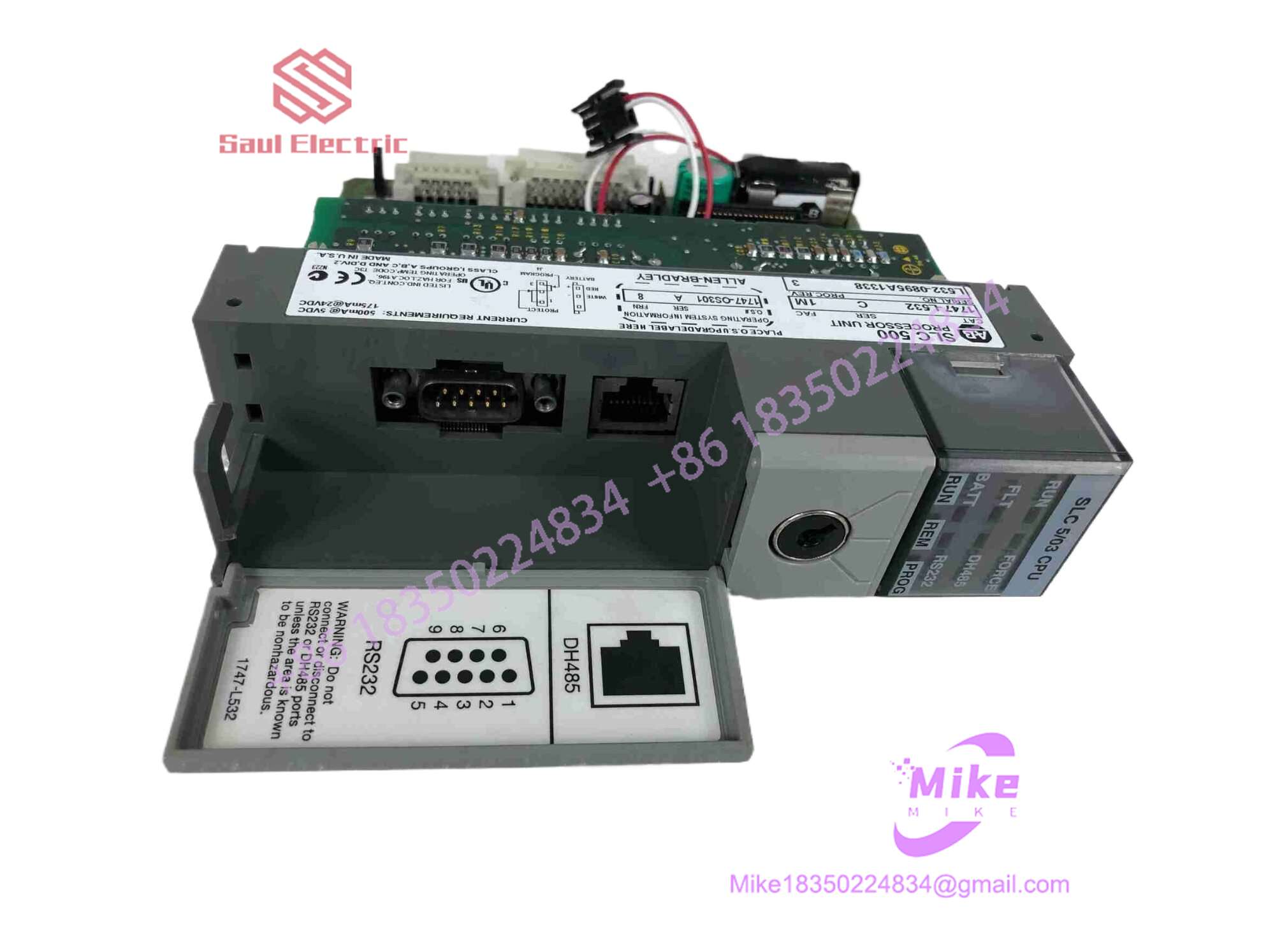
1747-L532
Key Technical Specifications
| Parameter | Specification Detail |
| Manufacturer | Allen-Bradley (Rockwell Automation) |
| Catalog Number | 1747-L532 (SLC 5/03 CPU) |
| System Family | SLC 500 Modular Controller Platform |
| Memory Capacity | 16K Words (User Memory) |
| Communication Ports | Channel 0: RS-232 (DF1, DH-485, ASCII, Modbus RTU master/slave); Channel 1: DH-485 |
| Execution Speed | Approx. 0.44 \mus per instruction |
| Chassis Compatibility | 1746 Modular I/O Chassis (Slots 1-30 depending on configuration) |
| Operating Environment | Industrial control enclosures (0^\circ C to 60^\circ C) |
Global Sourcing & Live-Test SOP (Transparency Core)
Acquiring secondary-market legacy controller hardware requires strict electrical and memory validation to ensure zero battery degradation, flash corruption, or communication failure prior to installation. Our multi-stage qualification protocol covers:
- Inbound Verification: Incoming processors undergo high-magnification optical inspection along the backplane edge connectors, communication ports, and internal battery/capacitor banks to check for corrosion, leakage, or thermal stress. OEM labels are authenticated against global traceability databases.
- Live Simulation: We mount the CPU into a dedicated Allen-Bradley SLC 500 test chassis rack powered by a live backspace test bench.
- Diagnostics: Engineers execute comprehensive memory read/write verification, port communication handshakes across both Channel 0 and Channel 1, and real-time clock stability tests. The unit undergoes an accelerated thermal soak cycle.
- Final Prep: Once testing criteria are met, memory is cleared to factory defaults, a fresh high-reliability lithium backup battery is installed, and the unit is sealed inside an antistatic, moisture-barrier shielding bag.
The Field Engineer’s Pitfall Guide
❗ Hot-Plugging Processor Risks: Never insert or remove the 1747-L532 CPU from the SLC 500 chassis while power is active. Doing so can cause electrical arcing, corrupt backplane communication, and permanently fry the processor motherboard.
❗ Ignoring Backup Battery Maintenance: Relying on an unmonitored, aged lithium battery is a recipe for disaster. When the battery fails during a power outage, your entire ladder logic program and data tables evaporate instantly. Always keep a verified offline backup file.
❗ Serial Port Ground Loop Damage: I’ve seen technicians connect ungrounded programming laptops directly to Channel 0 without an isolation isolator, resulting in an immediate ground loop that blows the processor’s communication transceiver chip.
Intent-Driven-FAQ
Can I upgrade an existing SLC 5/01 or 5/02 processor directly to the 1747-L532 (5/03)?
In many cases yes, provided your ladder logic is recompiled in programming software (such as RSLogix 500) to account for the upgraded instruction set, memory size, and communication channel configurations of the 5/03.
What causes the “FLT” (Fault) LED to flash or stay solid red on startup?
A flashing or solid red fault indicator typically points to a recoverable or unrecoverable processor error, such as a math overflow, corrupted memory, a bad I/O module configuration, or a hardware watchdog timeout. Check the software error buffer to diagnose the root cause.
Does the 1747-L532 support Ethernet communication out of the box?
No. The base 5/03 model features DH-485 and RS-232 ports. To add Ethernet capability, you must install a separate communication interface module (such as a 1761-NET-ENI) or upgrade to an SLC 5/05 processor model.
How do I clear a faulted processor when programming software is unavailable?
You can clear processor memory and reset faults by temporarily jumping the GND and VBB pins on the processor board or by removing the backup battery and shorting the capacitor terminals according to the technical manual.
What level of warranty is included with this surplus controller?
We back this component with a comprehensive one-year replacement warranty, covering material defects and operational processing performance under standard industrial conditions.