

Description
EPRO PR9268/202-000 | Electrodynamic Vibration Sensor
Dynamic Product Introduction
Monitoring absolute bearing housing vibration on massive steam turbines and hydro generators demands transducers that do not collapse under aggressive structural oscillation or intense thermal cycling. While proximity probes track relative shaft displacement within the journal clearance, absolute casing vibration requires an electrodynamic seismic sensor engineered to capture real-time structural movement. The Emerson EPRO PR9268/202-000 electrodynamic velocity sensor provides high-integrity casing vibration measurements directly to monitoring racks like the MMS 6120 or AMS 6500 signal processing modules.
Engineered specifically for vertical orientation mounting, the PR9268/202-000 utilizes a low natural spring-mass system calibrated to a low 4.5 Hz resonance point. This extremely low natural frequency allows the sensor to record slow rotational transients down to 4 Hz (240 RPM)—a capability standard high-frequency accelerometers struggle to deliver without introducing severe noise during integration. Equipped with an 8-meter flexible armored cable and a rugged Harting multipin plug connector, the PR9268/202-000 withstands tough plant conditions while feeding clean analog velocity signals to your plant asset management system.
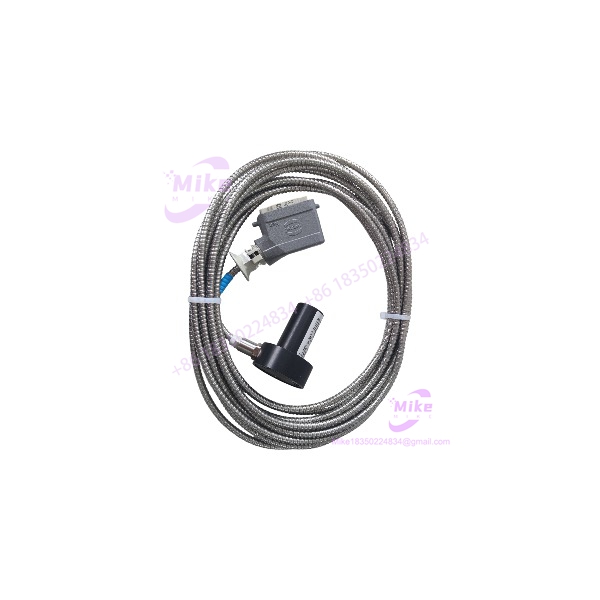
PR9268/202-000
Key Technical Specifications
- Measurement Principle: Electrodynamic moving-coil seismic transducer (self-generating, passive)
- Mounting Orientation: Vertical, ±30° tilt allowance without sinking current (expandable to ±60° with sinking current)
- Linear Frequency Range: 4 Hz to 1,000 Hz (-3dB cutoff point)
- Natural Frequency (f_0): 4.5 Hz ± 0.75 Hz at 20°C (68°F)
- Nominal Sensitivity: 28.5 mV/mm/s (723.9 mV/in/s) at 80 Hz with 100 kΩ load
- Maximum Vibration Displacement: 3,000 µm (peak-to-peak continuous limit); 4,000 µm mechanical limit
- Acceleration Limits: 10g continuous peak-to-peak; 20g intermittent peak-to-peak
- Transverse Sensitivity Ratio: ≤ 0.13 at 110 Hz
- Internal DC Resistance: 3,270 Ω ± 10% nominal coil resistance
- Cable & Connector Assembly: Integrated 8-meter stainless steel armored cable terminated with a Harting multi-pin connector
- Operating Temperature Range: -20°C to +100°C (-4°F to +212°F)
- Enclosure Rating: IP65 / IP67 heavy stainless steel housing
Global Sourcing & Live-Test SOP (Transparency Core)
Sourcing surplus or replacement TSI hardware requires comprehensive bench testing before putting sensors onto live critical assets. Every PR9268/202-000 passing through our inventory undergoes a rigorous quality control validation process:
- Inbound Verification: Serial numbers on the PR9268/202-000 stainless casing and the Harting connector plug housing are verified against Emerson distribution manifests. We inspect the outer armor sleeve for mechanical twisting, check internal pins for bent geometry, and verify the hermetic body seals for physical impact marks.
- Live Simulation: The PR9268/202-000 is mounted vertically on an electrodynamic shaker table calibrated via a reference standard accelerometer. The 8-meter armored cable with the Harting plug is connected directly to an authentic MMS 6120 dual-channel bearing vibration monitor.
- Diagnostics: The shaker sweeps from 4 Hz to 1,000 Hz at discrete velocity amplitudes. The AC voltage output across the Harting pins is verified on a Fluke 87V multimeter and an oscilloscope to confirm that the output voltage matches the 28.5 mV/mm/s curve. Harmonic distortion is checked at low frequencies to confirm the inner suspension coil moves freely without mechanical dragging.
- Electrical & Insulation Check: DC resistance across the primary coil winding is verified to sit within the 3,270 Ω ± 10% specification window. A high-voltage insulation tester applies 500 VDC between the internal coil wiring and the outer stainless housing, verifying insulation resistance exceeds 100 MΩ.
- Final Prep: Baseline calibration certificate sheets are updated, protective caps are secured over the Harting plug, and the PR9268/202-000 unit is sealed inside ESD-safe moisture-barrier packaging.
The Field Engineer’s Pitfall Guide
❗ Installing a Vertical Probe (PR9268/202-000) in a Horizontal Plane: Never mount the PR9268/202-000 horizontally across a bearing split line. The internal moving coil suspension inside the PR9268/202-000 relies on gravity to offset the internal spring pre-load. If mounted horizontally (greater than a 30° tilt off vertical), the internal seismic mass drops against the housing wall—a mistake I’ve seen cause immediate signal clipping, severe harmonic distortion, and premature mechanical wear on the coil guides.
❗ Misinterpreting Low-Frequency Signal Roll-Off Below 4 Hz: The PR9268/202-000 has a natural frequency around 4.5 Hz. If you attempt to measure low-speed barring gear rotation or slow roll speeds under 240 RPM (4 Hz), the output voltage drops off steeply. Relying on uncompensated raw voltage output during slow turbine roll causes under-reporting of true structural displacement unless your TSI monitor card (like the MMS 6120) has the correct low-frequency transfer function curve enabled.
❗ Damage to the Integrated 8-Meter Cable Armor: Do not bend the 8-meter armored cable of the PR9268/202-000 tighter than its minimum bend radius (typically 75 mm). Twisting or over-bending the stainless flexible armor shell can crush the inner signal conductors, causing intermittent micro-shorts during machine operation—an issue that shows up as random, high-amplitude spikes on vibration monitoring trend lines.
Intent-Driven FAQ
Q: What do the specific numbers in the PR9268/202-000 model number mean?The model breakdown identifies the exact mechanical construction: specifies the electrodynamic velocity sensor series. The /202 designator indicates a vertical mounting orientation (±30° off vertical) paired with an 8-meter integrated cable. The -000 suffix specifies the termination option, in this case, a industrial Harting multi-pin connector plug.
Q: Does the PR9268/202-000 require external power supply voltage to operate? No. The PR9268/202-000 is a completely passive, electrodynamic self-generating velocity sensor. As the sensor body moves with machine casing vibration, the internal suspended coil moves through a permanent magnetic field, generating an AC voltage output directly proportional to the vibration velocity.
Q: Can I connect the PR9268/202-000 directly into a standard 4-20 mA PLC input module? No. The raw output of the PR9268/202-000 is a dynamic AC voltage signal representing real-time vibration velocity. To feed a standard PLC 4-20 mA analog card, the sensor output must pass through a signal conditioner, transmitter, or specialized monitoring module (such as an MMS 6120 or AMS 6500 rack card) that rectifies and scales the peak/RMS velocity into a standard DC current loop.
Q: How do I verify whether a field-installed PR9268/202-000 has an open circuit coil? Disconnect the Harting connector plug at the junction box or monitor module. Using a digital multimeter set to resistance (Ohms), measure across the active signal pins of the PR9268/202-000 cable. A healthy internal coil will measure approximately 3,270 Ω (±10%) at room temperature. If the multimeter displays an open circuit (infinite resistance) or zero ohms, the internal coil or cable conductor is damaged.
Q: Is the PR9268/202-000 interchangeable with horizontal variants like the PR9268/302-000? Physically they may share similar housings, but mechanically they are not interchangeable. The PR9268/202-000 is internally sprung for vertical axis operation, whereas horizontal models (PR9268/30x) are sprung to counteract horizontal zero-offsets. Installing a horizontal variant vertically will offset the internal coil suspension, causing inaccurate measurements and potential signal distortion.





