

Description
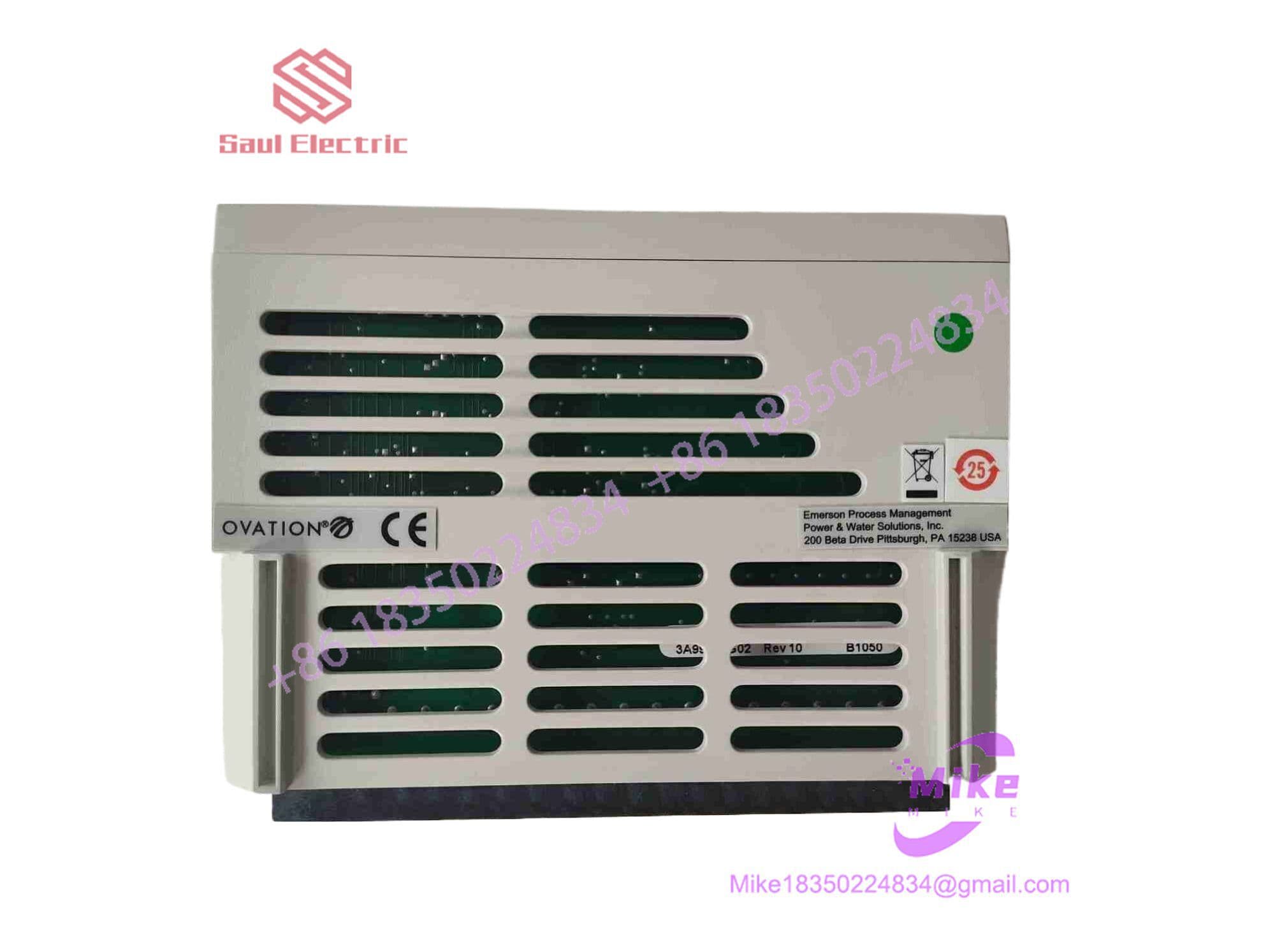
Emerson 1C31169G02 | Ovation RS485/RS422 Link Controller Module
Product Introduction
The Emerson 1C31169G02 is a dedicated Serial Link Controller Electronic Module (EMOD) designed for high-availability communication in the Ovation Distributed Control System (DCS). While its sibling—the 1C31169G01—is configured primarily for standard single-ended RS-232 communication links, the G02 variant is specifically engineered for 4-wire full-duplex RS-485 / RS-422 differential serial topologies.
By handling frame packaging, error checking, and data buffering locally on the module board, the 1C31169G02 offloads low-level serial processing from the main Ovation CPU. This preserves critical execution cycles for main control loops while providing reliable data transmission over long distances (up to 10 meters / 32.8 ft in CE-compliant configurations) through high-noise power plant and industrial environments.

- 1C31169G02

- 1C31169G02
Key Technical Specifications
| Parameter | Technical Specification |
| Part Number | 1C31169G02 |
| Manufacturer | Emerson / Westinghouse Ovation™ |
| Module Type | Serial Link Controller Electronics Module (EMOD) |
| Communication Protocol | RS-485 / RS-422 (4-Wire, Full-Duplex Differential) |
| Isolation Barrier | 1000 V AC/DC (channel-to-logic dielectric isolation) |
| Max Cable Length | 10 meters (32.8 ft) for CE Mark compliance |
| Operating Temperature | 0°C to 60°C (32°F to 140°F) |
| Storage Temperature | -40°C to 85°C (-40°F to 185°F) |
| Humidity Tolerance | 0% to 95% non-condensing |
| Physical Dimensions | 12.1 cm × 5.2 cm × 16.5 cm |
| Weight | ~0.32 kg (0.7 lbs) |
Application Scenarios & Performance Gains
Scenario 1: Field Troubleshooting – Substation Power Monitoring
In power generation plants, interfacing Ovation controllers with numerical protection relays or power meters in remote switchgear rooms often leads to communication dropouts when using unisolated RS-232 links. Replacing an RS-232 serial card with the 1C31169G02 provides differential signal transmission and 1000V dielectric isolation. This isolates the system from ground potential loops and electromagnetic spikes during breaker trips.
Scenario 2: RS-232 (G01) vs. RS-485/422 4-Wire (G02)
- Using 1C31169G01 (RS-232): Single-ended signaling; limited to short cable distances (~15m max), sensitive to industrial ground noise, and restricted to point-to-point connections.
- Using 1C31169G02 (RS-485/422 4-Wire): Differential noise immunity over longer runs, full-duplex simultaneous Transmit/Receive data streams, and stable multi-drop capability for field networks.
Scenario 3: Target Systems
- Interfacing Ovation DCS with Modbus RTU / DNP3 serial devices.
- Turbine Supervisory Instrumentation (TSI) and vibration monitoring systems.
- Burner Management Systems (BMS) requiring high-reliability data exchanges.
QA & Testing SOP (Verification Process)
Every pre-owned or stock 1C31169G02 module undergoes a multi-point quality check prior to dispatch:
- Visual Pin & Component Inspection: Surface examination of backplane connector pins, board traces, and optical isolator components under magnification to rule out thermal degradation or corrosion.
- Oscilloscope Differential Signal Test: The module is powered on a test fixture to monitor RS-485 Tx+/Tx- signal symmetry and differential voltage levels across maximum baud rates.
- Live Ovation Base Handshake: The module is inserted into an Ovation I/O base connected to an active controller. Continuous polling loops are run to ensure zero packet dropouts and verify status LED feedback.
- ESD Packaging: Approved units are sealed in anti-static ESD bags with desiccant packs before shipping.
Field Engineer’s Installation Guidelines
[!WARNING]
Check System Jumpers & Base Terminations
Ensure the PMOD / Personality Module or base wiring matches the 4-wire RS-485 hardware configuration. Mixing up Tx+/Tx- and Rx+/Rx- pairs on the base terminal block will prevent the driver from establishing communication.
- Enable Line Termination: Ensure proper 120-ohm termination resistors are selected across the differential pairs on long cable runs to prevent signal reflections.
- Avoid Model Swaps Without Verification: Do not swap a 1C31169G01 (RS-232) card with a 1C31169G02 (RS-485) card without updating the physical wiring and adjusting the link configurations in Ovation Developer Studio.
- Hot-Swap Precaution: The module supports live removal under standard Ovation procedures, but pulling the card will interrupt field data lines. Ensure dependent control loops are set to MANUAL mode before replacing the unit.
Frequently Asked Questions
Q: What is the main difference between 1C31169G01 and 1C31169G02?
A: The G01 variant is built for single-ended RS-232 communication, whereas the G02 variant is configured for 4-wire full-duplex RS-485 / RS-422 differential networks.
Q: Does this module require an external power supply?
A: No, the 1C31169G02 draws power directly from the 24 VDC backplane supply when inserted into the Ovation I/O base.
Q: How can I tell if a communication loss is due to the module or field wiring?
A: Check the front faceplate status indicators. If the power light is green and the Tx LED blinks during a poll command while the Rx LED remains off, the card is transmitting properly—indicating an issue with field wiring polarity, line termination, or the downstream device.





