

Description
Emerson PR9268/303-000 | Horizontal Electrodynamic Velocity Sensor
Dynamic Product Introduction
Mounting a vertical velocity probe onto a horizontal bearing split line is a classic recipe for catastrophic signal clipping and premature mechanical wear. When massive steam turbines or multi-stage gas compressors experience lateral shell vibration, relying on gravity-slanted sensors distorts absolute casing measurements entirely. Engineered specifically to solve this orientation mismatch, the Emerson EPRO PR9268/303-000 provides precise horizontal velocity tracking without introducing structural false readings or internal coil binding.
Operating entirely on passive electromagnetic induction, the PR9268/303-000 requires no external excitation loops while delivering a dependable 28.5 mV/mm/s output slope across a 4 Hz to 1,000 Hz frequency window. (Honestly, plant operators appreciate this self-powered reliability when auxiliary control power loops drop during an emergency shutdown.) By combining a tuned 4.5 Hz natural frequency with a heavy stainless steel housing and a 10-meter armored cable run, the PR9268/303-000 ensures your monitoring system captures true mechanical displacement vectors without interference.
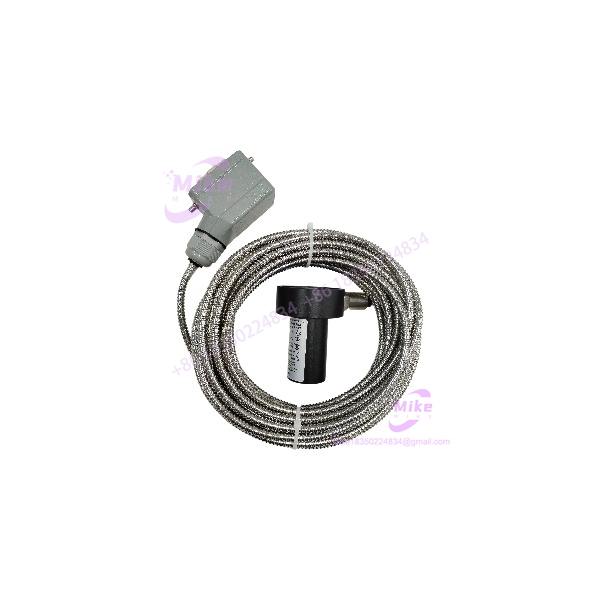
PR9268/303-000
Key Technical Specifications
- Measurement Principle: Electrodynamic moving-coil seismic transducer (passive self-generating)
- Mounting Orientation: Horizontal axis, ±10° angular tolerance without lifting or sinking current
- Linear Frequency Response: 4 Hz to 1,000 Hz (-3 dB cutoff point)
- Natural Frequency (f0f_0f0): 4.5 Hz ± 0.75 Hz at 20°C (68°F)
- Nominal Sensitivity: 28.5 mV/mm/s (723.9 mV/in/s) at 80 Hz with a 100 kΩ load
- Maximum Vibration Amplitude: 3,000 µm peak-to-peak continuous limit; 4,000 µm mechanical limit
- Acceleration Limits: 10g continuous peak-to-peak; 20g intermittent peak-to-peak
- Transverse Sensitivity Ratio: ≤ 0.27 at 110 Hz
- Internal Coil Resistance: 1,875 Ω ± 10% nominal resistance
- Cable Construction & Length: 10 meters total length, stainless steel flexible armor over PTFE core insulation
- Termination Interface: Heavy-duty Harting aviation plug connector
- Operating Temperature Range: -20°C to +100°C (-4°F to +212°F)
- Enclosure Ingress Protection: IP55 / IP65 heavy industrial stainless steel casing
Global Sourcing & Live-Test SOP (Transparency Core)
Procuring surplus turbomachinery hardware demands rigorous physical validation before dropping components onto active plant assets. Every PR9268/303-000 passing through our quality assurance chain undergoes a strict multi-stage verification protocol:
- Inbound Verification: Serial numbers on the PR9268/303-000 stainless housing and Harting plug are checked against factory distribution records. We inspect the flexible armor for jacket twists, examine internal connector pins for bent geometry, and verify hermetic body seals.
- Live Simulation: The sensor is mounted horizontally onto a reference electrodynamic shaker table calibrated via a master accelerometer. The 10-meter armored cable links directly to an authentic MMS 6120 dual-channel vibration monitor rack.
- Diagnostics: The shaker sweeps discrete frequencies from 4 Hz to 1,000 Hz at controlled velocity amplitudes. AC voltage output across the Harting pins is captured using a Fluke 87V digital multimeter to confirm that sensitivity tracks the 28.5 mV/mm/s curve within manufacturing limits.
- Electrical & Insulation Soak: DC resistance across the internal coil winding is measured to verify a nominal reading of 1,875 Ω ± 10%. A high-voltage tester applies 500 VDC between the coil conductors and the outer housing, ensuring insulation resistance exceeds 100 MΩ.
- Final Prep: Calibration sheets are updated, protective caps are secured over the Harting connector, and the unit is sealed inside anti-static moisture-barrier packaging.
The Field Engineer’s Pitfall Guide
❗ Mounting a Horizontal Sensor (PR9268/303-000) on Vertical Surfaces: Never install the horizontal PR9268/303-000 on a vertical bearing housing or thrust bracket. The internal moving-coil suspension is weighted specifically to offset gravity in a horizontal plane. Mounting this unit vertically causes the seismic mass to lean heavily against the internal housing wall, resulting in permanent coil drag, severe signal distortion, and immediate calibration failure.
❗ Exceeding the ±10° Horizontal Angular Tolerance: Ignoring the strict ±10° alignment rule during bracket fabrication creates subtle vector errors. If the turbine casing thermally expands and tilts the mounting pad beyond this angular threshold, the internal spring assembly experiences lateral binding—a common oversight that I have watched corrupt low-frequency vibration trend lines during full load tests.
❗ Crushing the Armored Cable Shield During Routing: Do not clamp the 10-meter armored cable too tightly against sharp structural steel corners during field pulls. Over-tightening zip ties or conduit clamps can deform the flexible stainless armor, pinching the inner PTFE core and causing intermittent micro-shorts that register as erratic noise spikes on your monitoring rack.
Intent-Driven FAQ
Q: What do the specific code digits in the PR9268/303-000 part number indicate?The model breakdown identifies the exact build configuration: specifies the electrodynamic velocity sensor series. The /30 designator denotes a horizontal mounting orientation with a ±10° angular tolerance. The 3 indicates a 10-meter armored cable, and the -000 suffix specifies the factory-terminated Harting aviation plug connector.
Q: Does the PR9268/303-000 require an external power source or loop excitation voltage? No. The PR9268/303-000 is a completely passive, self-generating electrodynamic transducer. As machine casing vibration moves the sensor body, the internal coil cuts through a permanent magnetic field, generating a proportional AC voltage signal without needing external power.
Q: Can I wire the PR9268/303-000 directly into a standard PLC analog input card? No. The raw output is a dynamic AC voltage representing velocity. It must pass through an appropriate signal conditioner, transmitter, or specialized TSI monitor card (such as an MMS 6120 or AMS 6500 module) that scales and conditions the signal into a standard 4-20 mA loop or digital protocol value.
Q: How do I test if an installed PR9268/303-000 has suffered an open coil failure? Disconnect the Harting connector plug at the junction box. Using a digital multimeter set to resistance (Ohms), measure across the active signal pins. A healthy internal coil will display a stable resistance reading around 1,875 Ω (±10%) at room temperature. An open circuit (infinite ohms) indicates an internal wire break.
Q: Can I shorten or splice the 10-meter armored cable in the field? Never shorten or splice the integrated cable on the PR9268/303-000. Electrodynamic loops rely on precise electrical resistance and capacitance characteristics. Modifying the cable length alters the loop impedance, throwing off the factory calibration curve and invalidating your absolute vibration readings.





