


Description
HIMA F8650X | Dual 386EX 25 MHz Central CPU
Product Introduction
The HIMA F8650X is the central processing module of the H51q safety architecture. It executes the operating system and user application while using two clock-synchronized processors to provide the redundant processing and diagnostic architecture expected from a safety-related HIMA PES.
F8650X uses two Intel 386EX 32-bit processors running at 25 MHz. Each processor has dedicated Flash-EPROM and SRAM resources. The module also provides two electrically isolated RS-485 interfaces, a four-digit diagnostic display, and a safety-related watchdog output. HIMA’s certification documentation confirms F8650X as an H51q central module, T4.
This is a significant distinction from the F8627X. F8627X is the Ethernet communication module; F8650X is the central processing module. Ethernet functions such as safeethernet, Modbus TCP, and ELOP II TCP are routed through an F8627X communication module when supported by the installed H51q configuration.
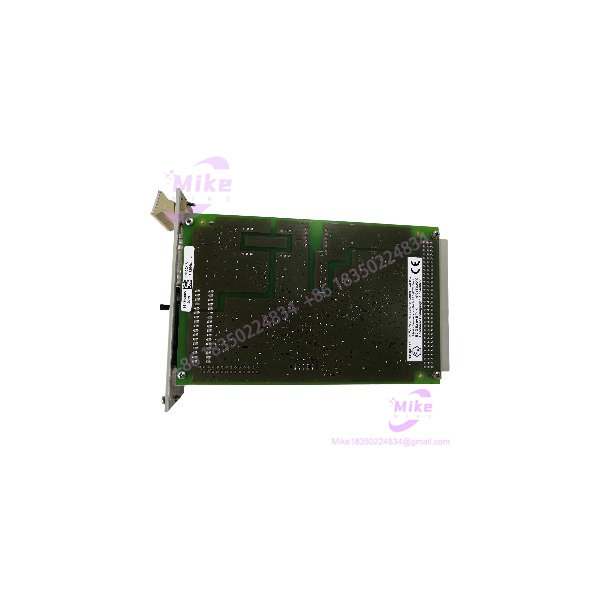
F8650X
Key Technical Specifications
- Manufacturer: HIMA Paul Hildebrandt GmbH + Co. KG
- Model: F8650X
- Product Type: Central Module
- System Family: H51q
- Applications: H51q-MS, H51q-HS, H51q-HRS
- Safety Architecture: Dual clock-synchronized processors
- Processor: Intel 386EX
- Processor Architecture: 32-bit
- Clock Frequency: 25 MHz
- Operating-System Memory: 1 MB Flash-EPROM per processor
- User-Program Memory: 1 MB Flash-EPROM per processor
- Data Memory: 1 MB SRAM per processor
- Serial Interfaces: 2 × RS-485
- RS-485 Isolation: Electrical isolation
- Diagnostic Display: Four-digit matrix/alphanumeric display
- Safety Watchdog: 24 VDC output, up to 500 mA
- Watchdog Protection: Short-circuit protected
- Space Requirement: 8 SU
- Operating Data: 5 VDC / 2 A
The documented memory utilization can depend on the installed operating-system version.
Dual-Processor Safety Architecture
does not use a conventional single-CPU PLC architecture.
Two Intel 386EX processors operate synchronously and participate in the HIMA safety-monitoring architecture. The central module performs internal diagnostics and comparison functions to detect processing and memory discrepancies.
This architecture includes:
- Dual synchronized CPU processing
- Program and data memory diagnostics
- Central-module self-tests
- Watchdog monitoring
- I/O-bus communication
- Diagnostic display functions
- Communication through the HIMA backplane
- Redundant central processing arrangements where configured
For a maintenance replacement, a successful boot is therefore only the first checkpoint. The complete application configuration, operating-system revision, redundant architecture, and connected I/O must be validated before the module is returned to a safety service.
RS-485 Communication
incorporates two electrically isolated RS-485 interfaces.
The serial interfaces support HIMA system communication and related protocols according to the installed operating system and configuration. Station addressing and transmission parameters should be checked against the actual H51q project rather than copied from another installation.
The documented architecture also supports expanded station addressing in Ethernet-based configurations. From the applicable BS41q/51q V7.0-8 operating-system revision, additional switch settings allow station numbers from 1–99 within an Ethernet network; the number of communication partners remains limited by the system architecture.
Ethernet Architecture
itself is not an Ethernet communication card.
Where Ethernet communication is required, HIMA documentation describes the use of an F8627X communication module. The communication path runs from the through the HIMA backplane to the F8627X and then into the Ethernet network.
Supported applications include:
- ELOP II TCP
- safeethernet
- Modbus TCP
- Communication with external Ethernet partners
The exact functions available depend on the H51q operating-system and communication-module revisions.
Diagnostic Display and Watchdog
The provides a four-digit matrix display with selectable diagnostic information.
The front-panel diagnostic architecture includes indicators for general CPU and I/O-area faults. Detailed diagnostic information can be requested through the front-panel controls.
The module also includes a safety-related watchdog with a 24 V output, capable of handling up to 500 mA and protected against short circuits. This output belongs to the safety architecture and should not be treated as an ordinary auxiliary power supply.
Buffer Battery and Maintenance
Battery condition is an important consideration when sourcing an that has spent years in storage.
HIMA-derived technical documentation specifies a lithium buffer battery for SRAM and hardware-clock retention. The documented battery-life figures without voltage feeding are approximately:
- 1,000 days at 25°C
- 200 days at 60°C
The same documentation recommends battery replacement no later than six years, or within three months after a BATI indication. A commonly specified battery is CR 2477N, HIMA part number 44 0000018.
Battery replacement should follow the approved HIMA maintenance procedure so that retained application data is not unintentionally lost.
vs. F8650
Do not treat the X suffix as cosmetic.
The original F8650 and the later are closely related H51q central modules, but the has a different memory configuration and a revised cooling concept.
F8650
- Earlier H51q central module
- Dual Intel 386EX processors
- 25 MHz
- Earlier memory configuration
- 8 SU
- 5 VDC / 2 A
- Later H51q central module
- Dual Intel 386EX processors
- 25 MHz
- 1 MB OS Flash-EPROM per processor
- 1 MB user-program Flash-EPROM per processor
- 1 MB SRAM per processor
- 8 SU
- 5 VDC / 2 A
- Revised cooling concept
HIMA-related documentation specifically notes that upgrading from F8650 to requires attention to the fan/cooling concept. Do not perform the hardware substitution without checking the installed subrack and cooling arrangement.
Global Sourcing & Live-Test SOP
1. Inbound Verification
- Confirm the exact front-panel designation: .
- Record serial number, hardware revision, and operating-system revision.
- Verify the module is intended for an H51q installation.
- Inspect both standard PCBs and the diagnostic display PCB.
- Check the edge connector for oxidation, contamination, or bent contacts.
- Inspect the battery area for leakage or corrosion.
- Check for unauthorized PCB rework or component substitution.
- Confirm the module revision against the customer’s existing H51q configuration.
2. Live Simulation
A meaningful test requires a compatible H51q test environment.
Recommended checks:
- Apply the specified 5 VDC supply.
- Verify current consumption against the applicable technical documentation.
- Perform controlled startup.
- Confirm expected operation of both synchronized processors.
- Exercise the four-digit diagnostic display.
- Test both RS-485 interfaces.
- Verify communication with compatible H51q equipment.
- Test the watchdog through the approved safety test procedure.
- Perform controlled power-cycle testing.
- Where applicable, verify communication through F8627X.
3. Diagnostics
- Record all startup diagnostics.
- Check CPU and I/O fault indications.
- Record the operating-system version.
- Verify RS-485 communication.
- Check battery status.
- Monitor module temperature during an extended run.
- Check for intermittent backplane communication.
- Verify diagnostic behavior following controlled communication interruption.
4. Final Preparation
- Handle the module using ESD-safe procedures.
- Protect the edge connector during storage.
- Record serial number and hardware revision.
- Document battery condition.
- Preserve operating-system/configuration information.
- Package in ESD-safe material.
- Maintain complete incoming-inspection and test records.
Field Engineer’s Pitfall Guide
❗ Do not confuse with F8650E. They belong to the H51q central-module family, but they are distinct hardware revisions. Verify the exact suffix before procurement and replacement.
❗ Do not replace F8650 with without checking cooling. The uses a revised fan/cooling concept. The mechanical fit alone is not sufficient evidence of a valid upgrade.
❗ Do not assume provides native Ethernet. Ethernet communication is implemented through the communication module and the HIMA backplane. If a project requires safeethernet, Modbus TCP, or ELOP II TCP, verify the complete + + operating-system combination.
Intent-Driven FAQ
What is HIMA ?
is a safety-related central module for the H51q-MS, H51q-HS, and H51q-HRS systems.
How many processors does have?
It uses two clock-synchronized Intel 386EX 32-bit processors operating at 25 MHz.
How much memory does have?
The documented configuration provides, per processor:
- 1 MB Flash-EPROM for the operating system
- 1 MB Flash-EPROM for the user program
- 1 MB SRAM for data
Actual memory utilization depends on the operating-system version.
Does have Ethernet?
No integrated Ethernet interface is specified for the central module. Ethernet communication is provided through an communication module when required.
What is the power requirement?
The documented operating data is 5 VDC / 2 A.
Is SIL 3?
The is a safety-related H51q central module used in HIMA systems designed for SIL 3 applications. The conformity documentation identifies as a T4 central module; actual achieved safety integrity depends on the complete certified system architecture and application.
Can replace F8650?
Potentially as part of a documented H51q upgrade path, but not as an uncontrolled drop-in substitution. Check operating-system compatibility, application configuration, hardware revision, and especially the required cooling/fan concept.





