


Description
Bently Nevada 3300/16-12-01-01-00-00 | Vibration Monitor Core Category
Dynamic Product Introduction
Safeguarding heavy industrial rotating equipment requires immediate trip logic when casing vibration exceeds structural safety thresholds. The Bently Nevada 3300/16-12-01-01-00-00 fulfills this critical mandate by delivering robust, rack-mounted signal conditioning designed explicitly for velocity and acceleration monitoring across massive gearboxes, fans, and compressors.
Outperforming basic analog monitors, this modular card integrates advanced filtering and scaled analog outputs directly into the classic 3300 rack backplane. Plant operations benefit from reliable, noise-immune signal acquisition that prevents catastrophic mechanical failure without triggering false shutdowns during transient startup loads.
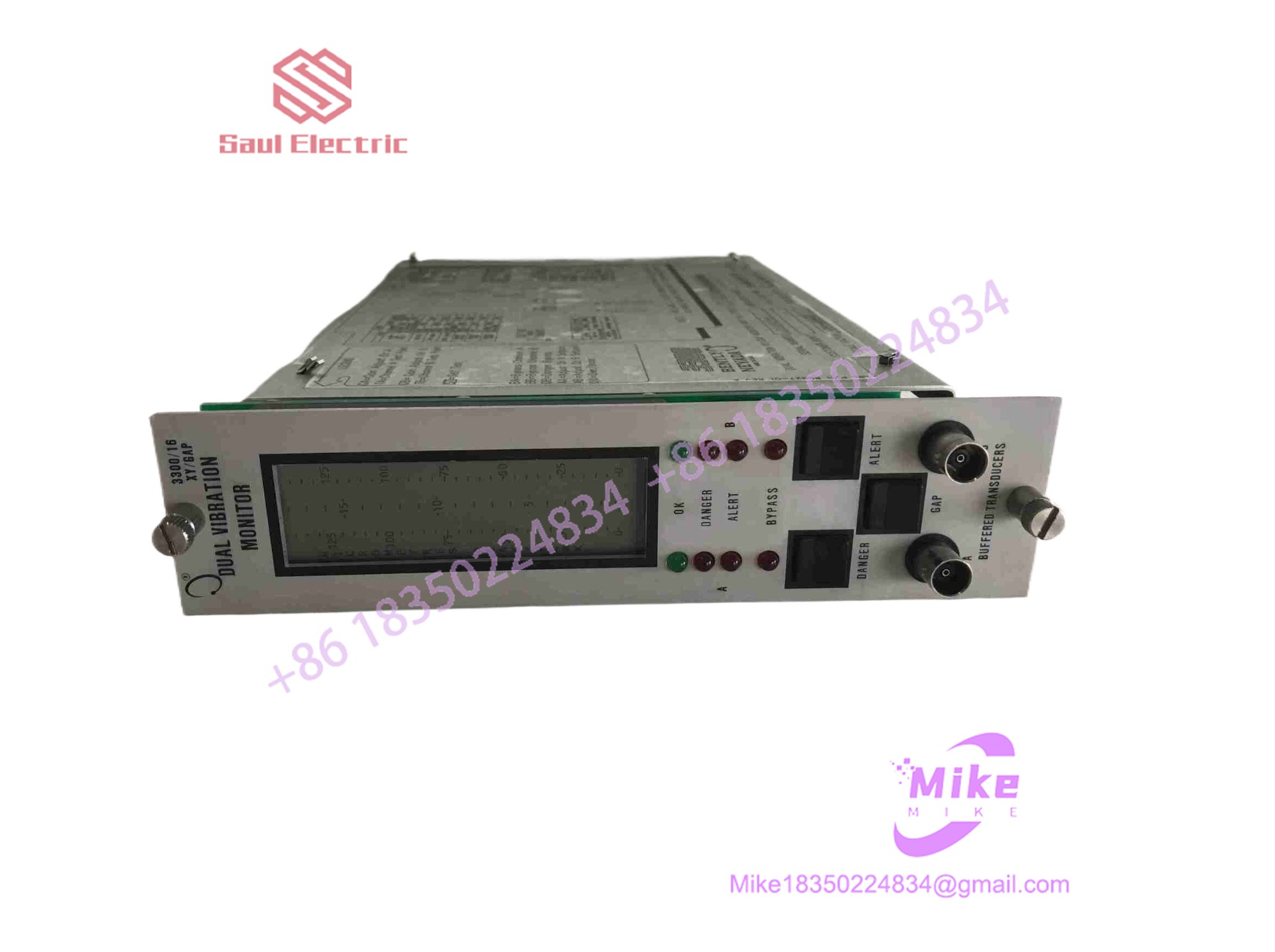
330016-12-01-01-00-00-00
Key Technical Specifications
| Core Parameter | Technical Specification |
| Product Identifier | 3300/16-12-01-01-00-00 (Seismic Monitor) |
| Input Channels | 2 independent channels (accelerometers or velocity transducers) |
| Frequency Response | 0.7 Hz to 1000 Hz (\pm 3 dB) |
| Power Consumption | 3.5 W typical (drawn from rack power supply) |
| Recorders Output | 4-20 mA proportional to full-scale range |
| Alarm Setpoints | Independent Alert and Danger thresholds per channel |
| Display Compatibility | Interfaces with 3300 rack front-panel readouts |
| Operating Temperature | 0°C to +65°C (32^\circF to 149^\circF) |
| Chassis Mounting | Standard 3300 rack backplane slot installation |
Global Sourcing & Live-Test SOP (Transparency Core)
Deploying legacy protection cards into active machinery racks demands an absolute, unyielding quality control and testing pipeline:
- Inbound Verification: Every unit is audited against factory serial registries, tracking customs provenance, and inspecting gold-edge connector fingers for wear or oxidation under magnification.
- Live Simulation: Cards are inserted into a fully powered, genuine Bently Nevada 3300 test rack equipped with calibrated power supply modules.
- Diagnostics: Technicians inject precise synthetic vibration frequencies using function generators, verifying 4-20 mA loop tracking accuracy, alarm relay trip thresholds, and a 24-hour thermal soak under continuous load.
- Final Prep: Diagnostic pass reports are archived against the unique serial number before the module is sealed in multi-layer anti-static packaging.
The Field Engineer’s Pitfall Guide
❗ Backplane Slot Address Conflicts: Inserting a replacement card into an unprogrammed or incorrectly jumpered rack slot can disrupt rack communication protocols. (I’ve seen maintenance teams trigger unexpected trip alarms because a replacement monitor card was slipped into the wrong slot without verifying channel address jumpers.)
❗ Transducer Power Ground Loops: Failing to isolate the accelerometer cable shield at the field junction box while grounding it at the monitor rack can introduce 50/60 Hz electrical hum, inflating baseline vibration readings.
❗ Firmware and Scale Revision Mismatches: Assuming all 3300/16 sub-model options share identical full-scale range configurations without cross-referencing the suffix code can result in severely miscalibrated recorder outputs to the DCS.
Intent-Driven FAQ
Will swapping this monitor card interrupt the main machinery protection trip logic?
Yes, removing a monitor card from a powered 3300 rack will unlatch or fault the associated channels; always place the rack into maintenance/bypass mode or coordinate a planned shutdown before extraction.
What do the specific option digits (-12-01-01-00-00) represent in this part number?
These suffixes define the exact factory configuration parameters, including input transducer type compatibility, frequency filter ranges, recorder output scaling, and agency hazardous area approvals.
Are these modules supplied brand new or as refurbished surplus?
Inventory batches feature a combination of verified factory-sealed surplus (unused) and fully bench-tested, certified secondary stock. Provenance is explicitly stated on every quote.
Can this card interface directly with velocity pickups and piezoelectric accelerometers?
Yes, the internal signal conditioning accommodates both seismic velocity transducers and standard constant-current accelerometers depending on the configured input option.





