Water & Wastewater Treatment DCS/PLC Control Solutions
Water and wastewater treatment facilities rely on distributed automation architectures to monitor and control geographically dispersed assets including pump stations, treatment plants, and storage reservoirs. ABB’s AC500 PLC platform has become the mainstream control solution for these applications due to its robust design, flexible I/O options, and seamless integration with SCADA systems.
Remote Pump Station Monitoring and Control
Municipal water distribution networks consist of dozens or hundreds of pump stations located throughout service territories, requiring centralized SCADA monitoring with local PLC control. AC500 PLCs serve as the “brain” of each pump station, managing real-time pressure control, lead/lag/standby pump rotation, runtime hour metering, and automatic fault detection. The PLC continuously monitors discharge pressure from 4-20mA transmitters and adjusts variable frequency drive speed references to maintain target pressure while minimizing energy consumption. S500 I/O modules connected to the AC500 platform provide cost-efficient, high-reliability interfaces to field devices with hot-swap capability for online replacement without system shutdown. Communication to central SCADA systems utilizes Modbus TCP or other industrial protocols over fiber optic, cellular, or radio networks, enabling operators to monitor reservoir levels, flow rates, and pump status across the entire distribution system from a single control room.
Aeration Basin Dissolved Oxygen Control
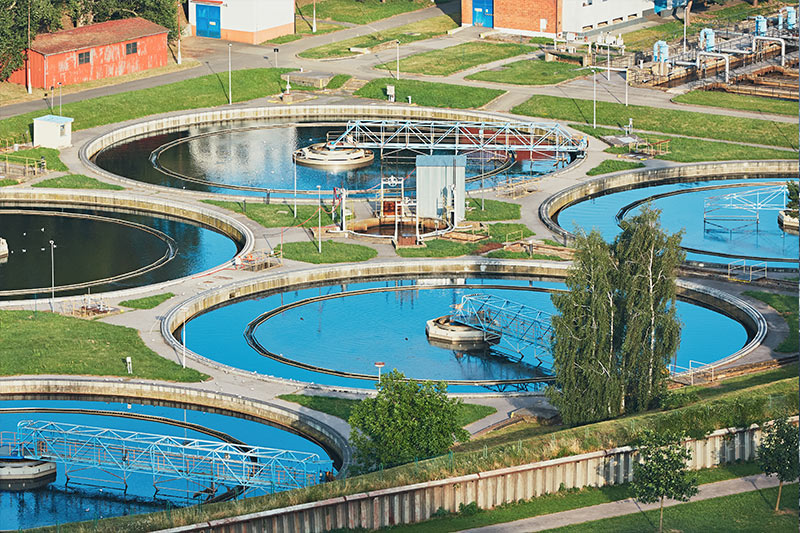
Biological treatment processes in wastewater facilities depend on precise dissolved oxygen (DO) control in aeration basins to optimize microbial activity while minimizing blower energy costs. Each aeration zone is configured as a control zone equipped with a DO probe, modulating air control valve, and air mass flow meter interfaced to the PLC analog I/O system. The control system determines required air flow rates to reach or maintain DO set-points for each zone, then adjusts valve position set-points simultaneously to achieve desired air distribution. Advanced implementations monitor oxygen uptake rate (OUR) in real-time, allowing the controller to adapt to changing loading conditions including variations in biochemical oxygen demand (BOD), ammonia, flow rate, temperature, and mixed liquor suspended solids. Modern aeration control strategies leverage machine learning algorithms including LSTM neural networks and fuzzy inference systems integrated with traditional PID control to improve DO stability and reduce operational expenses.
Water Quality Analyzer Integration
Treatment plants monitor critical water quality parameters including pH, turbidity, chlorine residual, conductivity, and nutrient concentrations through specialized analytical instruments. These analyzers output 4-20mA analog signals or digital communication protocols that connect directly to PLC analog input modules. The AC500 platform’s flexible I/O architecture accommodates various signal types including voltage (0-10V), current (4-20mA), resistance temperature detectors (RTDs), and digital pulse inputs from ultrasonic flow meters. AC500-XC and S500-XC ruggedized variants withstand wider temperature ranges and corrosive gas environments common in wastewater treatment facilities, ensuring reliable operation in harsh installation locations.
Spare Parts Focus: Distributed Site Requirements
Water and wastewater utilities operate numerous geographically dispersed installations, creating unique spare parts management challenges compared to centralized industrial facilities.
AC500 PLC Platform Dominance
The AC500 PLC has become the mainstream control platform for water/wastewater applications due to its modular design, robust construction, and extensive communication capabilities. Utilities standardizing on AC500 systems maintain centralized spare parts inventories covering multiple sites, reducing total stock requirements compared to supporting diverse controller brands. Critical spare parts include AC500 CPU modules in various performance levels (PM554, PM564, PM583), Ethernet communication modules for SCADA connectivity, power supply units compatible with utility DC systems, and memory cards containing validated application programs. Many utilities maintain pre-configured spare CPU modules loaded with standard programming to enable rapid controller replacement by field technicians without requiring on-site programming expertise.
High-Demand Analog I/O Modules
Analog input modules represent the highest-consumption spare parts category in water/wastewater applications due to the large number of sensors and analyzers requiring continuous monitoring. Each treatment plant and pump station connects numerous 4-20mA transmitters measuring pressure, flow, level, temperature, pH, turbidity, chlorine, and dissolved oxygen. Typical installations require AI523 analog input modules (8-channel, 4-20mA) as the primary interface for process measurements, AI531 modules for RTD temperature sensors in digester and chemical feed applications, and AI535 modules for thermocouple inputs in incineration and thermal processes. Analog output modules including AO523 (8-channel, 0-10V) provide speed references to variable frequency drives controlling pumps and blowers. The modular S500 I/O design allows utilities to stock common module types applicable across different sites, while per-channel open wire detection capabilities (especially for 4-20mA inputs) enable immediate fault identification triggering spare module deployment.
Environmental Protection and Reliability
Water and wastewater facilities expose control equipment to humidity, corrosive gases (hydrogen sulfide, chlorine, ammonia), temperature extremes, and vibration from rotating equipment. The AC500-XC extreme conditions variant tolerates -40°C to +70°C ambient temperatures and resists corrosive atmospheres better than standard models, reducing failure rates in harsh pump station and headworks installations. Despite these protections, utilities implement proactive spare parts strategies including biennial or triennial replacement of analog I/O modules in highly corrosive locations, pre-failure replacement based on historical data showing typical 5-7 year service life in wastewater environments, and maintaining dual-site spare inventories for large utilities with critical infrastructure requiring immediate restoration. Integration of SCADA diagnostics monitoring I/O module health parameters enables condition-based maintenance, where modules exhibiting drift or communication errors are replaced during scheduled maintenance before complete failure occurs.