


Description
HIMA F8627X | H41q H51q Ethernet Communication Module
Product Introduction
The F8627X is not simply an Ethernet interface added to an old safety rack. It is the dedicated communication processor that connects the HIMA H41q/H51q architecture with Ethernet-based systems while handling both safety-related and non-safety-related communication functions.
HIMA F8627X supports Ethernet communication through a 10Base-T or 100Base-TX interface and connects to the HIMA high-speed redundancy architecture through its HSR interface. The module uses a 32-bit Motorola MPC860T processor with an integrated RISC communication controller.
The major distinction from the earlier F8627 is software capability. HIMA introduced F8627X with additional functions including OPC A&E, MODBUS-TCP slave, and ELOP II programming over Ethernet. These functions depend on the installed F8627X operating-system version, so a hardware-only replacement check is not sufficient.
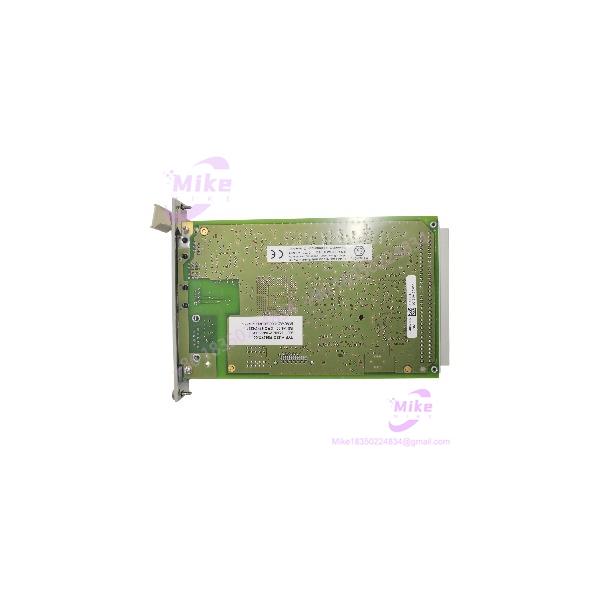
F8627X
Key Technical Specifications
- Manufacturer: HIMA Paul Hildebrandt GmbH & Co. KG
- Model: F8627X
- Order Number: 98 4862765
- Product Type: Ethernet Communication Module
- Application: H41q / H51q PES
- Ethernet Standard: IEEE 802.3
- Ethernet Interface: 10Base-T / 100Base-TX
- Ethernet Connector: RJ-45
- Processor: 32-bit Motorola MPC860T
- Communication Controller: Integrated RISC communication controller
- Operating Voltage: 5 VDC
- Current Consumption: Approximately 1 A
- Rack Space: 3 HU × 4 SU/WU
- HSR Interface: High-speed serial interface to redundant HSR communication architecture
- HSR Connector: RJ-12 with applicable BV 7053 interface
- Diagnostic Indicators: 6 LEDs
- Configuration: DIP-switch functions provided
- Serial FB Interface: Not used in the documented configuration
Supported Communication Functions
The was designed to consolidate several communication functions within the H41q/H51q environment.
Depending on the module operating-system revision and system configuration, supported functions include:
- safeethernet safety-related communication
- OPC DA through the HIMA OPC server
- OPC Alarm & Event
- MODBUS-TCP slave
- ELOP II TCP / programming over Ethernet
- Communication between HIMA safety systems
- Ethernet-based engineering access on supported system revisions
The original HIMA product announcement specifies MODBUS-TCP slave and ELOP II programming over Ethernet from the applicable ELOP II software generation. The later operating documentation states that the additional MODBUS TCP slave and ELOP II TCP functions require operating system V4.x or higher.
F8627 vs.
This is the comparison procurement engineers should make before ordering a replacement.
F8627
- Earlier Ethernet communication module
- 10Base-T / 100Base-TX Ethernet
- SafeEthernet capability
- OPC-related communication
- Older H41q/H51q application environments
- Same fundamental Ethernet communication role
- Compatible with the F8627 architecture
- Adds newer communication functions through appropriate operating-system versions
- MODBUS-TCP slave
- ELOP II TCP/programming over Ethernet
- OPC Alarm & Event
- Designed for newer HIMA CPU generations such as F865xX in the documented product announcement
The HIMA documentation specifically states that has the same basic functions as F8627 and is compatible with it, while the newer functions require the appropriate operating-system version.
Global Sourcing & Live-Test SOP
1. Inbound Verification
- Confirm the front-panel designation is , not F8627 or F8628X.
- Verify the order number where available: 98 4862765.
- Record serial number, hardware revision, and operating-system revision.
- Inspect the RJ-45 connector for bent contacts or mechanical damage.
- Inspect the HSR/RJ-12 interface and module edge connector.
- Check the six diagnostic LEDs during controlled startup.
- Inspect the PCB for corrosion, unauthorized component replacement, or rework.
- Preserve serial-number traceability for the entire procurement record.
2. Live Simulation
A meaningful test requires a compatible H41q/H51q environment rather than a generic Ethernet bench.
Recommended checks:
- Verify stable 5 VDC supply.
- Measure module current against the applicable documentation.
- Establish Ethernet link through the RJ-45 interface.
- Test 10Base-T and/or 100Base-TX operation as applicable.
- Verify communication with the engineering environment.
- Test safeethernet communication where a suitable HIMA test system is available.
- Test MODBUS-TCP slave functionality only when the installed OS supports it.
- Verify ELOP II Ethernet communication where supported.
- Exercise the HSR interface when the required HIMA redundancy hardware is available.
3. Diagnostics
- Record startup LED behavior.
- Verify Ethernet link stability.
- Perform repeated power-cycle testing.
- Monitor for intermittent communication failures.
- Check configuration/DIP-switch settings.
- Record operating-system and hardware identification.
- Verify network timeout behavior under controlled interruption.
- Confirm the test configuration matches the target H41q/H51q system revision.
4. Final Preparation
- Clean the module using an approved electronics-handling procedure.
- Protect the RJ-45, HSR connector, and module edge connector.
- Package in ESD-safe material.
- Record serial number and hardware/OS revision.
- Include the inspection report with the procurement documentation.
- Do not describe a bench Ethernet test as proof of functional-safety compliance.
Field Engineer’s Pitfall Guide
❗ Do not confuse with F8628X. is the Ethernet communication module; F8628X is the corresponding PROFIBUS-DP communication module. HIMA’s certification documentation lists them separately.
❗ Do not ignore the operating-system revision. The hardware can be compatible while a required function is unavailable because the installed OS is too old. In particular, the documented MODBUS-TCP slave and ELOP II TCP functions require the appropriate OS revision.
❗ Do not treat the RJ-45 port as an ordinary PLC Ethernet port. Network architecture matters. HIMA’s documentation specifies requirements for switches, full-duplex operation, bandwidth, timeout calculations, and logical Ethernet segmentation when using the .
Intent-Driven FAQ
What is HIMA ?
HIMA is an Ethernet communication module for the H41q/H51q family of legacy HIMA safety systems.
What is the HIMA order number?
The HIMA product announcement identifies 98 4862765 as the part number.
Does support Modbus TCP?
Yes. The documented supports MODBUS-TCP slave functionality when the appropriate operating-system version is installed.
Can be programmed through Ethernet?
Yes. supports ELOP II programming over Ethernet with the applicable software and operating-system revision. HIMA’s product documentation identifies this as one of the major additions over the earlier .
Does support safeethernet?
Yes. is designed for safety-related communication between supported HIMA systems through safeethernet, including mono and redundant configurations.
What Ethernet connector does use?
The module uses an RJ-45 Ethernet connector and supports 10Base-T / 100Base-TX according to IEEE 802.3.
Is a safety CPU?
No. It is a communication module. The safety CPU remains a separate component of the H41q/H51q architecture.
Is compatible with ?
The HIMA operating documentation states that has the same basic functions as and is compatible with it. However, the additional functions depend on the installed operating-system revision, so replacement validation should include hardware, OS, ELOP II version, and system configuration.





