


Description
HIMA F8621A | H41q H51q Coprocessor Module
Product Introduction
When a legacy HIMA safety rack still has to communicate with an external control or supervisory system, the processor architecture matters just as much as the physical spare. HIMA F8621A is a dedicated coprocessor module rather than the primary central CPU. It provides local processing resources and serial interfaces while exchanging data with the central system through dual-port RAM.
The F8621A uses an HD64180 microprocessor running at 10 MHz and provides 384 kB of static memory implemented with CMOS RAM and EPROM. Its two RS-485 half-duplex interfaces are galvanically isolated and have their own communication processor, making the module suitable for legacy serial communication functions in HIMA H41q/H51q installations. HIMA’s certification documentation explicitly identifies F8621A as a coprocessor module.
For procurement, this distinction is important. Do not substitute F8621A merely because another HIMA communication module fits the same general rack family. F8627X and F8628X, for example, serve Ethernet and PROFIBUS-DP functions respectively; F8621A is the serial/coprocessing option.
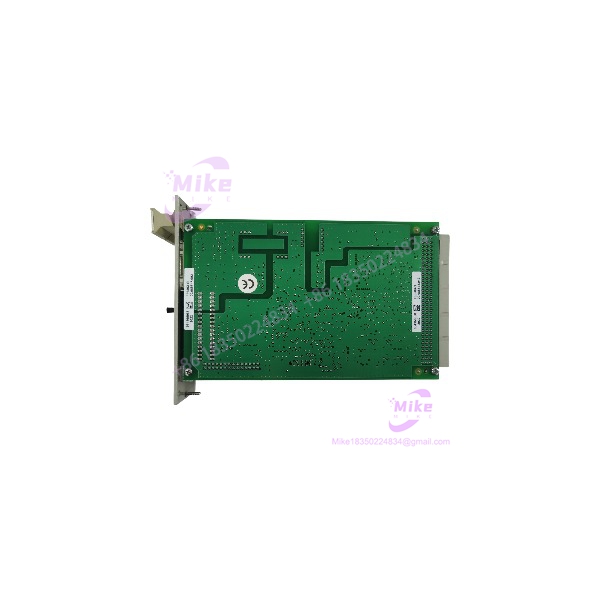
F8621A
Key Technical Specifications
- Manufacturer: HIMA Paul Hildebrandt GmbH & Co. KG
- Model:
- Product Type: Coprocessor Module
- Processor: HD64180
- Processor Clock: 10 MHz
- Static Memory: 384 kB
- Memory Technology: CMOS RAM and EPROM
- Serial Interfaces: 2 × RS-485
- RS-485 Mode: Half-duplex
- RS-485 Isolation: Galvanically isolated
- Communication Processing: Dedicated communication processor
- Data Exchange: Dual-port RAM for rapid access between processing modules
- Transmission Rates: 300 to 57,600 bps, depending on configuration
- Rack Space: 4 TE
- Supply: 5 VDC
- Typical Current Consumption: 360 mA
- RAM Buffering: Associated with the F7131 power-supply monitoring/battery module in H51q configurations
Communication Architecture
The is particularly relevant where an existing HIMA installation uses serial communications rather than newer Ethernet-based architecture.
Its two RS-485 interfaces operate in half-duplex mode and use galvanic isolation. Available transmission rates include 300, 600, 1,200, 2,400, 4,800, 9,600, 19,200, 38,400, and 57,600 bps in the documented configuration.
The module also incorporates dual-port RAM, allowing rapid memory access between the coprocessor and the central processing architecture. This is one reason should not be treated as a generic RS-485 adapter.
Global Sourcing & Live-Test SOP
1. Inbound Verification
- Confirm the front-label designation is , not F8621X, F8627X, or another visually similar HIMA module.
- Record the complete ordering code, serial number, hardware revision, and visible PCB markings.
- Compare connector arrangement and front-panel labeling against the expected configuration.
- Trace available OEM documentation and historical procurement records.
- Inspect the PCB for corrosion, rework, damaged connectors, or unauthorized component replacement.
- Verify packaging and ESD protection before warehouse release.
2. Live Simulation
For a used or refurbished unit, the recommended test rack should reproduce the intended H41q/H51q central-rack environment.
- Verify 5 VDC supply behavior.
- Confirm approximately 360 mA module consumption under the specified operating condition.
- Exercise both RS-485 interfaces.
- Perform RS-485 transmit/receive loopback testing.
- Verify galvanic isolation between the serial interface and internal electronics.
- Check communication at the required baud rate.
- Verify dual-port RAM data exchange with a compatible central module where the complete test environment is available.
3. Diagnostics
- Record startup and diagnostic indications.
- Confirm stable operation during repeated power cycles.
- Verify communication error handling.
- Check for intermittent RS-485 faults or connector sensitivity.
- Record firmware/software-relevant information where accessible.
- For safety-system deployment, perform the customer’s approved validation procedure rather than treating a bench communication test as proof of functional safety.
4. Final Preparation
- Clean connectors using an approved electronics-cleaning procedure.
- Protect the module in an ESD-safe package.
- Preserve the serial number and inspection record.
- Include the recorded hardware identification with the shipment.
- Keep configuration and compatibility documentation attached to the service record.
Field Engineer’s Pitfall Guide
❗ Do not confuse with F8627X or F8628X. These modules occupy related HIMA system architectures but provide different communication functions. HIMA identifies F8627X as an Ethernet communication module and F8628X as a PROFIBUS-DP communication module.
❗ Do not assume an is the main CPU. It is a coprocessor module. Replacing a failed central module with is not an equivalent substitution.
❗ Check the exact suffix before ordering. The HIMA documentation reviewed here identifies , not a generic F8621X, as the certified coprocessor designation. A listing that says only “F8621X” should therefore be verified against the physical nameplate and OEM documentation before purchase.
Intent-Driven FAQ
Is HIMA a CPU module?
No. is identified by HIMA as a Coprocessor Module. It has its own HD64180 processor but should not be treated as the system’s primary central CPU.
What HIMA systems use ?
is associated with the legacy H41q/H51q HIQuad safety-system architecture. HIMA documentation lists among the modules used with these systems.
How many RS-485 ports does have?
It provides two RS-485 half-duplex interfaces, with galvanic isolation and a dedicated communication processor.
What processor is inside ?
The documented processor is an HD64180 running at 10 MHz.
How much memory does provide?
The module provides 384 kB of static memory, using CMOS RAM and EPROM.
Does use 24 VDC directly?
The documented module operating supply is 5 VDC, with a typical current requirement of approximately 360 mA. It should therefore be evaluated as a rack-level module rather than a standalone 24 V field device.
Is F8621X the same as ?
Do not assume so. HIMA’s official certification material identifies . If your physical unit or purchase request says F8621X, verify the label, hardware revision, and ordering documentation before treating it as an replacement.





