

Description
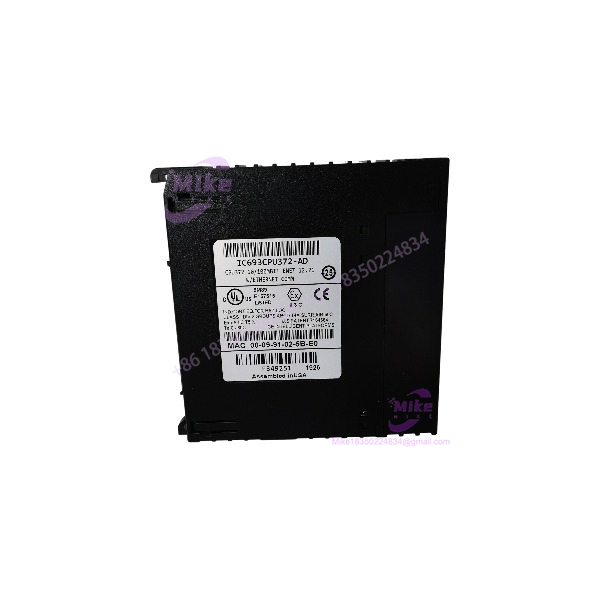
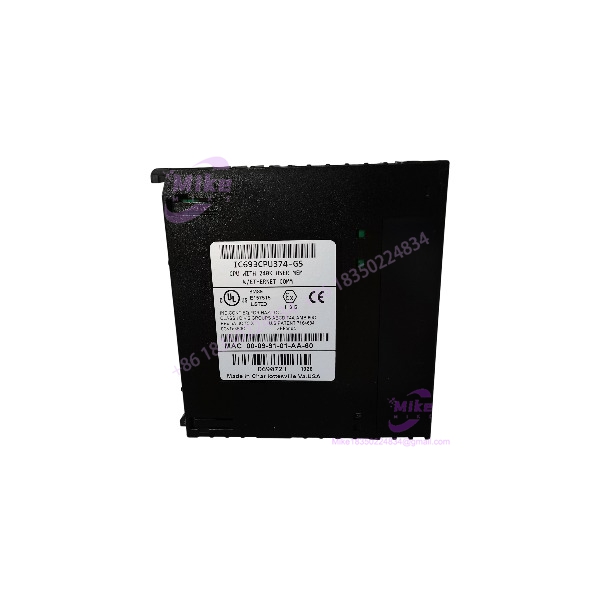
GE Fanuc IC693CPU374 | Series 90-30 PLC CPU Module
Product Introduction
When a Series 90-30 PLC is already integrated into a running process, replacing the controller is not a casual hardware swap. The CPU must match the existing application, communications setup, and installed baseplate configuration. The GE Fanuc IC693CPU374 combines PLC processing with an embedded Ethernet interface, making it relevant to legacy systems that rely on the Series 90-30 platform and Ethernet-based data exchange.
The IC693CPU374 provides a 133 MHz embedded 586 processor, 240 KB of total user memory, and two 10/100 Mbps Ethernet ports. Its embedded switch can simplify network connections, while SRTP and EGD support enables communication with compatible devices and software. For maintenance teams sourcing discontinued or hard-to-find Series 90-30 hardware, revision-level verification is essential: earlier CPU374 units and CPU374 PLUS versions do not provide identical Ethernet capabilities.
IC693CPU374
Key Technical Specifications
- Catalog Number: IC693CPU374
- CPU Architecture: Single-slot Series 90-30 CPU with embedded Ethernet
- Processor Speed: 133 MHz for the standard CPU374
- Processor Type: Embedded 586
- Typical Scan Rate: 0.15 ms per 1K of Boolean logic
- User Memory: 240 KB total; usable application memory varies with reference-table configuration
- Discrete Inputs (%I): 2,048 fixed points
- Discrete Outputs (%Q): 2,048 fixed points
- Discrete Global Memory (%G): 1,280 bits
- Internal Coils (%M): 4,096 bits
- Register Memory (%R): Configurable from 128 to 32,640 words
- Analog Input Memory (%AI): Configurable from 128 to 32,640 words
- Analog Output Memory (%AQ): Configurable from 128 to 32,640 words
- Ethernet Ports: Two 10/100Base-T/TX RJ-45 ports
- Ethernet Addressing: One IP address
- Embedded Ethernet Switch: Yes
- Standard Ethernet Protocols: SRTP and EGD
- Power Draw: 7.4 W from the 5 VDC supply
- Operating Temperature: 0°C to 60°C (32°F to 140°F) for standard-rated units; low-temperature versions may differ
- Programming Software: VersaPro and applicable CIMPLICITY Machine Edition Logic Developer versions; compatibility depends on CPU firmware
Specifications are based on GE Fanuc Series 90-30 hardware documentation. Verify the exact suffix and firmware against the unit being supplied.
Global Sourcing & Live-Test SOP
For industrial CPU procurement, a catalog number alone is not enough. The following checks help establish the condition and traceability of the supplied IC693CPU374.
Incoming Verification
- Confirm the IC693CPU374 catalog number and full revision suffix from the product label.
- Record serial number, visible condition, and any evidence of prior field installation.
- Inspect the board, connectors, Ethernet ports, and module housing for damage or corrosion.
- Distinguish the CPU module from a complete PLC rack, power supply, or other accessories.
Authenticity & Traceability
- Photograph the OEM label and identifying markings.
- Compare label details and physical construction against available GE Fanuc documentation.
- Record the source and condition classification: new surplus, used, or refurbished.
- Do not represent a used or refurbished unit as factory sealed.
Functional Test
- Install the module in a compatible Series 90-30 test baseplate.
- Apply suitable power and check startup behavior and CPU status indicators.
- Verify that the CPU reaches an expected operating state without persistent diagnostic faults.
- Where test resources permit, load a controlled test program and verify basic logic execution.
- Check Ethernet link/activity on both ports and validate communications using a compatible setup.
Extended Run & Configuration Record
- Perform an extended powered run where test equipment and procedures permit; record the actual duration.
- Capture available CPU and Ethernet firmware revisions.
- Record test results, observed faults, and any limitations in the test setup.
- Do not claim a 24-hour heat run unless that test was actually completed and documented.
ESD-Safe Packaging
- Use ESD-protective packaging and suitable cushioning.
- Protect the module from connector damage and electrostatic discharge during transit.
- Include the verified catalog number and condition classification on the packing documentation.
Field Engineer’s Pitfall Guide
- ❗ Firmware and revision are not interchangeable assumptions. CPU374 PLUS Release 12.0 and later adds Ethernet functions not available on earlier CPU374 versions. Confirm the complete suffix and firmware against the existing application before treating the module as a replacement.
- ❗ Do not assume the CPU is a complete PLC assembly. The is a CPU module. A compatible Series 90-30 baseplate, power supply, and application-specific I/O are separate system components unless explicitly included in the sale.
- ❗ Check Ethernet configuration before commissioning. The standard CPU374 uses SRTP and EGD, while PLUS revisions add enhanced functions. Confirm protocol requirements, IP configuration, and the existing PLC’s communications dependencies before removing the original CPU.
Intent-Driven FAQ
Q1: Is the a standalone PLC?
No. It is a CPU module for the GE Fanuc Series 90-30 platform. A compatible baseplate, power supply, and required I/O are needed for a functioning control system.
Q2: Does the have built-in Ethernet?
Yes. It has two 10/100 Mbps RJ-45 Ethernet ports with an embedded switch. The supported feature set depends on the CPU hardware and firmware revision.
Q3: Is every a PLUS?
No. PLUS is associated with later hardware and firmware releases. Earlier versions do not automatically support the enhanced Ethernet features introduced with PLUS.
Q4: Can I use the as a direct replacement for my existing CPU?
Possibly, but confirm the full catalog number suffix, firmware, application compatibility, reference-table configuration, and communications requirements. A matching base catalog number alone does not establish a drop-in replacement.
Q5: Does the support hot swapping?
Do not assume it can be removed or replaced under power. Follow the Series 90-30 installation procedures and site lockout requirements before removing the CPU.
Q6: Is the obsolete?
It is a legacy Series 90-30 product, and sourcing may depend on surplus or refurbished inventory. Confirm actual stock condition, test documentation, and warranty terms with the supplier.
Q7: What should I confirm before ordering?
Request photographs of the actual label, full revision suffix, firmware information where available, condition classification, included accessories, test scope, and written warranty terms.





