

Description
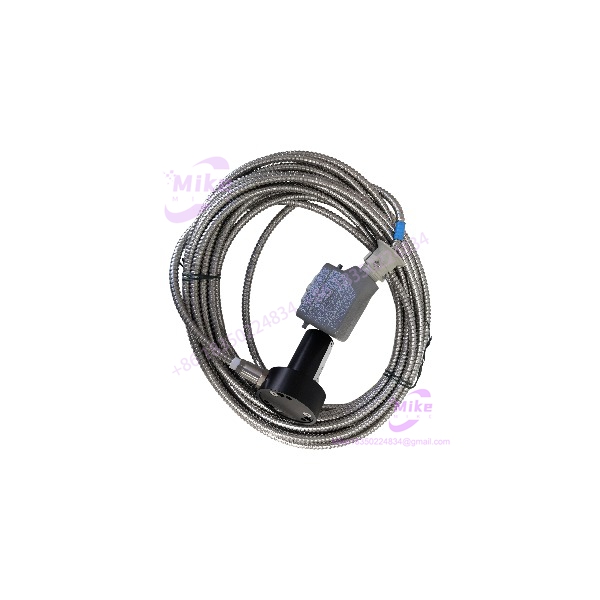
Emerson PR9268/203-000 | Vertical Electrodynamic Velocity Transducer
Dynamic Product Introduction
Field engineers know that absolute bearing housing vibration requires rugged, passive instrumentation that survives aggressive thermal cycles and structural resonance without signal drift. While proximity probes monitor relative shaft journal movement, absolute casing vibration demands an electrodynamic seismic design capable of capturing real-time velocity vectors. The Emerson EPRO PR9268/203-000 electrodynamic velocity sensor delivers high-precision absolute vibration feedback directly to turbine supervisory systems like the AMS 6500 or MMS 6120 processing cards.
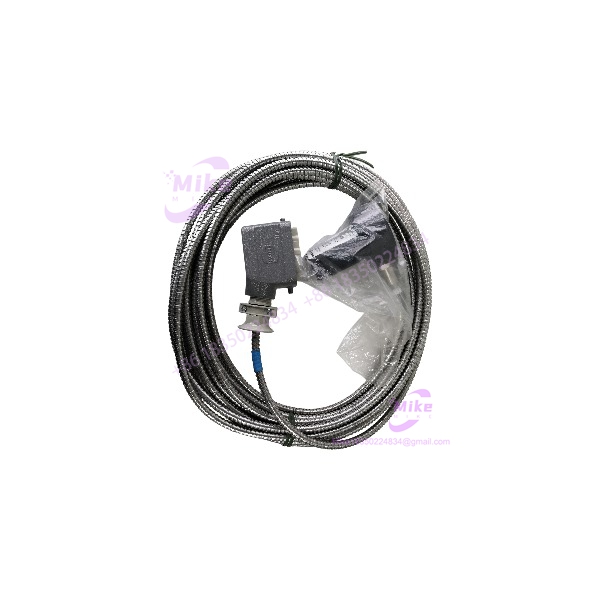
Engineered specifically for vertical orientation mounting, the PR9268/203-000 features a finely tuned spring-mass suspension centered on a 4.5 Hz natural frequency. This low resonant point enables accurate tracking of rotational dynamics down to 4 Hz (240 RPM) without the phase lag or high-frequency noise inherent in standard accelerometer setups. Complete with a generous 10-meter stainless steel armored cable and bare open-end wire terminations, the PR9268/203-000 lets technicians land signal lines directly onto junction box terminal blocks without dealing with intermediate plug bulk.
PR9268/203-000
Key Technical Specifications
- Measurement Principle: Electrodynamic moving-coil seismic transducer (passive self-generating)
- Mounting Orientation: Vertical axis, ±30° tilt tolerance without active current sinking
- Linear Frequency Response: 4 Hz to 1,000 Hz (-3dB point)
- Natural Frequency (f_0): 4.5 Hz ± 0.75 Hz at 20°C (68°F)
- Nominal Sensitivity: 28.5 mV/mm/s (723.9 mV/in/s) at 80 Hz with 100 kΩ load
- Maximum Vibration Displacement: 3,000 µm continuous peak-to-peak; 4,000 µm mechanical limit
- Acceleration Limits: 10g continuous peak-to-peak; 20g intermittent peak-to-peak
- Transverse Sensitivity Ratio: ≤ 0.13 at 110 Hz
- Internal DC Resistance: 3,270 Ω ± 10% nominal coil resistance
- Cable Construction & Length: 10 meters total length, stainless steel flexible armor over PTFE core, open-end stripped leads
- Operating Temperature Range: -20°C to +100°C (-4°F to +212°F)
- Enclosure Protection Rating: IP65 / IP67 heavy stainless steel casing
Global Sourcing & Live-Test SOP (Transparency Core)
Procuring surplus or pre-owned turbomachinery instrumentation demands strict validation before live plant deployment. Every PR9268/203-000 unit entering our facility undergoes a rigorous five-stage quality control protocol:
- Inbound Verification: Stamped serial numbers on the PR9268/203-000 body are cross-referenced with Emerson distribution logs. We inspect the stainless steel armor jacket for twist fractures, examine the PEEK housing seals, and verify stripped wire ends for cleanliness and oxidation.
- Live Simulation: The PR9268/203-000 is mounted vertically onto a reference electrodynamic shaker table. The open-end cable leads are wired into a calibrated MMS 6120 dual-channel vibration monitor rack powered by an isolated DC source.
- Diagnostics: The shaker table sweeps discrete frequencies from 4 Hz to 1,000 Hz at controlled velocity amplitudes. Output voltage across the leads is captured using a Fluke 87V meter to ensure sensitivity tracks strictly along the 28.5 mV/mm/s curve within manufacturing tolerances. Harmonic distortion sweeps verify coil freedom of movement.
- Electrical & Insulation Soak: DC resistance across the internal coil is measured to confirm a nominal reading of 3,270 Ω ± 10%. A high-voltage insulation test applies 500 VDC between the internal coil conductors and the outer stainless housing, verifying insulation resistance exceeds 100 MΩ.
- Final Prep: Calibration sheets are updated, open wire ends are capped with protective heat-shrink tubing, and the PR9268/203-000 unit is sealed inside an anti-static moisture-barrier bag.
The Field Engineer’s Pitfall Guide
❗ Mounting a Vertical Sensor (PR9268/202 vs PR9268/203) Horizontally: Never install the vertical PR9268/203-000 in a horizontal orientation on a bearing split line. The internal moving-coil assembly relies on gravity to maintain proper mechanical zero-positioning. Mounting this unit sideways causes the seismic mass to lean against the internal housing wall—a critical error that introduces heavy friction, signal clipping, and severe harmonic distortion.
❗ Improper Shield Grounding on Open-End Cable Runs: The PR9268/203-000 features a 10-meter open-end cable including an internal shield drain wire. Terminating this drain wire at both ends (the field junction box and the rack cabinet) creates a ground loop. In field deployments, this loop injects 60 Hz electrical noise directly into your low-level velocity signal, masking actual turbine vibration peaks. Always ground the shield at a single point (typically the monitor rack end).
❗ Exceeding the 10-Meter Cable Attenuation Limits: While the factory 10-meter cable handles standard distances between bearing housings and local junction boxes, attempting to splice or extend this cable with unrated wire introduces unwanted capacitance and resistance changes. This alters loop impedance and degrades the high-frequency response of the electrodynamic measuring loop.
Intent-Driven FAQ
Q: What do the specific code digits in the PR9268/203-000 part number indicate? The part number defines the physical configuration: specifies the electrodynamic velocity sensor family. The /203 suffix denotes a vertical mounting orientation paired with an integrated 10-meter cable. The -000 suffix designates the termination style, which in this model refers to stripped open-end wire leads.
Q: Does the PR9268/203-000 require an external loop power supply? No. The PR9268/203-000 is a passive electrodynamic generator. As machine casing vibration forces the sensor body to move, the internal coil cuts through a permanent magnetic field, generating an AC voltage output proportional to vibration velocity without needing external excitation voltage.
Q: Can I connect the open-end wires of the PR9268/203-000 directly into a standard PLC analog input card? No. The raw output is a dynamic AC voltage representing velocity. It must be processed through an appropriate signal conditioner, transmitter, or specialized TSI monitor module (such as an MMS 6120 or AMS 6500 rack card) that scales and rectifies the signal into a standard 4-20 mA DC loop or digital bus value.
Q: How do I test if an installed PR9268/203-000 has suffered an open coil failure during an outage? Disconnect the open-end leads at the terminal block. Using a digital multimeter set to resistance (Ohms), measure across the signal conductors. A healthy PR9268/203-000 coil will display a stable resistance reading around 3,270 Ω (±10%) at ambient temperature. An open circuit (infinite ohms) indicates an internal wire fracture or severe mechanical damage.
Q: Can the PR9268/203-000 be used on high-temperature gas turbine compressor casings? Yes, provided the casing temperature remains within the specified operating range of -20°C to +100°C (-4°F to +212°F). For high-temperature steam or gas turbine applications exceeding +100°C on the mounting surface, you must use specialized high-temp models or thermal isolation mounting studs to protect the internal coil assembly from thermal degradation.





