Description
PR642310R-030-CN+CON021 Emerson EPRO Sensor
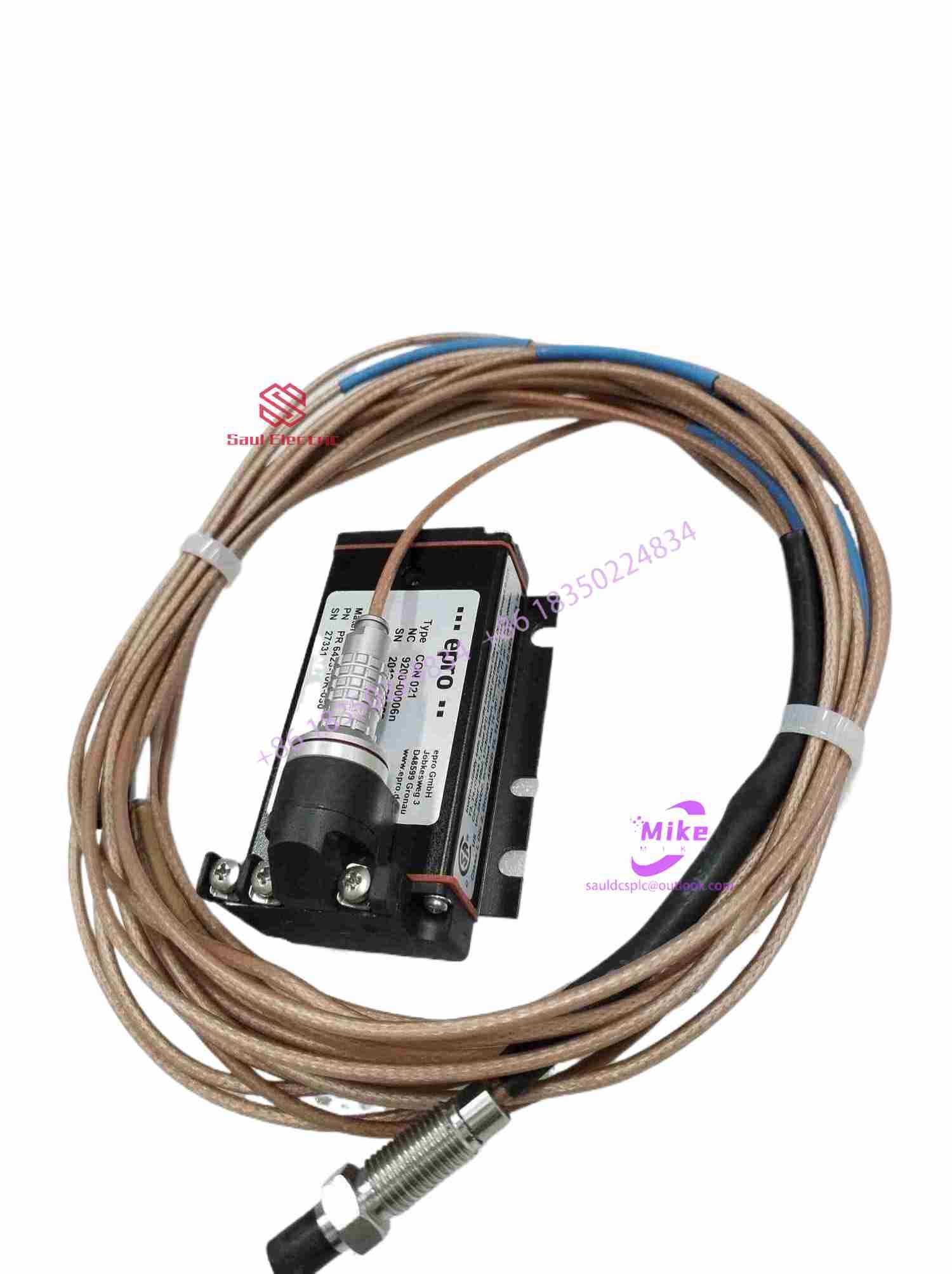
PR642310R-030-CN+CON021 Emerson EPRO Sensor
Communication and Control
One advantage of PWM is that the signals from the processor to the controlled system are all in digital form, eliminating the need for digital-to-analog conversion. Keeping the signals in digital form minimizes the impact of noise. Noise can only affect digital signals if it is strong enough to change a logic 1 to a logic 0 or vice versa.
Enhanced noise immunity is another advantage of PWM over analog control, and this is also a major reason why PWM is sometimes used in communication. Switching from analog signals to PWM can significantly extend communication distances. At the receiving end, the modulated high-frequency square wave can be filtered out and the signal restored to analog form using an appropriate RC or LC network . PWM is widely used in a variety of systems.
In summary, PWM is economical, space-saving, and has strong noise immunity, making it an effective technology that engineers should use in many design applications.
Commonly used linear series-type voltage regulator chips include: 78XX series (positive voltage type), 79XX series (negative voltage type) (in actual products , XX is represented by a number, and the output voltage is the value of XX. For example, 7805 has an output voltage of 5V); LM317 (adjustable positive voltage type), LM337 (adjustable negative voltage type); 1117 (low dropout type, with various models, the voltage value is indicated by the last digit. For example, 1117-3.3 is 3.3V, and 1117- ADJ is adjustable).
The difference between PID controllers and switching controllers
I. Introduction
In industrial automation control systems , PID controllers and switching controllers are two common control strategies. Each has its unique working principle , application scenarios, advantages, and disadvantages. This article aims to explore the differences between PID controllers and switching controllers in detail, comparing and analyzing them from multiple aspects such as working principles, application scenarios, and performance characteristics, so that readers can gain a deeper understanding of these two control strategies and make more reasonable choices in practical applications.
II. Working Principle and Characteristics of PID Controllers
Working principle
A PID (Proportional-Integral-Derivative) controller is a feedback control algorithm based on error, consisting of three control terms: proportional (P), integral (I), and derivative (D). It measures the difference (deviation) between the output value and the desired value of the controlled object, and then processes this deviation using the proportional, integral, and derivative control terms to obtain the controller’s output. The working principle of a PID controller is based on error feedback adjustment; by continuously adjusting the control input, the system output gradually approaches the setpoint.