


Description
Unitrol 9180B-8 | Resistance Welding Control, New In Stock
Architect’s Product Breakdown
The Unitrol 9180B-8 controller provides advanced management for resistance welding machinery, ensuring consistent heat, squeeze, weld, and hold intervals required in high-volume metal fabrication cells. In precision manufacturing and automotive assembly lines, inconsistent current delivery or timing drift leads to weak nugget formation and structural weld failures. This control unit replaces outdated analog timers with repeatable, solid-state scheduling logic that stabilizes weld quality across varying line voltages.
Integrating replacement weld controls into legacy production equipment requires strict compatibility checks regarding SCR firing configurations and transformer primary voltage ratings. Deploying an authentic Unitrol 9180B-8 ensures proper communication with existing foot switches, air valves, and SCR contactors, eliminating the integration headaches often encountered with unbranded generic replacements.
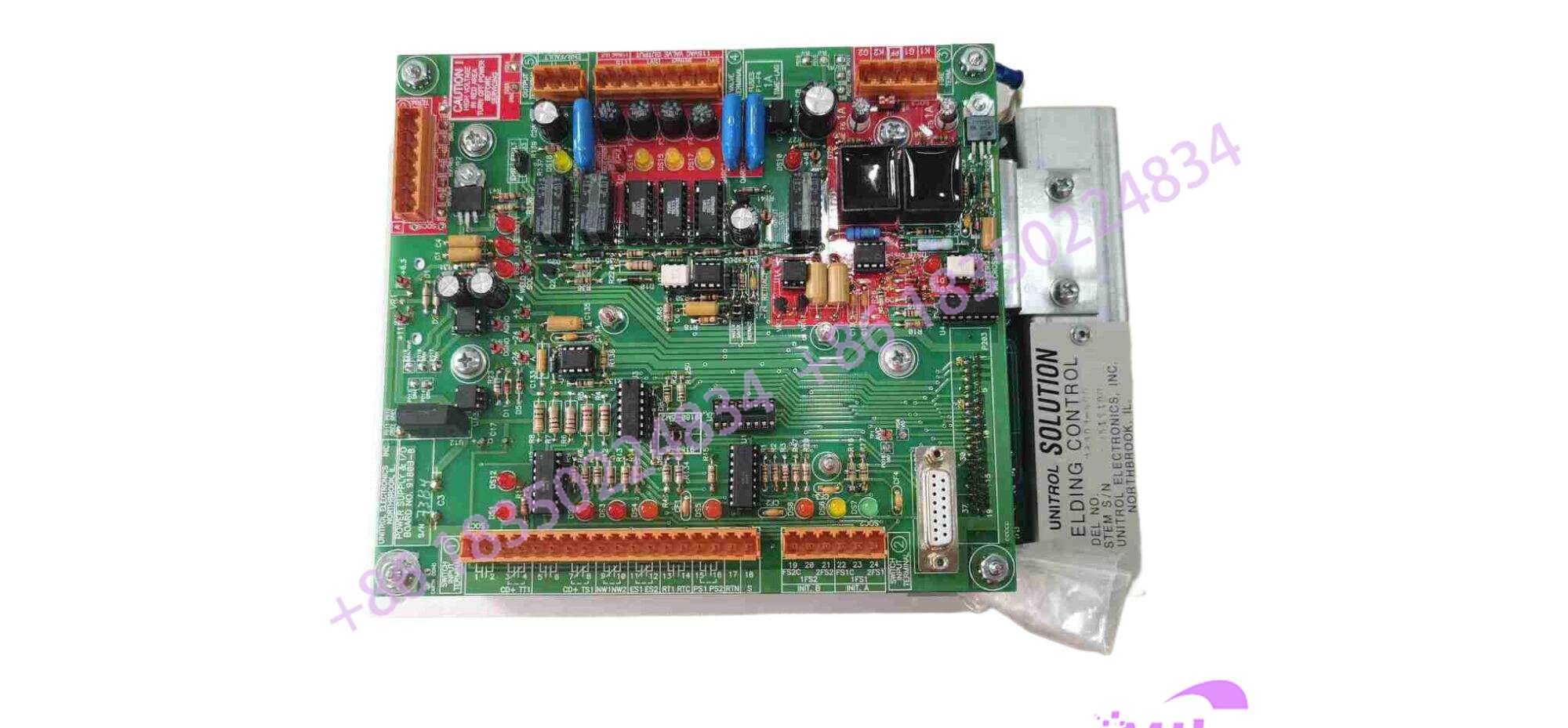
9180B-8
Key Technical Specifications
| Parameter | Technical Specification |
| System Compatibility | Standard industrial resistance welders, spot welders, and projection welders |
| Controller Type | Microprocessor-based resistance welding control |
| Timing Functions | Squeeze, Weld 1, Cool 1, Weld 2, Cool 2, Hold, Off |
| Control Interface | Front-panel keypad and digital display / status indicators |
| Input Power | Standard control transformer primary requirements (per OEM machine spec) |
| Output Control | SCR firing pulses and isolated control relays for valve/contactor actuation |
| Operating Temperature | +0°C to +50°C |
| Mounting Configuration | NEMA enclosure panel mount |
Field Engineer’s Pitfall Guide (Unique Value)
- Warning: SCR Trigger Polarity and Sizing: Verify that your firing card configuration matches the specific gate requirements of your welding transformer’s SCRs. Mismatched trigger pulses can cause half-welding or fail to fire the contractor entirely, risking damage to power components.
- Warning: Ground Loop Noise: Resistance welding environments are notoriously saturated with high electromagnetic interference (EMI) from high-amperage current loops. I’ve tracked down intermittent control lockups in production cells where technicians ran low-voltage initiation wires parallel to high-current secondary welding cables instead of using dedicated shielded conduit.
- Warning: Backup Battery / Parameter Loss: Ensure internal parameter backups or program schedules are recorded externally before swapping units. Replacing a control module without noting custom schedule steps can halt production while operators reprogram custom heat profiles.
QA & Testing SOP (Transparency)
- Visual & Origin Inspection: Inspected for original Unitrol manufacturer labels, uncompromised conformal coating on circuit boards, and secure terminal block integrity.
- Powered Bench Test: Energized on a specialized electronic test fixture to verify display functionality, internal power supply regulation, and microprocessor boot sequence.
- Timing & Output Simulation: Simulated initiation inputs tested against internal relay transitions and SCR trigger pulse outputs to confirm precise schedule execution.
- Packaging: Wrapped in anti-static shielding material and packed inside high-density foam containment to protect against transit shock.
Technical FAQ
Can the 9180B-8 be used to upgrade older mechanical or analog weld timers?
Yes. The 9180B-8 is frequently deployed as a direct modern replacement to retrofit older analog or mechanical weld controls, significantly improving timing repeatability and diagnostic feedback on legacy welding machines.
Does this controller require an external power supply?
Typically, these units operate off a dedicated control transformer tied directly to the machine’s primary input power source. Always verify the input tap voltage matches your facility supply before applying power.
What causes an immediate weld fault or failure to initiate upon foot-switch closure?
Common causes include an open safety pressure switch (indicating inadequate air pressure), an e-stop loop interruption, or a misconfigured interlock schedule within the internal menu parameters. Check the diagnostic display codes first.
Are welding schedules retained if main power is disconnected?
Yes. User-programmed weld schedules and configuration settings are stored in non-volatile memory, preventing data loss during routine power shutdowns or maintenance intervals.





