


Description
VIBRO-METER MPC4 Module UNIT 200-510-070-113 VM600 — Mechanical Protection Card
Product Overview
The VIBRO-METER MPC4 (200-510-070-113, VM600) is a mechanical protection card designed for continuous online vibration monitoring and protection of critical rotating machinery. It is a core module within the VM600 Mechanical Protection System (MPS), originally developed by Vibro-Meter, which is now part of Meggitt PLC (acquired in 2006). The VM600 platform is one of the most widely deployed machinery protection systems globally, used in power generation, oil & gas, petrochemical, and heavy industry.
In practical terms: this card sits between your vibration sensors (accelerometers, proximity probes, velocity sensors) and your plant safety system. It continuously measures vibration, compares it against programmable alarm and trip limits, and — if vibration exceeds the danger threshold — triggers a relay output to shut the machine down before catastrophic damage occurs.
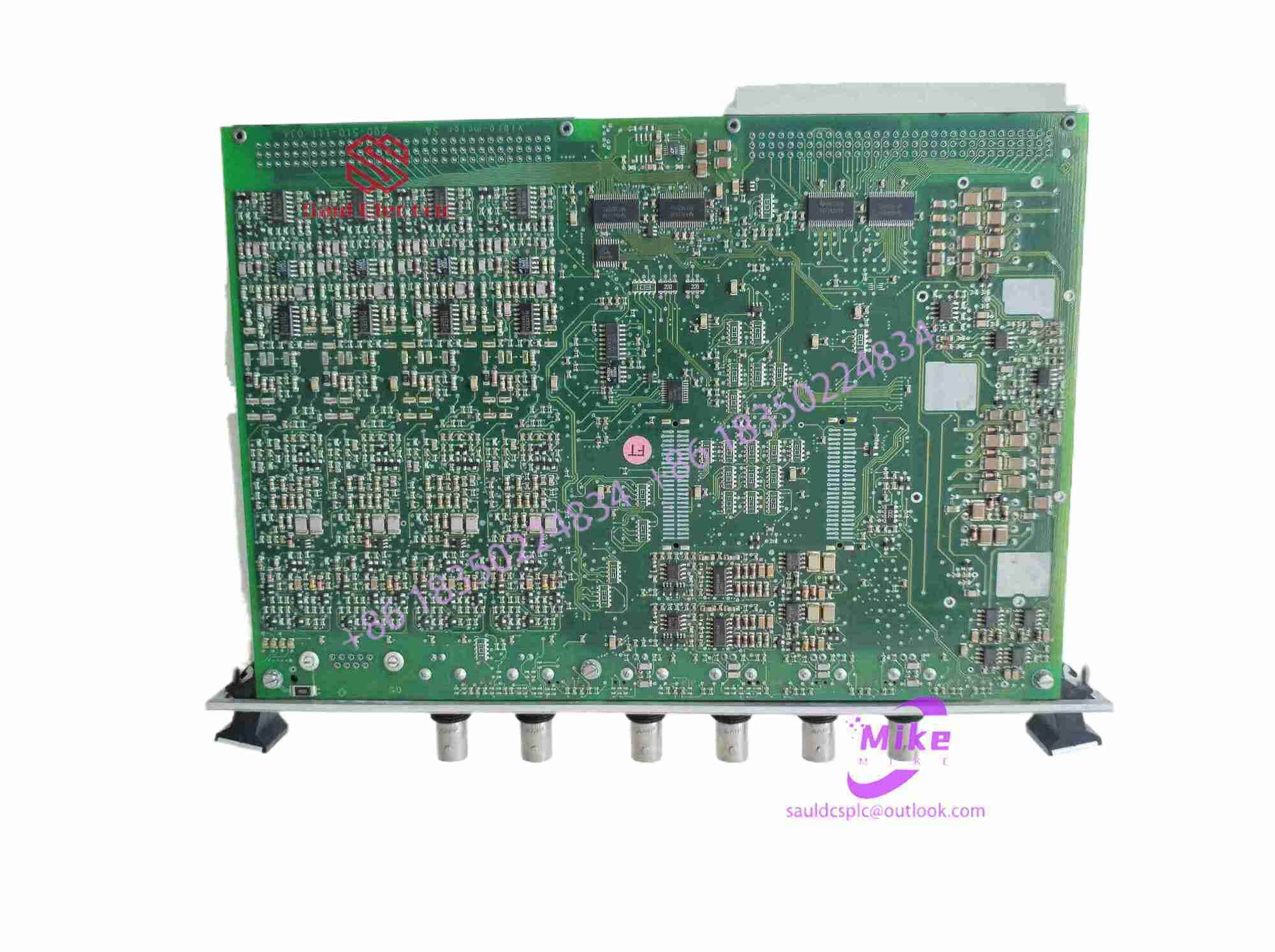
VIBRO-METER MPC4 module UNIT 200-510-070-113 VM600
Model Number Breakdown
| Field | Meaning |
|---|---|
| VIBRO-METER | Brand — originally Vibro-Meter, now Meggitt |
| MPC4 | Mechanical Protection Card, 4th generation — the core processing card |
| 200-510-070-113 | Full part number: 200 = VM600 family; 510 = MPC4 card type; 070 = configuration variant (standard, non-SIL); 113 = firmware/hardware revision |
| VM600 | System platform — VM600 Mechanical Protection System |
Related part numbers you may encounter:
- 200-510-111-034 — alternate configuration of the same MPC4 card
- 200-510-071-113 — variant with different I/O mapping
- 200-510-074-113 — another configuration variant
- 200-560-101-015 / 017 — the paired IOC4T input/output card (required for analog outputs and relays)
- 200-595-072-122 — CPUM CPU module for the VM600 chassis
The MPC4 always works as a card pair with the IOC4T — MPC4 does the signal processing; IOC4T provides the analog outputs (4–20 mA, 0–10 V) and relay contacts.
Core Functions
Continuous Vibration Monitoring — The MPC4 accepts up to 4 dynamic signal channels (acceleration, velocity, or proximity/displacement) and 2 tachometer (speed) channels, all independently programmable. Each channel can be configured for a different sensor type, filter setting, and alarm threshold.
Real-time DSP Processing — Built on advanced Digital Signal Processor (DSP) technology, the card performs onboard filtering (both broadband and narrowband), integration/differentiation, rectification (RMS, peak, true peak), and order tracking (amplitude and phase simultaneously) — all in real time, with millisecond response.
Multi-parameter Measurement — Beyond simple vibration velocity, the MPC4 can derive:
- Relative and absolute vibration
- Smax (maximum shaft displacement)
- Eccentricity
- Thrust position
- Absolute and differential casing expansion
- Displacement (proximity)
- Dynamic pressure
Programmable Alarms and Trip — Each channel has fully programmable Alarm, Danger, and OK setpoints with adjustable time delays, hysteresis, and lockout logic. Danger levels can be speed-dependent or adjusted by external signals. When danger is exceeded, the internal digital output fires — driving relays on the IOC4T card or external relay cards (RLC16, IRC4) to trip the machine.
“OK” System Diagnostics — The card continuously monitors the entire measurement chain — sensor, cable, and signal conditioner. If a sensor cable breaks, a sensor fails, or the signal goes out of range, the “OK” relay de-energizes and all 4–20 mA outputs drop to 0 mA (fail-safe behavior). Six front-panel LEDs (one per channel) show OK/Alarm status at a glance.
Raw Signal Access — Front-panel BNC connectors on each channel provide buffered, unfiltered “raw” sensor signals — invaluable for on-site troubleshooting and analysis without disturbing the protection loop.
Hot-swappable — The MPC4 is a live-plug card — it can be inserted or removed from the VM600 chassis while the system is powered on, with no disruption to other cards or the protection function.





