


Description
MOXA EDS-308-MM-SC | 8-Port, 2-Fiber SC
Product Introduction
A network cabinet can have perfectly healthy PLCs and remote I/O while one failed switch takes the communication layer down. The MOXA EDS-308-MM-SC addresses that specific industrial networking requirement with six copper Ethernet ports and two 100BaseFX multimode fiber ports using SC connectors. It is an unmanaged switch, so there is no configuration software standing between the technician and a basic physical network connection.
The important detail is the port mix. The EDS-308-MM-SC provides 6 × 10/100BaseT(X) RJ45 ports plus 2 × 100BaseFX multimode SC fiber ports, with auto-negotiation, full/half-duplex operation, and Auto MDI/MDI-X on the copper side. Its store-and-forward architecture uses a 2-kbit MAC address table and 768 Kbit packet buffer, while redundant DC power inputs help keep an industrial network cabinet serviceable when one supply path is lost.
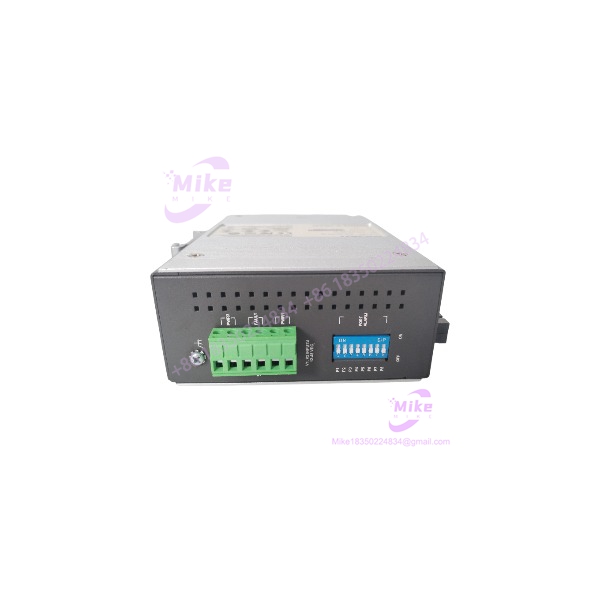
EDS-308-MM-SC
Key Technical Specifications
| Parameter | Specification |
|---|---|
| Manufacturer | MOXA |
| Model | EDS-308-MM-SC |
| Series | EDS-308 |
| Product Type | Unmanaged Industrial Ethernet Switch |
| Total Ethernet Ports | 8 |
| Copper Ports | 6 × 10/100BaseT(X), RJ45 |
| Fiber Ports | 2 × 100BaseFX multimode, SC |
| Fiber Type | Multimode |
| Typical Fiber Distance | Up to 4 km, depending on fiber and link conditions |
| Optical Wavelength | 1300 nm typical |
| Ethernet Standards | IEEE 802.3, 802.3u, 802.3x |
| Switching Method | Store-and-forward |
| MAC Table | 2 kbits |
| Packet Buffer | 768 Kbit |
| Alarm Output | 1 relay output, 1A @ 24VDC |
| Input Voltage | Redundant dual 12/24/48VDC |
| Operating Voltage | 9.6–60VDC |
| Input Current | 0.15A @ 24VDC |
| Reverse Polarity Protection | Yes |
| Overload Protection | Yes |
| Housing | Metal |
| IP Rating | IP30 |
| Operating Temperature | -10°C to +60°C |
| Storage Temperature | -40°C to +85°C |
| Humidity | 5–95% RH, non-condensing |
| Dimensions | 53.6 × 135 × 105 mm |
| Weight | Approximately 790 g |
| Installation | DIN rail; wall mounting with optional kit |
| MTBF | 2,382,553 hours, MIL-HDBK-217F |
| Warranty | 5 years |
Moxa specifies two 100BaseFX multimode SC ports for this exact model, with an optical typical distance of 4 km under the specified fiber conditions. The switch also supports a relay alarm output for power failure or port-break conditions.
Application Scenarios & Pain Points
Scenario 1 — Copper-to-Fiber Industrial Backbone
Without the EDS-308-MM-SC:
A control cabinet may have plenty of copper Ethernet devices but no practical way to extend the network over a multimode fiber backbone.
With the EDS-308-MM-SC:
Six local RJ45 devices can connect directly to the switch while the two SC fiber ports provide 100BaseFX links to another cabinet, control room, or remote network segment.
That mixed-media arrangement is the main reason to select the instead of a standard eight-port copper-only switch.
Scenario 2 — Long Industrial Cable Runs
Multimode fiber can provide significantly greater physical separation than conventional copper Ethernet. Moxa specifies a 4 km typical distance for the multimode 100BaseFX configuration under the documented fiber conditions. Actual distance still depends on cable type, attenuation, connectors, and optical budget.
Scenario 3 — Harsh Control Cabinets
-10°C to +60°C operation makes the standard suitable for many industrial control environments. If the cabinet routinely exceeds 60°C, however, the standard model should not be confused with the , which is the wide-temperature variant rated to -40°C to +75°C.
Scenario 4 — Redundant DC Power
The switch accepts redundant dual DC inputs covering 12/24/48VDC nominal systems, with an operating range of 9.6–60VDC. Reverse-polarity and overload-current protection are also specified. This makes it easier to integrate into control cabinets where dual DC feeds are already part of the architecture.
Scenario 5 — Network Fault Detection
The built-in relay output can provide an alarm signal when a power failure or configured port-break condition occurs. That matters when the switch sits in an unmanned cabinet and the network failure needs to reach a PLC, alarm system, or maintenance circuit.
QA & Live Testing SOP
For an industrial Ethernet switch, simply seeing link LEDs illuminate is not a sufficient acceptance test.
A proper receiving inspection should include:
- Model verification
- Confirm the nameplate reads .
- Verify the unit has six RJ45 copper ports and two SC fiber ports.
- Check serial number, revision markings, housing condition, and terminal block.
- Physical inspection
- Inspect the RJ45 sockets, SC fiber interfaces, DIN mounting mechanism, grounding point, and removable power terminal.
- Look for bent contacts, damaged optical interfaces, corrosion, or enclosure damage.
- Power test
- Apply a controlled DC supply within the specified operating range.
- Verify normal startup and measure current draw.
- The published current consumption is approximately 0.15A at 24VDC for this model.
- Copper Ethernet test
- Connect known-good 10/100BaseT(X) devices.
- Confirm link negotiation.
- Verify packet transmission in both directions.
- Fiber test
- Connect compatible multimode fiber to both SC ports.
- Verify link establishment and packet transfer.
- Check optical connectors for contamination before insertion—fiber faults are often painfully simple.
- Alarm verification
- Where test equipment permits, verify the relay alarm behavior for the configured port-break condition.
- ESD-safe packaging
- Protect the switch and connectors against static discharge, impact, moisture, and contamination during shipment.
Moxa states that EDS-308 switches undergo a 100% burn-in test as part of the manufacturer’s production process.
Field Engineer’s Pitfall Guide
❗ Do Not C With -T
The suffix matters.
-10°C to +60°C
-40°C to +75°C
If the cabinet is exposed to sub-zero conditions or elevated ambient temperatures, ordering the wrong suffix can create a specification problem before the switch even reaches the network.
❗ MM-SC Means Multimode SC Fiber
Do not assume an SC connector automatically means single-mode fiber.
The specifically uses 100BaseFX multimode fiber with SC connectors. Moxa lists 1300 nm typical optical operation and a typical distance of 4 km under the specified multimode conditions.
❗ It Is an Unmanaged Switch
The does not provide the configuration depth of a managed industrial Ethernet switch.
There is no expectation of VLAN engineering, SNMP-based switch management, or managed routing functions. If the network design requires those capabilities, selecting an unmanaged simply because the port count looks right is the wrong approach.
Intent-Driven FAQ
MOXA an unmanaged switch?
Yes. The series is an unmanaged industrial Ethernet switch. The provides eight physical Ethernet interfaces but does not require conventional managed-switch configuration.
How many Ethernet pos the have?
It has 8 total ports: 6 × 10/100BaseT(X) RJ45 ports and 2 × 100BaseFX multimode SC fiber ports.
What type of fis the use?
The two fiber ports are 100BaseFX multimode ports with SC connectors. Moxa specifies a typical 1300 nm wavelength and approximately 4 km typical distance for the documented multimode configuration.
What volts the require?
The switch supports redundant dual 12/24/48VDC inputs, with a specified operating voltage range of 9.6–60VDC.
n the operate in a -40°C cabinet?
No—not ndard . Its specified operating range is -10°C to +60°C. For -40°C to +75°C, the appropriate model is the wide-temperature version.
s the have an alarm relay?
Yes. It provides one relay output rated at 1A @ 24VDC, intended for alarm functions such as power failure and port-break indication.





