


Description
Molex SST 5136-DNP-CPCI | DeviceNet 3U CompactPCI Interface Card
Product Introduction
When a mission-critical embedded industrial computer or VME/cPCI test rack requires deterministic communication with DeviceNet field devices, standard general-purpose network cards fall short. The Molex SST 5136-DNP-CPCI is not a standard office-grade Ethernet card; it is a high-performance industrial network interface card built explicitly for 3U CompactPCI architectures. It acts as an intelligent hardware co-processor that offloads complete DeviceNet protocol processing from the host CPU.
Engineered with an independent onboard 40 MHz processor and shared RAM, this card executes full DeviceNet protocol routines locally—supporting UCMM capability, explicit messaging, and simultaneous Group 2 client/server operations. It handles tough industrial operating conditions—withstanding ambient panel thresholds from 0^\circC to +50^\circC—while providing 500V optical isolation on the network port. If you are maintaining legacy embedded test systems or running specialized HMI/PC control automation, this card slides straight into your existing cPCI backplane slot.
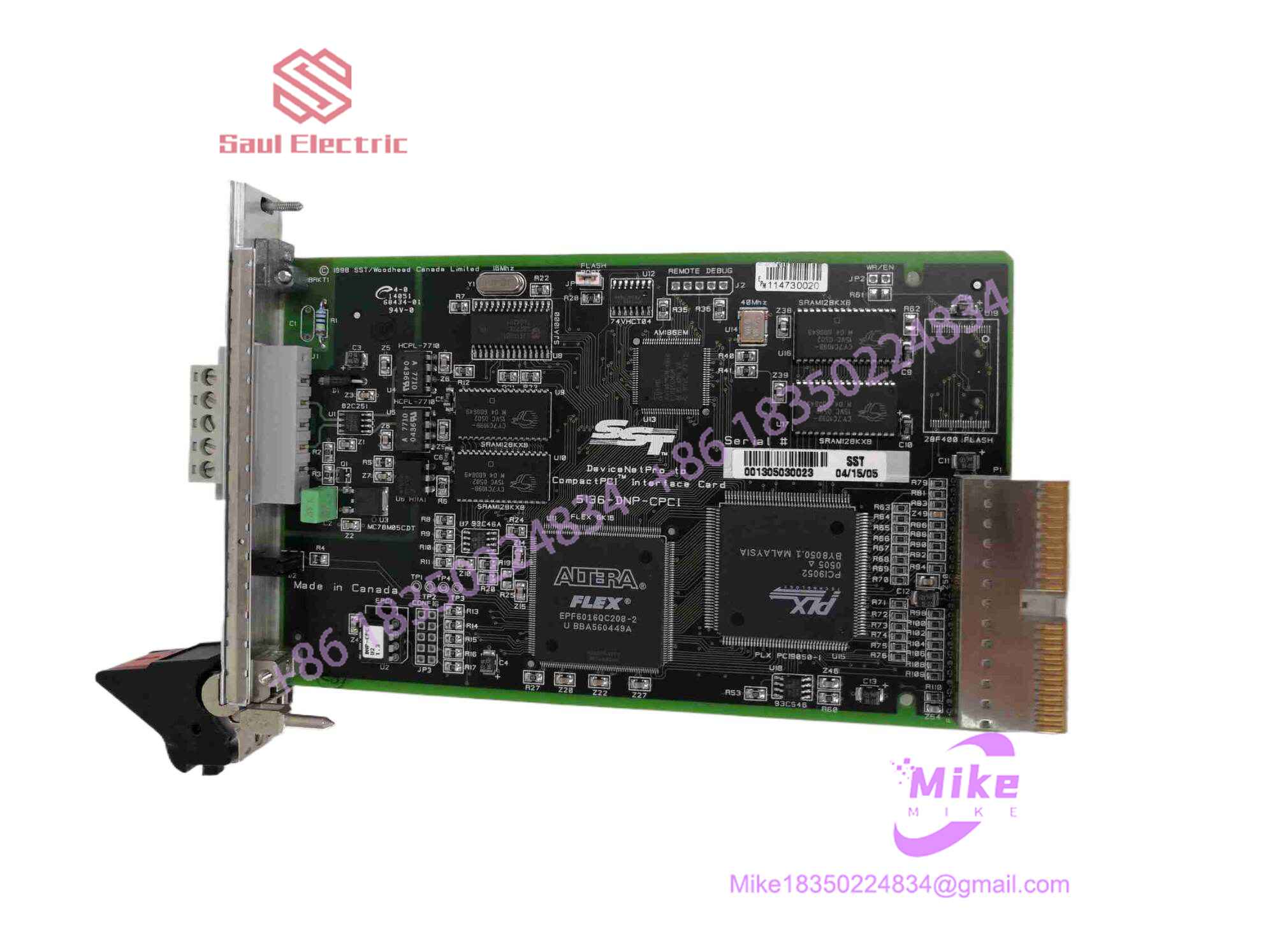
5136-DNP-CPCI
Key Technical Specifications
| Parameter | Specification Metric |
| Device Category | DeviceNet / CAN Bus Network Interface Card (NIC) |
| Form Factor | 3U CompactPCI (cPCI) 32-bit / 33 MHz module |
| Onboard Processor | 40 MHz AM186EM with 256K RAM / Flash memory |
| Shared Memory Window | 256 Kbytes dual-port shared RAM |
| Network Physical Layer | Optically isolated CAN interface (ISO 11898 / CAN 2.0A compatible) |
| Supported Data Rates | Standard DeviceNet rates: 125, 250, and 500 Kbaud (up to 1 Mbaud CAN) |
| Network Connector | Standard 5-pin removable DeviceNet terminal block |
| Isolation Voltage | 500 V RMS optical isolation |
| Operating Temperature | 0^\circC to +50^\circC |
| Power Consumption | +5 VDC (\pm 5\%), approx. 400 mA |
Application Scenarios & Pain Points
- Semiconductor Manufacturing Test Rags: Embedded cPCI computer systems driving precision wafer-handling tools require deterministic DeviceNet I/O scanning. The 5136-DNP-CPCI executes protocol handling locally, preventing host CPU latency spikes from causing motion sync errors.
- Power Utility Substation Automation: SCADA gateway computers monitoring remote electrical switchgear rely on robust, isolated communication nodes. The card’s 500V optical isolation protects host processing racks from destructive ground loops and electrical transients.
- Automotive Body Shop Robotic Cells: High-density welding cells utilize DeviceNet backbones to coordinate multi-axis tooling. This interface card ensures real-time packet processing and rapid error recovery during high-vibration manufacturing cycles.
QA & Live Testing SOP (Trust Signal)
We don’t warehouse legacy communication cards without verifying their bus performance and protocol execution health; every 5136-DNP-CPCI unit goes through our rigorous bench validation protocol:
- Visual & Pin Audit: Inspected under optical magnification for gold-finger connector integrity, surface-mount solder joint stability, and complete absence of corrosion or component stress.
- Dynamic cPCI Rack Insertion: Slotted into an active 3U CompactPCI test chassis to verify clean backplane power handshakes, Plug-and-Play BIOS resource allocation, and shared RAM read/write stability.
- CAN / DeviceNet Loopback Verification: Connected to a calibrated network simulator to verify baud-rate auto-detection, explicit messaging handshakes, and zero frame-drop rates across all supported speeds (125, 250, 500 Kbaud).
- Protective Packaging: Sealed inside heavy-duty anti-static shielding bags and suspended securely within high-density structural foam to prevent transit vibration damage.
Field Engineer’s Pitfall Guide
- ❗ Slot Voltage Mismatch: The 5136-DNP-CPCI plugs into standard 5V CompactPCI motherboard connectors; ensure your backplane supports the required voltage rails and avoid forcing the card into strict 3.3V-only PCI slots.
- ❗ Network Termination Compliance: Always install a proper 120-ohm terminal resistor across pins 2 and 4 of the 5-pin DeviceNet connector if the card is located at either extreme end of the trunk line.
- ❗ External Power Requirements: If your network trunk cable lacks integrated power conductors, remember to supply an independent 11–25 VDC source to the V+/V- pins on the module’s connector.
Intent-Driven FAQ
Is the Molex 5136-DNP-CPCI compatible with standard Windows operating systems?
Yes. Molex (SST) provides 32-bit Windows DLLs, drivers, and software development examples that map clean memory structures for application integration.
Does this card require manual DIP switch configuration?
No. The 5136-DNP-CPCI is fully Plug-and-Play compatible; all required memory spaces, I/O regions, and system interrupts are allocated automatically by the host system’s BIOS.
What causes the onboard Health LED to show a solid red status?
A red status indicator typically points to a failure of the application firmware module to load properly during boot, a memory corruption error, or a fatal runtime exception on the card’s internal processor.
Can multiple 5136-DNP cards be installed in the same computer chassis?
Yes. You can configure multiple interface cards within a single cPCI system rack, provided your backplane slot allocation and driver software map distinct memory windows for each node.
What kind of warranty covers this surplus hardware?
Every unit is backed by our comprehensive replacement guarantee, supported by multi-point pre-shipment bench testing to ensure absolute backplane and network communication readiness.





