


Description
Delta Tau ACC-24E2S | UMAC Sinusoidal Encoder Interface Module
Dynamic Product Introduction
High-precision positioning applications—such as semiconductor wafer handling, optical inspection stages, and ultra-smooth direct-drive motor systems—rely heavily on analog sinusoidal encoder feedback to achieve sub-micron resolution through hardware interpolation. The Delta Tau ACC-24E2S is engineered specifically for these demands, taking raw 1Vpp Sin/Cos encoder signals and multiplying their resolution via onboard interpolation circuits before passing position data to the PMAC CPU.
Maintaining legacy motion controllers that use high-resolution feedback requires exact hardware matching. Swapping a standard digital encoder card in place of an ACC-24E2S will instantly break your feedback scaling loops—always verify your encoder signal profile and interpolation multiplier settings before installing a replacement module.
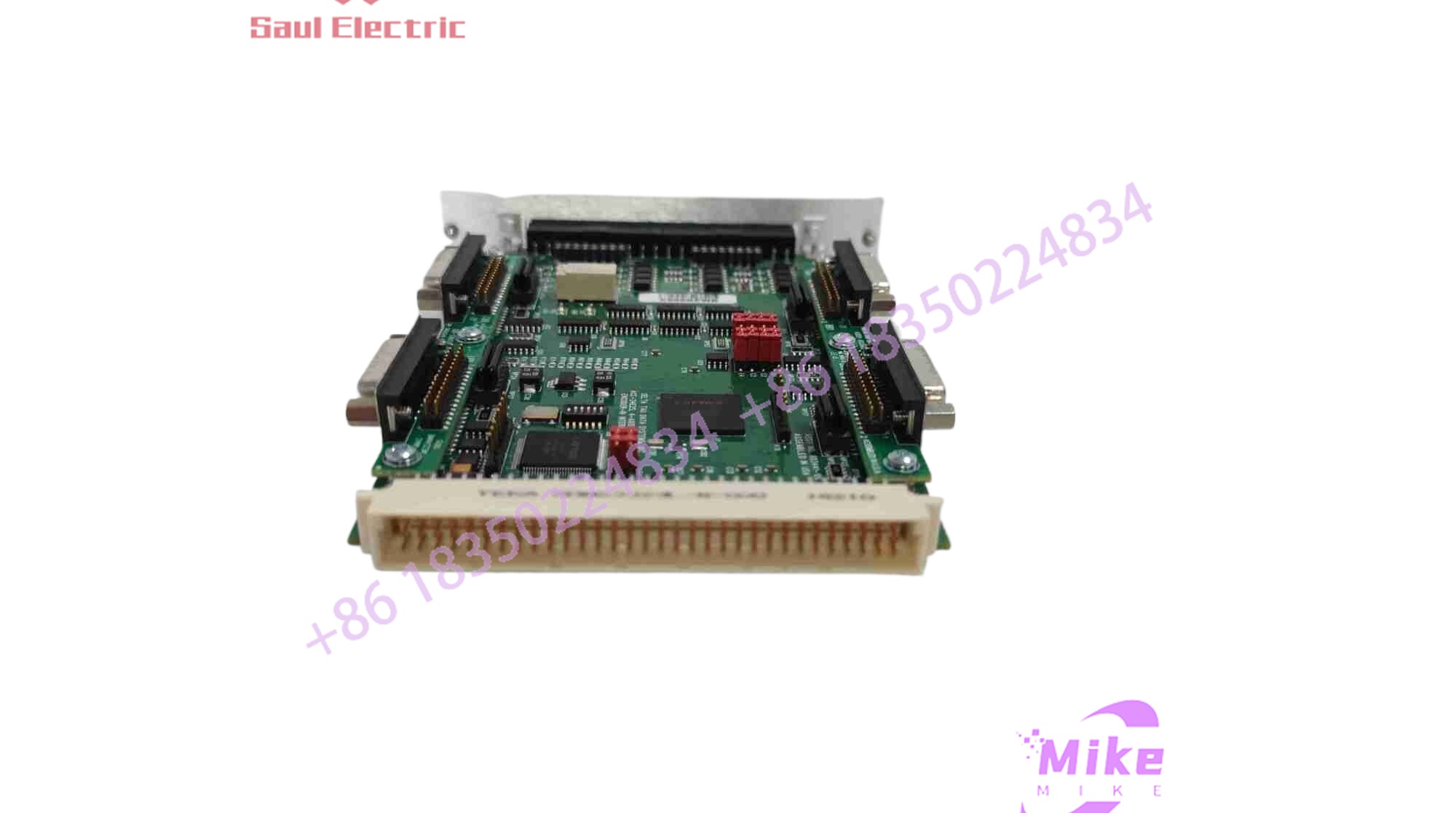
ACC-24E2S
Key Technical Specifications
| Parameter | Specification Detail |
| Primary Architecture | PMAC2-style DSPGATE1 core with onboard Sin/Cos Interpolation Hardware |
| System Compatibility | UMAC Turbo, Turbo PMAC2, and compatible MACRO Stations |
| Feedback Inputs | Analog Sinusoidal (Sin/Cos) differential signals (typically 1Vpp) |
| Interpolation | High-resolution onboard hardware multiplier / interpolator |
| Control Outputs | Digital PWM or \pm10V Analog command options (depending on sub-assembly configuration) |
| Axis Capacity | Multi-axis layout (typically 2 to 4 axes depending on base/piggyback configuration) |
| Auxiliary I/O | Over-travel limits, amplifier faults, drive enables, and hardware position compare triggers |
| Form Factor & Mounting | 3U industrial rack-mount module (occupies standard UMAC backplane slots) |
Global Sourcing & Live-Test SOP
Sourcing surplus interpolating encoder cards requires rigorous signal integrity checks to ensure analog front-end amplifiers and digital multiplier chips maintain phase accuracy:
- Inbound Verification: Board part numbers, revision etchings, and analog front-end component stamps are audited against authentic Delta Tau build documentation.
- Live Rack Simulation: The card is mounted onto a verified UMAC Turbo test backplane, confirming proper module registration across the high-speed UBUS.
- Diagnostics: Using a precision function generator, we inject simulated 1Vpp Sin/Cos signals into the feedback channels. We monitor the internal interpolation counters and verify that position counts scale linearly without jitter, phase drift, or dropped interpolation pulses.
- Final Prep: Approved units are cleaned, fitted with protective connector caps, and sealed in heavy-duty anti-static moisture-barrier packaging.
The Field Engineer’s Pitfall Guide
❗ Phase Offset and Gain Imbalance: Analog sinusoidal encoders require precise calibration of the Sine and Cosine signal amplitudes and phase relationships. If your cabling introduces a DC offset or imbalance, the hardware interpolator will create non-linear position errors, resulting in velocity ripple at low speeds.
❗ Shielding and Common-Mode Noise: Because Sin/Cos lines transmit low-voltage analog signals rather than robust digital square waves, failing to ground the encoder cable shield continuously at both ends can inject high-frequency noise that disrupts the interpolation counters.
❗ Parameter Scaling Discrepancies: Replacing an ACC-24E2S card requires verifying your encoder conversion table (Ixx08 / scale factor parameters) in PMAC firmware. Changing interpolation multipliers without updating scale factors will throw off position feedback units by factors of 10x or more.
Intent-Driven FAQ
Can the ACC-24E2S accept standard digital quadrature encoders?
While the underlying DSPGATE architecture shares similarities with standard cards, the ACC-24E2S variant is purpose-built with dedicated analog front-end circuitry optimized for Sin/Cos sinusoidal feedback. Standard digital inputs may require alternative base models.
How does hardware interpolation improve motor performance?
Hardware interpolation takes a single sine/cosine wave cycle and electronically slices it into thousands of intermediate steps. This provides exceptionally high position resolution far beyond the physical line count of the encoder disk, enabling ultra-smooth velocity control at low RPMs.
Do I need to re-tune my control loops when swapping this card?
If you are replacing an exact matching part number with identical interpolation settings and firmware configuration, your tuning files will run immediately. However, if board revisions alter internal delay timing, minor loop adjustments may be required.
What causes erratic position jumps on sinusoidal channels?
Erratic jumps typically point to electrical noise coupling into the analog Sin/Cos lines, a failing encoder lamp/sensor inside the motor, or damaged cable shielding compromising the differential signal balance.
What warranty is included with surplus units?
Every unit shipped from our stock is backed by a comprehensive 12-month operational warranty covering internal interpolator accuracy, transceiver health, and power regulation stability.





