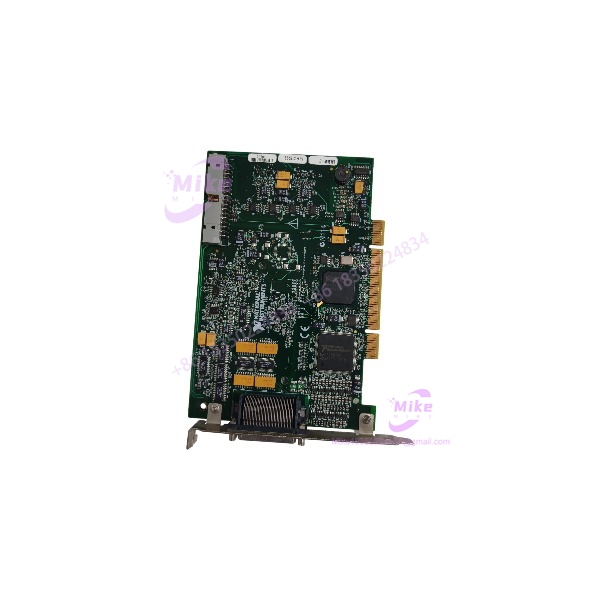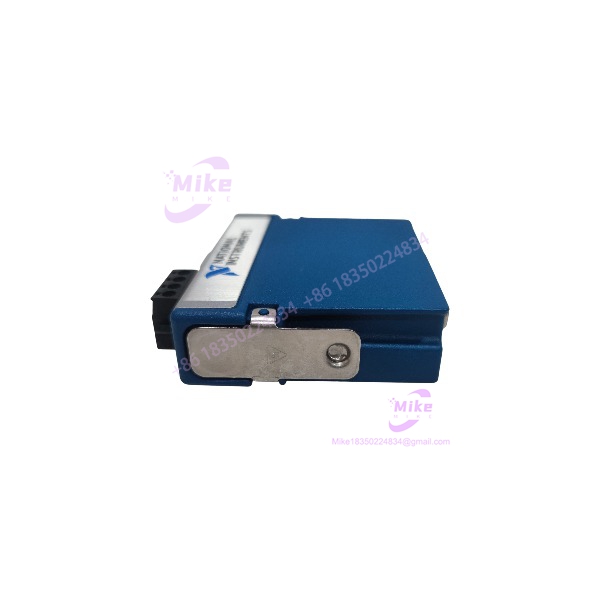
Description
National Instruments NI-9505 | DC Brushed Servo Drive Module
Product Introduction
When a motion-control axis fails, replacing the drive with a generic amplifier can introduce encoder compatibility problems, control-loop changes, and unexpected commissioning delays. The NI-9505 is a C Series brushed DC servo drive designed for NI CompactRIO and other compatible RIO-based control systems. Its full H-bridge output, integrated current sensing, and encoder interface support closed-loop motion applications without requiring a separate encoder acquisition module.
The engineering advantage lies in combining motor drive and feedback interfaces in one module. Operating from an external 8–30 VDC motor supply, the NI-9505 supports continuous current up to 5 A at 40°C, subject to thermal derating, and provides a current-loop update rate of 20 µs. Peak current capability reaches approximately 12.7 A for limited intervals, so duty cycle, motor inductance, and cabinet temperature must be checked before commissioning. This is a motion-control component, not a standalone PLC output card.
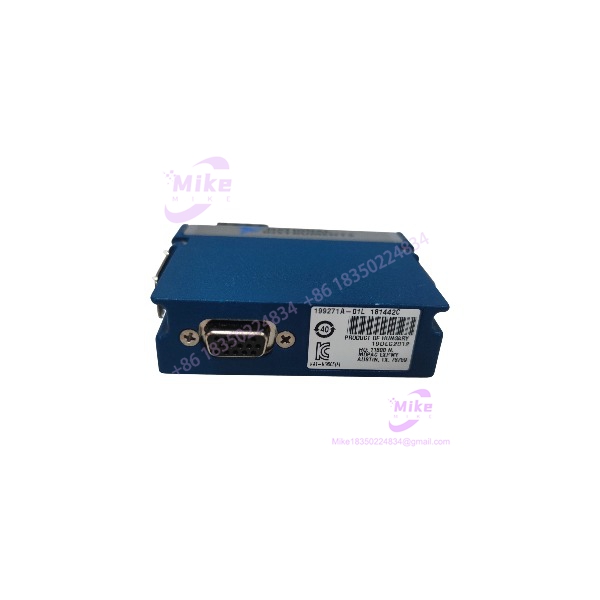
NI-9505
Key Technical Specifications
- Manufacturer: National Instruments
- Model number: NI-9505
- Manufacturer part number: 779126-01
- Module architecture: C Series full H-bridge brushed servo drive
- Compatible platform: CompactRIO and supported RIO-based systems
- Motor supply voltage: 8–30 VDC
- Continuous output current: 5 A at 40°C, decreasing to 1 A at 70°C with the standard terminal arrangement
- Current-loop ADC resolution: 12 bits
- Maximum current-loop update rate: 20 µs
- Encoder interface: Quadrature Phase A, Phase B, and Index inputs; single-ended or differential configurations
- Maximum encoder quadrature frequency: 5 MHz
- Encoder power output: 5 VDC, up to 125 mA
- Motor connections: Detachable screw-terminal connector
- Feedback and control connections: 9-pin female D-SUB connector
- Operating temperature: −40°C to 70°C
- Weight: Approximately 155 g (5.5 oz)
These specifications describe the standard NI-9505. Confirm the exact hardware variant and applicable manual before ordering, particularly when matching older installations.
Application Scenarios & Pain Points
Scenario A — Legacy CompactRIO motion-axis recovery
A production machine loses its brushed servo drive, and the replacement must preserve the existing LabVIEW FPGA control architecture. Using the correct NI-9505 can reduce redesign work because its integrated encoder interface and current sensing support the original control strategy. Before installation, verify the chassis, software dependencies, connector arrangement, and existing FPGA implementation.
Scenario B — High encoder pulse rates
- Condition: Encoder feedback approaches the module’s 5 MHz maximum quadrature frequency.
- Without proper verification: Missed or distorted position feedback can undermine velocity estimation and positioning accuracy.
- With a verified configuration: Check encoder output frequency, signal levels, cable length, and differential versus single-ended wiring before enabling the axis. NI recommends differential line-driver encoders when cable runs exceed 3.05 m (10 ft).
Scenario C — Thermal overload inside a crowded control cabinet
At 40°C, the standard terminal arrangement permits up to 5 A continuous output; at 70°C, that rating falls to 1 A. The optional NI 9931 screw-terminal accessory can increase the 40°C rating to 7.3 A, but it does not eliminate thermal derating. A cabinet operating near its temperature limit needs a load-current review, not simply a larger motor supply.
Scenario D — Automated actuator or valve control
For brushed DC motors, relays, lamps, solenoids, and compatible valves, the NI-9505 can provide a configurable output stage. Current feedback also supports application-specific monitoring and control algorithms. Confirm that the load’s electrical characteristics and switching requirements fall within the module’s published limits.
QA & Live Testing SOP
A part number on a label is only the beginning of an acceptance check. For an industrial replacement, request evidence that the actual unit has been inspected and tested.
- Origin and identity verification: Inspect the NI label, part number, connector condition, and available OEM packaging or seals. Packaging alone does not establish authenticity.
- Physical inspection: Check the PCB, terminals, D-SUB connector, mounting features, and visible signs of corrosion, impact, or repair.
- Electrical verification: Where suitable equipment and test procedures are available, verify power behavior and inspect the motor output and encoder interface under controlled conditions.
- Functional test: Request documentation showing that the module was powered on using a compatible RIO-based test setup, with its drive-enable behavior, encoder inputs, and current-feedback functions checked.
- Communication and software checks: Validate the applicable LabVIEW FPGA and NI SoftMotion configuration. Modbus or Profibus testing is not an appropriate default acceptance test for this module.
- ESD-safe handling: Package the unit in suitable electrostatic-discharge protective material and secure the connectors against transit damage.
Purchasing note: These are recommended acceptance criteria, not a claim that a particular unit has already passed them. Confirm actual test results, condition, warranty terms, and return provisions with the seller before purchase.
Field Engineer’s Pitfall Guide
- ❗ Do not confuse CompactRIO compatibility with CompactDAQ compatibility. The NI-9505 requires an appropriate RIO-based platform. NI documentation states that its C Series motor-drive modules do not operate in ordinary CompactDAQ configurations. Verify the exact controller and chassis before placing the order.
- ❗ Never assume a hot-swap is safe just because the module fits the chassis. The NI-9505 is disabled when inserted into the chassis, but that behavior does not establish that replacing it in an energized machine is safe. Follow the machine’s isolation procedure, manage the external motor supply, and verify the software’s enable sequence before restoring motion.
- ❗ Don’t overlook current derating or assume a firmware revision will be interchangeable. Motor current depends on ambient temperature and terminal configuration. Separately, software and FPGA compatibility must be confirmed against the installed project and supported hardware. Do not assume a particular firmware version or undocumented jumper setting applies to every NI-9505 installation.
Intent-Driven FAQ
Q1: Is the NI-9505 compatible with my CompactRIO controller?
It can be used with compatible CompactRIO and other supported RIO-based systems, but compatibility depends on the specific chassis, controller, software environment, and application. Check NI’s compatibility documentation before substituting the module into an existing rack. A physical fit alone is not sufficient.
Q2: Can I use the NI-9505 in a CompactDAQ chassis?
No, not as a standard supported configuration. NI identifies its C Series motor-drive modules as requiring RIO-based systems, including supported CompactRIO and EtherCAT RIO or Ethernet RIO platforms. Choose a compatible motion-control architecture if your system is built around CompactDAQ.
Q3: What is the maximum continuous current of the NI-9505?
The standard terminal configuration supports up to 5 A at 40°C, derating to 1 A at 70°C. With the optional NI 9931 screw-terminal accessory, the published maximum at 40°C increases to 7.3 A. Actual current limits depend on operating temperature and installation conditions.
Q4: Does the NI-9505 support encoder feedback?
Yes. It includes quadrature encoder inputs for Phase A, Phase B, and Index signals, with single-ended or differential configurations. The maximum quadrature frequency is 5 MHz. For long cable runs, verify signal integrity and follow the manufacturer’s encoder wiring recommendations.
Q5: Is the NI-9505 discontinued, and can I still buy one?
Yes, NI identifies the product as discontinued and no longer available for purchase directly from the manufacturer. Remaining units may be available through independent industrial automation suppliers, but stock, condition, and authenticity must be verified for each offer.
Q6: How can I verify that a replacement NI-9505 is genuine and functional?
Compare the label and part number with the required hardware, inspect the module and connectors, and request available provenance and functional-test records. For critical machinery, require a documented test using a compatible RIO-based system and confirm the seller’s warranty and return policy. A photograph or unopened box is not proof of operational performance.
Q7: What warranty should I expect when buying an NI-9505?
Warranty coverage depends on the seller and the unit’s condition. Do not assume that a discontinued module carries a current manufacturer’s warranty. Obtain the warranty duration, coverage for functional defects, return window, and any exclusions in writing before purchasing.
Final procurement recommendation: When sourcing the NI-9505, prioritize the exact part number, compatible RIO hardware, verified operating condition, and documented warranty. Those checks matter more than a low initial price when the replacement must return a motion axis to service without introducing another commissioning problem.