


Description
Honeywell CC-PDOD51 | Series C Digital Output Module Core Category
Dynamic Product Introduction
Looking down at a dark control cabinet floor while a plant unit sits tripped is an experience no senior technician wants to repeat. When a legacy output card drops its channels under thermal stress, the resulting downtime wreaks havoc on production quotas.
Enter the Honeywell CC-PDOD51, a heavy-duty hardware revision engineered to anchor high-density process automation loops. By packing 32 sink-type channels into a compact footprint, this module eliminates the footprint bloat common in older rack architectures. Field engineers replacing obsolete nodes will notice an immediate leap in signal routing stability and thermal dissipation efficiency—though this strictly depends on proper backplane grounding.
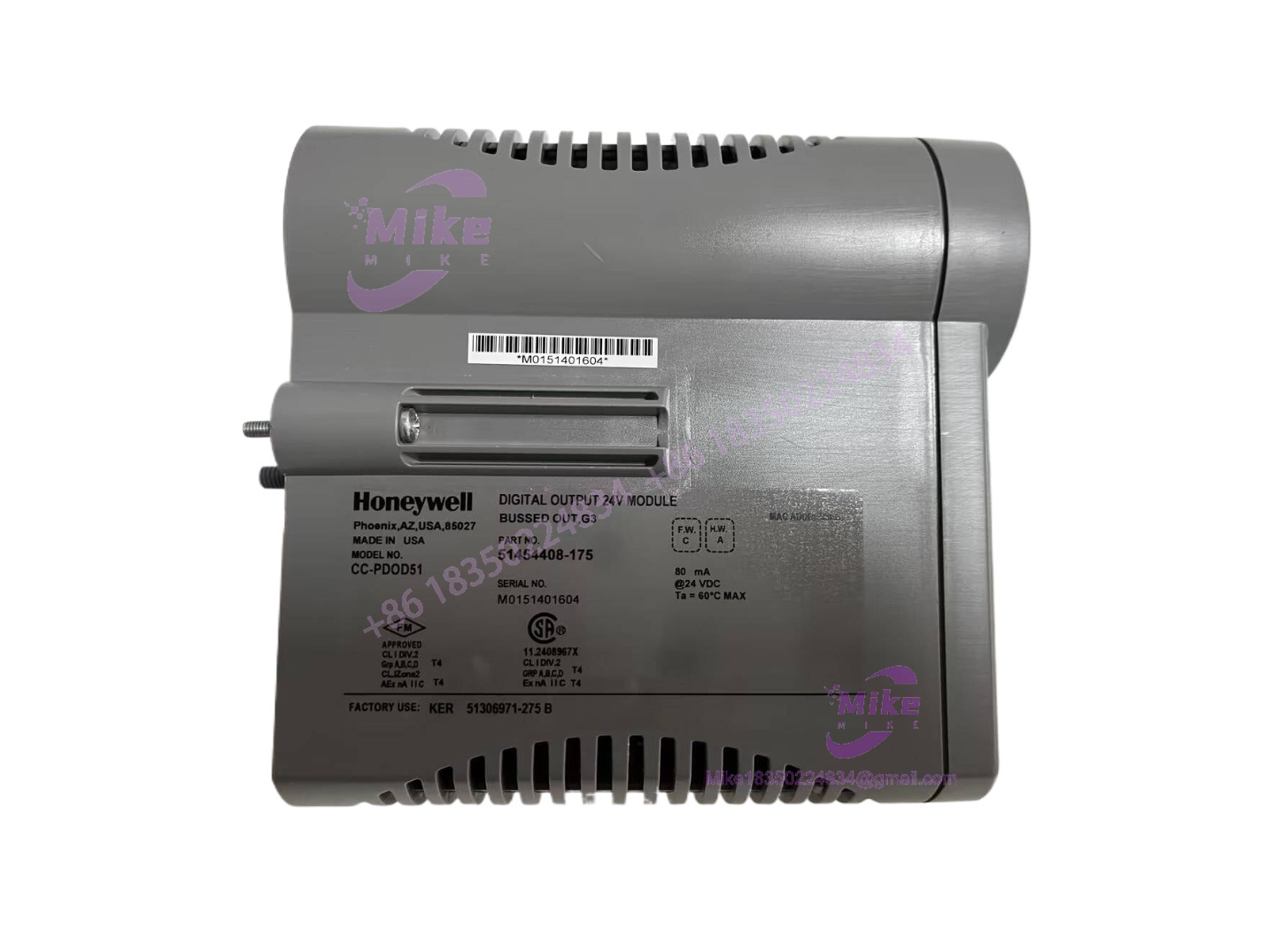
CC-PDOD51
Key Technical Specifications
| Core Parameter | Technical Specification |
| Output Channels | 32 Channels |
| Output Type | SINK (Open Drain) |
| Load Voltage Range | 30 VDC Maximum |
| Max Load Current | 0.1 A per channel |
| Galvanic Isolation | 1000 VAC RMS (System-to-Field) |
| On-State Voltage | 0VDC at max load current |
| Off-State Leakage | 100 µA Maximum |
| Turn-On/Off Time | 10 ms Maximum |
| Module Dimensions | 50.8 mm x 177.8 mm x 127 mm |
| Weight | 0.45 kg |
Global Sourcing & Live-Test SOP (Transparency Core)
Procuring surplus or replacement automation hardware demands an uncompromising quality control pipeline. In field deployments, dropping an untested board into a live rack can trigger catastrophic controller faults.
- Inbound Verification: Every incoming shipment of the CC-PDOD51 undergoes meticulous customs documentation review alongside high-magnification holographic serial number checks to block gray-market counterfeits.
- Live Simulation: Technicians mount the hardware onto an authentic Series C test bench to verify backplane pin alignment and mechanical latching integrity.
- Diagnostics: Engineers execute full-scale I/O point pulsing, measure switching speeds using calibrated Fluke multimeters, and run a 24-hour thermal heat run to flush out infant mortality defects.
- Final Prep: Once cleared, the unit is logged by firmware revision, packed in anti-static shielding, and vacuum-sealed for storage.
The Field Engineer’s Pitfall Guide
❗ Firmware Revision Mismatches: Dropping a newer revision hardware card into an older controller node without checking the Experion node configuration can trigger fatal communication timeouts. I’ve seen plants lose two days of production because an engineering station rejected the module signature until a minor patch was pushed.
❗ Terminal Resistor and IOTA Blindness: The CC-PDOD51 relies on matched Input/Output Termination Assemblies (IOTA like the CC-TDOD51). Forgetting to verify field wiring bussing configurations during a hot swap will instantly blow internal channel fuses.
❗ Power Draw Limits on Expanding Racks: Overloading the bussed external power supply with maximum 0.1A loads across all 32 channels simultaneously will trip power distribution monitors if supply sizing isn’t recalculated.
Intent-Driven FAQ
- Will I lose my configuration logic if I swap out a faulty CC-PDOD51?
No. The control logic resides in the controller node, not the I/O module. However, station configuration files must match the hardware slot profile exactly to avoid diagnostic alarms.
- Can this module handle inductive loads without external flyback diodes?
Honestly, relying solely on internal protection for heavy solenoids or valves is asking for trouble. Always install appropriate freewheeling diodes on inductive field loads to protect the open-drain outputs.
- Is the CC-PDOD51 compatible with redundant IOTA configurations?
Yes, when paired with the correct redundant termination assembly, it supports bumpless switchover with zero gap of output to field during transitions.
- What maintenance tools are required to verify channel states locally?
A high-impedance digital multimeter is sufficient for checking voltage drops, though monitoring the controller software diagnostic faceplate remains the definitive method.
- Are factory-sealed units supplied with updated firmware?
Surprise inventory often ships with baseline factory firmware. Always cross-check the revision against your system engineering requirements before final commissioning.





