


Description
GE Fanuc 8810-HI-TX | PAC8000 Safety Analog Input Module
Architect’s Product Breakdown
The GE Fanuc 8810-HI-TX operates as a high-integrity, 8-channel safety analog input module engineered within the PAC8000 and SafetyNet modular I/O architectures. Designed for hazardous and safety-critical industrial process environments—such as oil and gas facilities, emergency shutdown (ESD) systems, and chemical plants—it accurately processes 4-20mA current loops from field transmitters. Furthermore, it features embedded HART pass-through capabilities, allowing supervisory asset management systems to interrogate smart field instruments without interrupting safety-critical control loops.
Mounting directly onto standard PAC8000 carriers, the module links field wiring directly through dedicated terminal blocks, allowing live hot-swapping of electronics without disturbing core field cabling. Its robust channel-to-channel isolation and internal diagnostic self-testing ensure compliance with stringent safety loops while maintaining high measurement fidelity.
Deploying an authentic 8810-HI-TX module guarantees reliable system integration, protocol handshakes, and functional safety compliance across demanding process automation frameworks.
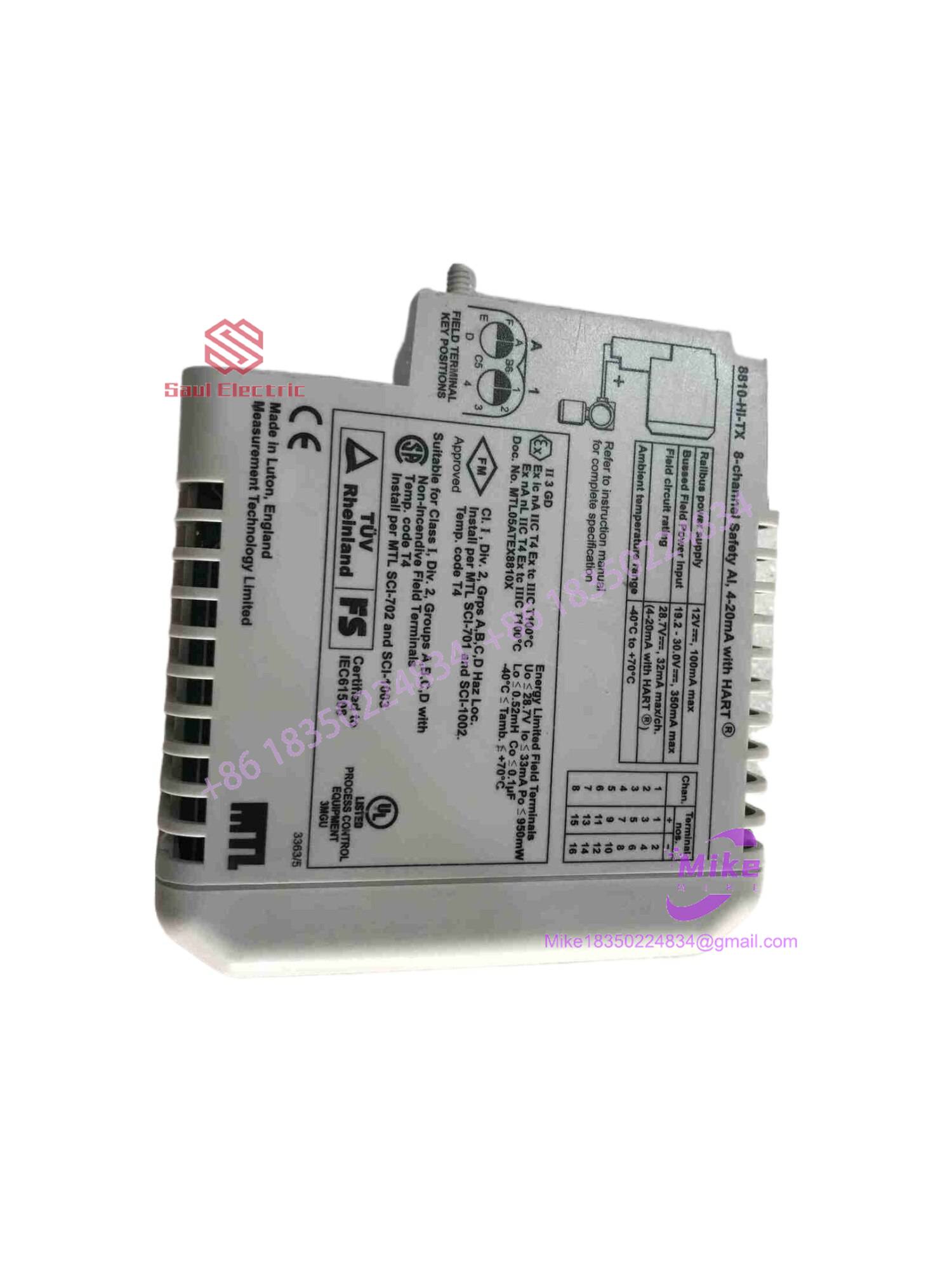
8810-HI-TX
Key Technical Specifications
| Parameter | Technical Specification |
| Module Type | 8-Channel Safety Analog Input (AI) with HART |
| System Compatibility | GE Fanuc PAC8000 / SafetyNet Modular I/O Platform |
| Input Channels | 8 single-ended channels (4-20mA loop powered / 2-, 3-, or 4-wire transmitters) |
| Resolution & Speed | 16-bit resolution; 25 ms update rate (HART 0.75 s/pt) |
| Field Circuit Protection | Non-incendive field circuits for hazardous area deployment |
| Power Consumption | System: ~70 mA; Field Loop Supply: ~350 mA (driven via bussed rail power) |
| Operating Temperature | -20°C to +70°C (-4°F to +158°F) standard industrial range |
| Physical Weight | ~3.0 kg (packaged transit weight varies by configuration) |
Field Engineer’s Pitfall Guide
- WARNING: Incorrect Loop Power Feed. Failing to supply clean 24 VDC bussed field power via the designated power distribution module will cause input loops to drop out or report false low-limit alarms.
- WARNING: HART Impedance Conflicts. Ensure that external loop resistance meets minimum HART communication specifications (typically 230 to 500 ohms) to prevent packet communication failures with smart field devices.
- WARNING: Live Carrier Pin Misalignment. When inserting the module onto a carrier backplane, ensure absolute vertical alignment. Forcing the unit can bend sensitive interface pins and compromise safety ground continuity.
QA & Testing SOP (Transparency)
- Visual & Origin Verification: Detailed physical inspection of OEM identification plates, part number tags (8810-HI-TX), conformal coating integrity, and connector pin cleanliness.
- Bench Power & Diagnostic Handshake: Modules are mounted on an isolated PAC8000 test carrier, powered via a regulated DC source, and verified for clean internal microprocessor boot behavior and status LED execution.
- Precision Signal Simulation: Technicians inject calibrated 4-20mA current sweeps across all 8 channels to validate A/D conversion accuracy, linearity, update timing, and HART pass-through data integrity.
- Final Packaging: Non-volatile status registers are cleared, and the unit is sealed in an anti-static moisture barrier bag before being packed inside high-density industrial foam containers.
Technical FAQ
Can I hot-swap this safety input module while the process loop is live?
Yes. The PAC8000 architecture supports hot-swapping electronic modules under power, provided local plant safety procedures and system configuration guidelines allow live replacement on safety-rated loops.
Does this module supply power to field transmitters?
Yes. The module coordinates with system power distribution rails to provide non-incendive 24 VDC field power to support 2-, 3-, or 4-wire active and passive transmitters.
Are configuration parameters saved during a total power loss?
Yes. Module configuration maps, channel scaling, and diagnostic thresholds are retained securely within non-volatile internal memory through complete power interruptions.
What causes a HART communication timeout on a channel?
A HART timeout is typically caused by insufficient loop resistance (below 230 ohms), excessive cable capacitance or electrical noise on long instrument wire runs, or an unaddressed/misconfigured smart field transmitter.





