


Description
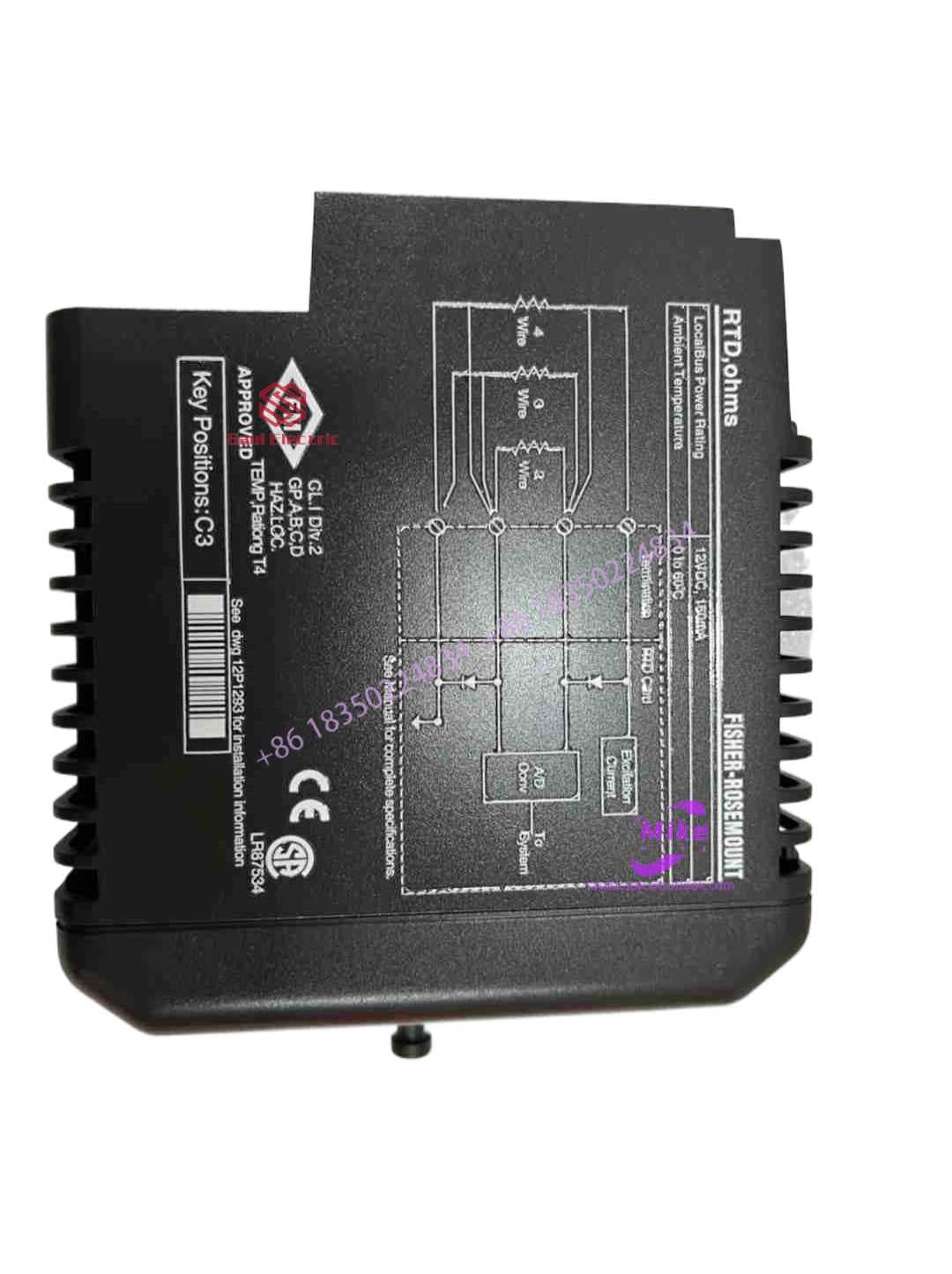
Emerson (Westinghouse) KJ3002X1-BF1 — DCS Input/Output Module
What It Is
The KJ3002X1-BF1 is a differential input/signal conditioner module manufactured by Emerson (formerly Westinghouse) Process Management for the Ovation distributed control system (DCS) platform. Its full Emerson cross-reference designation is 12P1732X042.
This module belongs to the Ovation I/O subsystem — the field-level interface that connects sensors, transmitters, and actuators in the plant to the Ovation controller. Specifically, the KJ3002X1-BF1 is a dual-channel differential input module designed to accept low-level millivolt signals from field instruments and convert them into high-level signals for the Ovation controller bus.
In simpler terms: It is the “ear” of the Ovation system — it listens to two separate sensor signals (like temperature or pressure transmitters), cleans up the signal, and passes reliable data to the controller.
EMERSON DeltaV KJ3002X1-BF1
Key Functions
| Function | Detail |
|---|---|
| Signal type | Differential (balanced) analog input — rejects common-mode noise and ground loops |
| Number of channels | 2 independent input channels per module |
| Input range | Typically ±50 mV to ±250 mV (configurable via jumper or software) — suitable for thermocouples, RTDs, and millivolt transmitters |
| Signal conditioning | On-board cold-junction compensation (for thermocouples), linearization, and filtering |
| Resolution | 16-bit A/D conversion per channel |
| Isolation | Channel-to-channel and channel-to-bus galvanic isolation (typically 500V) |
| Communication | Ovation I/O Bus — the module communicates with the Ovation controller via the backplane bus; no separate fieldbus protocol needed |
| Diagnostics | Built-in self-test, wire-break detection, sensor failure detection, and channel status LEDs |
| Redundancy | Supports hot-swap and redundant I/O configurations in Ovation redundant controller setups |
How It Fits in the Ovation System
The Ovation DCS has a modular I/O architecture. A typical Ovation I/O chassis (rack) holds multiple modules side by side:
1┌─────────────────────────────────────────────┐
2│  Ovation I/O Chassis (backplane bus)         │
3├────────┬────────┬────────┬────────┬────────┤
4│ Power  │ KJ3002 │ KJ3002 │ KJ2005 │ KJ2001 │
5│ Supply │ X1-BF1 │ X1-BF2 │ X1-BA1 │ X1-BC1 │
6│ Module │ (AI x2)│ (AI x2)│ (AO x4)│ (DI x8)│
7│        │        │        │        │        │
8│ ◄───── Ovation I/O Bus ──────────────────► │
9└────────┴────────┴────────┴────────┴────────┘
10         ↓        ↓        ↓        ↓
11      TC/RTD   TC/RTD   4-20mA   Dry contact
12      sensors  sensors  valves   relays
13
The KJ3002X1-BF1 plugs into one slot. The Ovation controller polls all modules on the bus cyclically (typically every 100–250 ms), reads the conditioned signal values, and uses them in control algorithms.
Typical Applications
| Application | What the module reads |
|---|---|
| Temperature measurement | Type K, J, T, E thermocouples; Pt100/Pt1000 RTDs (with external bridge or 4-wire connection) |
| Pressure measurement | Millivolt output pressure transmitters (e.g., strain-gauge based) |
| Flow measurement | Differential pressure transmitters (orifice plate, venturi) |
| Level measurement | Millivolt level transmitters |
| Strain / force | Load cell mV/V signals (with excitation provided by adjacent modules) |
| Laboratory / process | Any low-level differential sensor in chemical, power, oil & gas, or water/wastewater plants |
Technical Specifications (Typical)
| Parameter | Value |
|---|---|
| Part number | KJ3002X1-BF1 / 12P1732X042 |
| Manufacturer | Emerson (Westinghouse Ovation) |
| Module type | Dual-channel differential analog input |
| Input signal | Thermocouple (TC), RTD, or mV transmitter |
| Input range | ±50 mV / ±100 mV / ±250 mV (selectable) |
| Cold-junction compensation | Yes — automatic, built-in reference junction |
| A/D resolution | 16 bits |
| Sampling rate | Up to 10 samples/sec per channel (configurable) |
| Isolation | 500 VDC channel-to-bus, channel-to-channel |
| Common-mode rejection | >120 dB at 50/60 Hz |
| Accuracy | ±0.1% of span (typical) |
| Operating temperature | 0°C to +60°C (indoor chassis) |
| Power consumption | Approximately 1.5 W per module |
| Mounting | DIN-rail or chassis card slot (Ovation I/O rack) |
| Status LEDs | Power (green), Channel 1 active (green), Channel 2 active (green), Fault (red) |
| Weight | Approximately 0.2 – 0.3 kg |
Module Family — Quick Reference
| Model | Channels | Signal Type | Typical Use |
|---|---|---|---|
| KJ3002X1-BF1 | 2 × differential AI | TC / RTD / mV | Temperature, pressure |
| KJ3002X1-BF2 | 2 × differential AI | TC / RTD / mV | Same as BF1, different range |
| KJ3002X1-BB1 | 2 × single-ended AI | 4–20 mA / 0–10 V | Standard process signals |
| KJ3002X1-BA1 | 4 × single-ended AI | 4–20 mA | Higher density AI |
| KJ3002X1-BC1 | 8 × single-ended DI | Dry contact / 24V | Discrete inputs (relays, switches) |
| KJ3002X1-BG1 | 4 × single-ended AO | 4–20 mA | Analog outputs to valves |
| KJ3001X1-BJ1 | 8 × single-ended DO | Dry contact / 24V | Discrete outputs (solenoids, indicators) |
Compatible Ovation Controllers
The KJ3002X1-BF1 works with all Ovation controller families:
- OV3000 — standard process controller
- OV3200 — redundant process controller
- OV3500 — high-performance controller
- OV500 — small/compact controller for remote I/O
All communicate via the same Ovation I/O Bus, so the module is backward-compatible across controller generations.
Configuration & Commissioning
The module is configured through Ovation Control Studio (the engineering software):
- Hardware setup: Slide the module into the I/O chassis — it is hot-swappable
- Channel assignment: In Control Studio, assign each channel to a specific process point (e.g., “Reactor Temp TC-101”)
- Range selection: Set the input range (e.g., Type K thermocouple = ±250 mV)
- Filtering: Configure digital filtering (typically 2–10 seconds time constant for temperature)
- Alarms: Set high/low alarm thresholds per channel
- Scaling: Map raw counts to engineering units (°C, °F, psi, etc.)
No manual jumpers are required — everything is software-configured, though some legacy installations may use DIP switches.
Status & Availability
| Item | Detail |
|---|---|
| Platform status | Ovation is Emerson’s current active DCS platform — the KJ3002X1-BF1 is NOT obsolete |
| Still manufactured? | Yes — Emerson continues to produce Ovation I/O modules |
| New old stock | Widely available from Emerson authorized distributors |
| Lead time | Typically 4–8 weeks for new units; 1–3 days for stock items |
| Price range | Approximately ¥5,000 – ¥15,000 RMB (~700–2,100 USD) depending on region and quantity |
| Refurbished | Available from third-party DCS parts specialists — often 40–60% cheaper |
| Replacement path | Emerson offers pin-compatible upgraded modules (e.g., KJ3002X1-BF3 with enhanced diagnostics) |
Common Issues & Maintenance
- Noise on readings: Check that the sensor cable is twisted-pair, shielded, and properly grounded at the module end only. Differential inputs reject common-mode noise — but only if wiring is correct.
- Channel fault LED red: Check for wire break, sensor failure, or incorrect range setting. The module will flag a fault if input voltage exceeds the selected range.
- Drift over time: Calibrate annually using a precision mV simulator or thermocouple calibrator. The module’s A/D is stable, but sensor drift is the usual culprit.
- Hot-swap caution: While the module supports hot insertion, always follow Emerson’s procedure — power down the chassis if possible, insert/remove slowly, and allow 30 seconds for the bus to re-enumerate.
Bottom Line
The Emerson (Westinghouse) KJ3002X1-BF1 (12P1732X042) is a dual-channel differential analog input module for the Ovation DCS platform — purpose-built for thermocouple, RTD, and millivolt transmitter signals in power generation, water/wastewater, oil & gas, chemical, and other process industries. With 16-bit resolution, 500V isolation, built-in cold-junction compensation, and full Ovation Control Studio integration, it delivers high-accuracy, noise-immune signal acquisition in one of the most widely deployed DCS platforms in the world. It remains an active, supported product with excellent parts availability.
For the official datasheet, wiring diagrams, or Ovation Control Studio configuration guides, visit Emerson Ovation documentation portal or contact your local Emerson/Ovation sales representative.





