

Description
EPRO MMS6210 | Dual-Channel Shaft Position Monitor
Product Introduction
A turbine protection system needs more than vibration data. Shaft position can tell you whether a rotor is moving axially, whether differential expansion is developing, or whether a radial position measurement is beginning to drift outside the expected operating envelope. The EPRO MMS6210 is designed for exactly this measurement layer within the MMS 6000 architecture.
The module processes two independent eddy-current sensor signals and can be configured for several shaft-position measurement modes, including independent two-channel operation, tandem measurement, and cone measurement. It supports EPRO PR 6422 through PR 6426 eddy-current sensor systems with the appropriate CON interface.
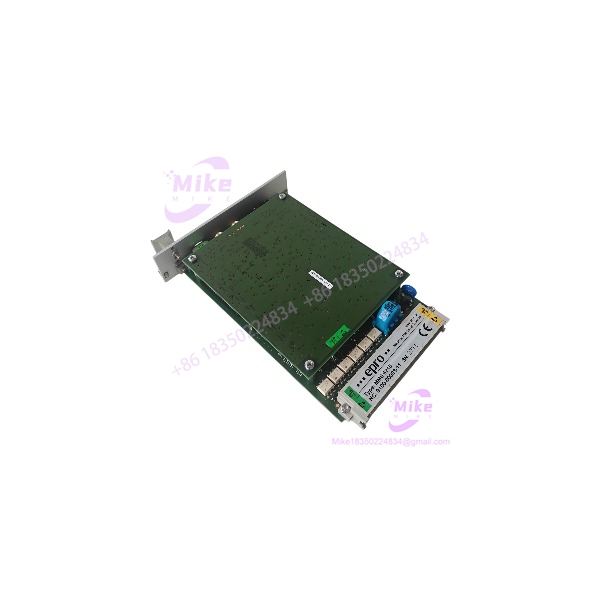
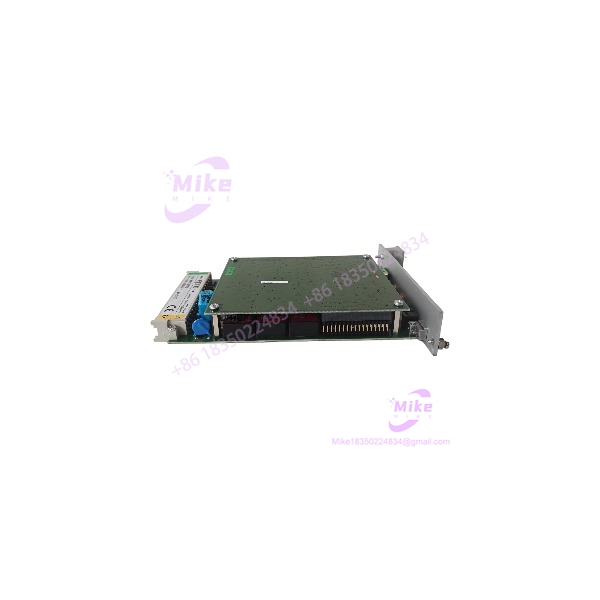
Physically, the MMS6210 follows the compact MMS 6000 plug-in architecture: 30 mm wide, 128.4 mm high, and 160 mm deep, occupying 6 TE × 3 HE in a DIN 41494-format rack. Up to 14 modules can occupy a 19-inch rack, providing 28 measurement channels when fully populated with two-channel modules.
MMS6210
Key Technical Specifications
- Model: MMS6210
- Manufacturer: EPRO
- System: MMS 6000
- Function: Dual-channel shaft displacement measurement
- Measurement Channels: 2
- Measurement Technology: Eddy-current displacement sensing
- Measurement Modes: Independent channels, tandem mode, cone measurement
- Typical Measurements: Axial shaft position, differential expansion, thermal expansion, radial shaft position, shaft bending
- Compatible Sensors: PR 6422 / PR 6423 / PR 6424 / PR 6425 / PR 6426 families with compatible CON interfaces
- Power Supply: 18–31.2 VDC
- Power Consumption: Maximum 6 W
- Communication: RS-232 and RS-485
- Diagnostic Interface: RS-485 connection to the MMS 6850 analysis and diagnostic system
- Sensor Self-Test: Integrated
- Linearization: Built-in
- Power Architecture: Redundant power inputs
- PCB Format: DIN 41494 / EURO card
- Width: 30.0 mm / 6 TE
- Height: 128.4 mm / 3 HE
- Length: 160 mm
- Net Weight: Approximately 320 g
- 19-Inch Rack Capacity: Up to 14 modules / 28 channels
The documented specifications identify the MMS6210 as a dual-channel shaft displacement monitor, not simply a generic vibration card. Its measurement scope includes axial position, differential and thermal expansion, radial position, and shaft bending.
Application Scenarios & Pain Points
Steam Turbine Thrust Position
A turbine rotor can remain mechanically operational while its axial position gradually moves away from the expected operating point. That is exactly the kind of condition a dedicated shaft-position channel is intended to expose.
With the MMS6210, two independent displacement signals can be evaluated as part of the machine protection architecture. The module can also be configured for tandem arrangements where the application calls for that measurement method.
Differential and Thermal Expansion
Without shaft-displacement monitoring:
The DCS may show acceptable process temperature and load values while mechanical expansion is occurring at the rotor or casing interface.
The displacement measurement becomes a dedicated machine-health parameter that can be passed into the wider protection and diagnostic system.
This is particularly relevant during turbine startup, shutdown, and large thermal transients.
Radial Shaft Position
The can also be applied to radial shaft-position measurements. Eddy-current sensing gives the monitoring system a non-contact measurement of the distance between the probe and the conductive shaft target.
That makes probe installation geometry, target material, probe gap, and cable/interface compatibility important engineering variables.
Shaft Bending
Shaft bending is another documented application. Two-channel measurements can provide information about the relative position of the shaft and help feed a larger turbomachinery diagnostic strategy.
Legacy MMS 6000 Rack Maintenance
The compact 6 TE × 3 HE format makes the appropriate for maintaining existing MMS 6000 racks where replacing the complete monitoring platform would create unnecessary downtime and engineering effort.
The card is designed for modular rack installation rather than standalone cabinet mounting.
QA & Live Testing SOP
The deserves a functional test that matches what it actually does.
A meaningful acceptance procedure should include:
- Model verification: Confirm the complete marking and hardware identification.
- Physical inspection: Examine the PCB, card edge, connectors, front-panel interfaces, and mounting hardware.
- Power check: Verify the 18–31.2VDC supply range before energizing the module.
- Controlled rack installation: Test the module in a compatible MMS 6000 rack or approved laboratory fixture.
- Channel 1 test: Apply a controlled displacement-equivalent signal and verify the measured value.
- Channel 2 test: Repeat independently rather than assuming both channels behave identically.
- Sensor interface check: Verify compatibility with the intended PR 642x sensor and CON interface.
- Linearization check: Confirm configured scaling and linearization behavior.
- Alarm verification: Test configured alarm and danger thresholds using controlled input values.
- Communication test: Verify RS-232 configuration access and RS-485 communication where the appropriate MMS system hardware is available.
- Self-test verification: Confirm the module’s sensor/measurement-chain diagnostic functions.
- Power-cycle test: Remove and restore control power under controlled conditions and verify correct restart behavior.
- ESD-safe packaging: Protect the PCB, card edge, and connectors during handling and shipment.
One practical point: a replacement card that simply powers up has not completed a useful engineering test. The measurement channels and sensor interface need to be exercised.
Field Engineer’s Pitfall Guide
❗ Do Not Confuse With MMS6120
These two model numbers are close enough to cause procurement mistakes.
The MMS6120 is associated with bearing vibration measurement using electrodynamic sensors. The is a shaft-displacement monitor using eddy-current sensors. They are not interchangeable merely because both occupy the MMS 6000 family.
❗ Verify the Complete Probe Chain
The is designed around EPRO eddy-current sensor systems. Confirm the exact PR 642x probe, extension cable, and CON interface before commissioning.
A monitor/card match without a sensor-chain match is not a completed compatibility check.
❗ Do Not Assume Every Channel Has the Same Configuration
The two channels can operate independently, but applications can also use tandem or cone measurement modes. The existing machine configuration must therefore be preserved when replacing the module.
Check the configuration before changing thresholds or scaling.
❗ Check the Actual Rack Before Installation
The documented module dimensions are approximately 30 × 128.4 × 160 mm and correspond to the MMS 6000 DIN 41494 card format.
Do not treat the as a universal standalone panel instrument. Its intended architecture is a modular MMS 6000 rack.
Intent-Driven FAQ
What is the EPRO used for?
The is a dual-channel shaft displacement monitoring module. It measures shaft movement using eddy-current displacement sensors and can monitor axial position, differential expansion, thermal expansion, radial shaft position, and shaft bending.
Is the a vibration monitor?
Not in the same sense as the MMS6120 bearing-vibration module. The is specifically a shaft-displacement measuring module based on eddy-current sensing. Some marketplace listings loosely call it a vibration monitor, but the manufacturer’s product description identifies its primary function as shaft displacement measurement.
What sensors are compatible with ?
The documented compatible sensor family is PR 6422 through PR 6426, used with the appropriate CON interface. Confirm the exact sensor and interface combination against the existing machine documentation before ordering.
Does have two channels?
Yes. It provides two independent measurement channels. It can also operate in tandem and cone measurement modes for appropriate applications.
Does support RS-485?
Yes. The module provides RS-485 communication and can communicate with EPRO’s MMS 6850 analysis and diagnostic system. RS-232 is also available for measurement-data readout and configuration.
What power supply does require?
The documented supply range is 18–31.2 VDC, with maximum power consumption of 6 W. The module also supports redundant power inputs.
What are the physical dimensions of the ?
The module is approximately 30.0 mm wide × 128.4 mm high × 160 mm long, occupying 6 TE × 3 HE in the MMS 6000 rack. Its documented net weight is approximately 320 g.
Can be used for turbine protection?
Yes. Its documented applications include axial shaft position, differential expansion, thermal expansion, radial shaft position, and shaft bending — all relevant measurements within a broader turbomachinery protection architecture. The manufacturer-oriented documentation recommends combining these measurements with other machine measurements when establishing a protection system.
Can be replaced during operation?
The available product documentation states that the module is replaceable during operation and can use redundant power inputs. However, live replacement should only be performed when the installed MMS 6000 rack, protection design, plant procedure, and applicable safety rules explicitly permit it.
What should I verify before buying an replacement?
Verify the model, hardware revision, existing sensor type, CON interface, measurement mode, alarm configuration, rack compatibility, and communication arrangement. Most importantly, compare the replacement against the installed card and the approved machine schematic.
Bottom line: the is a specialized two-channel shaft-position module for the MMS 6000 machinery protection platform. If the application involves turbine thrust position, differential expansion, radial shaft position, or shaft bending, matching the complete eddy-current sensor chain is just as important as matching the model number.





