


Description
PR6423/010-040+CON021 Emerson EPRO Sensor Probe
PR6423/010-040+CON021 is a high-performance non-contact eddy current sensor system manufactured by EPRO Germany, now part of Emerson Baker Hughes. It is specifically designed for condition monitoring and fault early warning of critical rotating machinery, and is widely used in heavy industries such as power generation, petrochemical, metallurgy, mining, and hydropower. It is an indispensable core detection component in turbine supervisory instrumentation (TSI) systems and machine protection systems.
The product complies with international standards including DIN 45670, ISO 10817-1, and API 670, and holds explosion-proof certification Eex ib IIC T6/T4, allowing safe use in hazardous areas.
Regarding the model code, PR6423 represents the EPRO eddy current sensor series, the rugged type specifically designed for turbomachinery. 010 indicates the probe tip diameter is 10mm. 040 indicates the linear measurement range is 40mm, approximately 1600 mils. CON021 is the matching standard proximitor, also known as a signal converter or proximitor.
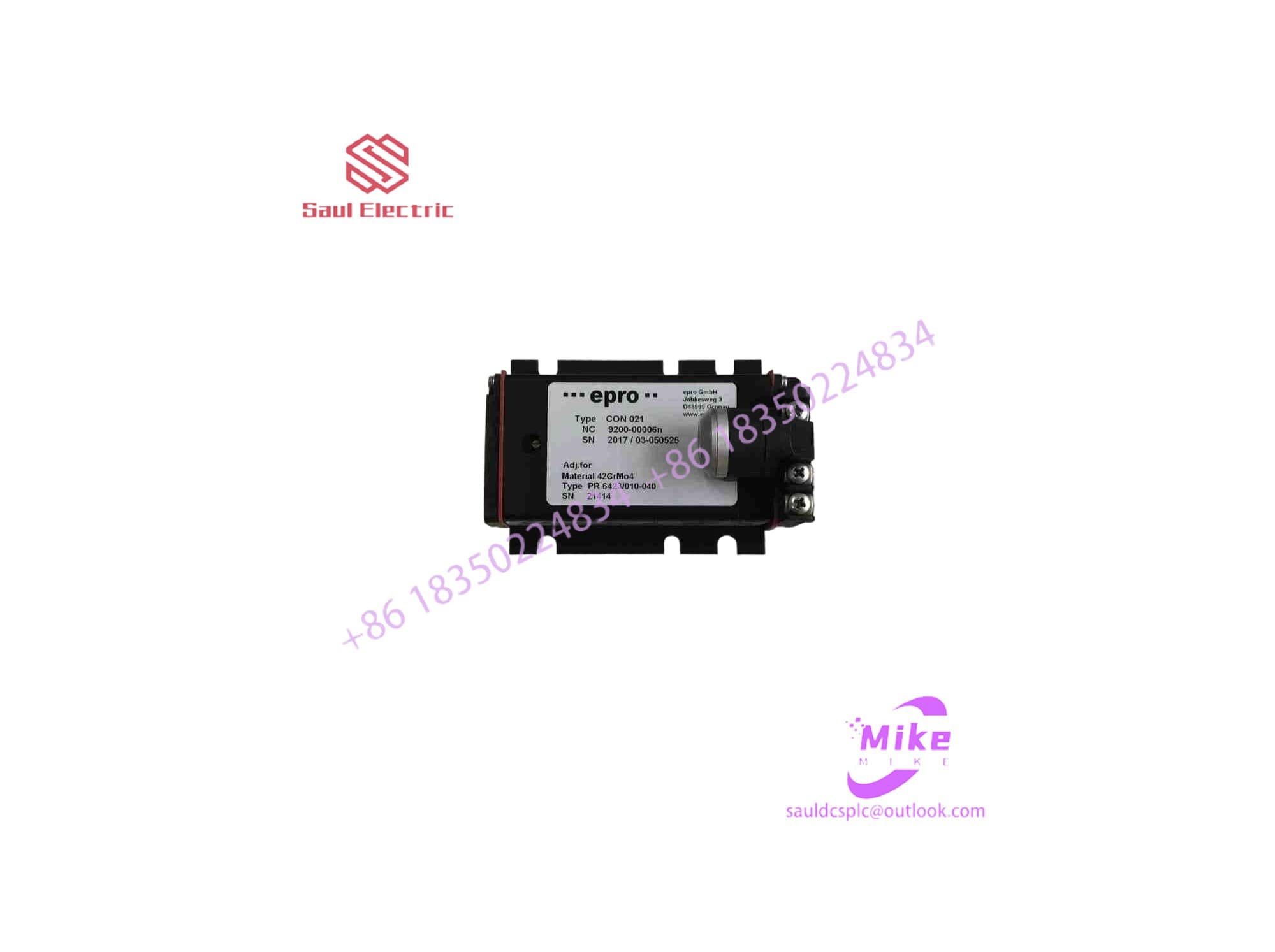
PR6423/003-030+CON021 Emerson EPRO Sensor Probe
The system consists of two parts. The PR6423/010 is a 10mm diameter non-contact eddy current probe with a built-in high-frequency excitation coil operating at 1 to 2 MHz. The CON021 is a standard proximitor responsible for signal amplification and conversion, transforming the probe impedance change into a standard DC voltage signal output. The two are connected via a LEMO plug, and factory-matched system-level calibration is completed before delivery, ensuring signal consistency and long-term stability. Users can install and use immediately without on-site pairing.
The working principle is based on the eddy current effect governed by Faraday’s law of electromagnetic induction. The CON021 proximitor injects a high-frequency alternating current into the probe coil, generating a high-frequency alternating magnetic field. When this magnetic field approaches the surface of a ferromagnetic shaft, closed-loop eddy currents are induced on the conductor surface. These eddy currents produce a reverse magnetic field that changes the equivalent impedance of the probe coil, including both inductance and resistance. The impedance change is proportional to the gap distance between the probe and the measured surface. The CON021 proximitor linearly converts this impedance change into a DC voltage signal output, with a typical sensitivity of 8V per mm, or 203.2mV per mil. The output voltage linear range is -4V to -20V DC, with a nominal midpoint output of -12V DC.
Key technical specifications are as follows. Probe diameter is 10mm, static linear range is plus or minus 2.0mm, dynamic response covers up to 40mm, linearity error is less than or equal to plus or minus 1% full scale, and frequency response ranges from 0 to 10kHz, covering conventional shaft vibration frequencies. Typical sensitivity is 8V per mm or 203.2mV per mil. The recommended initial installation gap is 0.5mm or 20mil, with a recommended working gap of approximately 1.0 to 1.5mm. Supply voltage is -24V DC, output signal is -4V to -20V DC, internal resistance is 100k ohms, and response time is only 15 microseconds. The operating temperature range is -50 degrees Celsius to plus 200 degrees Celsius, and the cable temperature rating also reaches plus 200 degrees Celsius. The proximitor protection class is IP20 and must be installed inside a cast aluminum housing. The probe mounting thread is M10x1 or 3/8 inch minus 24UNF. The target material is ferromagnetic steel such as 42CrMo4, and the measured shaft diameter must be at least 3 times the probe tip diameter, meaning 30mm or more. The surface must be flat, smooth, and free of electroplating. The product weight is approximately 0.34kg including probe and proximitor.
The system can measure multiple physical quantities, including shaft radial vibration, using X and Y dual-channel monitoring to identify early faults such as unbalance, misalignment, bearing wear, and looseness. Axial displacement measurement is used to monitor thrust disc position, prevent thrust bearing overload, and protect turbines. Differential expansion, also known as axial growth measurement, monitors the thermal expansion difference between the rotor and the casing. Shaft eccentricity monitoring evaluates rotor eccentricity status. Oil film thickness measurement assesses bearing lubrication conditions. Additionally, it can be used for speed detection and zero speed protection, as well as valve position monitoring.
Typical application scenarios cover multiple industries. In the power industry, it is used for steam turbines, generators, and exciters. In the petrochemical industry, it is used for compressors, blowers, and pump sets. In the metallurgy industry, it is used for large motors and rolling mills. In the mining industry, it is used for mine hoists. In the hydropower industry, it is used for hydraulic turbines. The system integrates seamlessly with mainstream monitoring and protection systems such as EPRO MMS 3000 and 6000 series, Bently Nevada 3500 and 3300 series, and Honeywell TK3.
Installation guidelines are as follows. The probe is installed on the bearing housing, with the probe centerline perpendicular to the shaft centerline, and the installation gap adjusted to approximately 1.0 to 1.5mm. Two probes are installed at each bearing, distributed at 90 degrees plus or minus 5 degrees, corresponding to the X and Y directions respectively. Threaded connection M10x1 is used for fixing, and the support natural frequency must be greater than 10 times the power frequency. When adjusting the gap, lock the probe after the proximitor output voltage reaches -12V DC plus or minus 2V. The cable should be the original low-noise cable, avoid running parallel to power cables, and route the cable downward to prevent water ingress. The proximitor is installed inside a cast aluminum housing, away from high temperature, moisture, and corrosive gases, and the metal housing must be isolated and grounded.
Core product advantages include non-contact measurement with zero wear, suitable for harsh environments such as high speed, high temperature, and corrosive conditions. High precision with sub-micron resolution and linearity error less than or equal to plus or minus 1% full scale. Wide temperature operating range from -50 degrees Celsius to plus 200 degrees Celsius. Strong anti-interference capability, unaffected by electromagnetic fields, dust, or humidity. Extremely fast response of only 15 microseconds for real-time dynamic vibration feedback. Explosion-proof certification allowing use in hazardous areas. No moving parts, maintenance-free, with a service life of up to several decades. Factory-completed system-level calibration for plug-and-play installation.
Comparing optional models in the same series, PR6423/000-030+CON021 is an 8mm probe with 3mm range, suitable for small motors and gearboxes. PR6423/003-030+CON021 is an 8mm probe with 3mm range, suitable for general shaft vibration monitoring. PR6423/005-030+CON021 is an 8mm probe with 3mm range, suitable for compact space installation. PR6423/010-040+CON021, which is this model, is a 10mm probe with 40mm range, suitable for steam turbines and compressors. PR6423/014-140+CON021 is a 14mm probe with 140mm range, suitable for large low-speed units and axial growth measurement. The PR6424 series is for high-temperature environments. The PR6426 series is for general displacement measurement.
PR6423/010-040+CON021, with its rugged structural design, wide measurement range coverage, and outstanding environmental adaptability, is the ideal choice for predictive maintenance and condition-based monitoring of rotating machinery in the power and heavy industry sectors. It helps users achieve a full transition from traditional scheduled maintenance to real-time data-driven condition-based maintenance, significantly reducing the risk of unplanned downtime and improving equipment availability and production efficiency.





