

Description
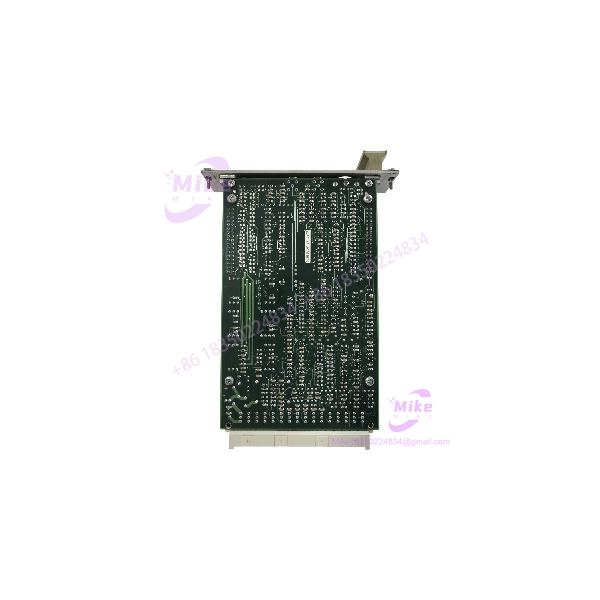
EPRO MMS6120 | Dual Channel Vibration Monitor
Product Introduction
A turbine or compressor rarely gives you the luxury of waiting for a bearing failure before taking action. The useful information comes earlier — vibration amplitude, alarm thresholds, sensor condition, and changes in the mechanical signature. The EPRO MMS6120 is built specifically for that job: two independent channels continuously evaluate bearing vibration and provide protection-system outputs for rotating machinery.
The module accepts signals from compatible electrodynamic vibration sensors and processes each channel independently. Measurement values can be configured through the monitoring software, while RS-232 provides local configuration and readout and RS-485 allows integration with the broader MMS diagnostic architecture. The unit also uses redundant 24VDC power inputs, an important detail when the monitoring system itself is expected to remain available during a supply disturbance.
The MMS6120 is not a general-purpose PLC input card. It is a dedicated machine-protection instrument — designed around bearing vibration rather than generic analog I/O.
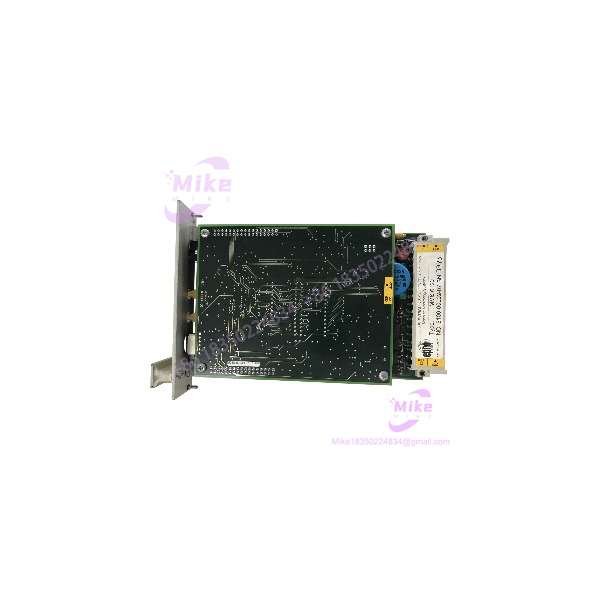
MMS6120
Key Technical Specifications
- Model: EPRO MMS6120
- Series: MMS 6000
- Order Number: 9100-00002
- Function: Dual-channel bearing vibration monitoring
- Measurement Channels: 2 independent channels
- Sensor Type: Electrodynamic vibration velocity sensors
- Compatible Sensor Family: EPRO PR 9266 / PR 9268 series
- Power Supply: 18–31.2 VDC
- Power Consumption: Maximum 6 W
- Typical 24VDC Current: Approximately 250 mA
- Communication: RS-232 and RS-485
- Local Interface: RS-232 for configuration and measurement readout
- System Interface: RS-485 for connection to the EPRO diagnostic system
- Input Resistance: Greater than 100 kΩ
- Logic Input Range: −5 to +15 VDC
- Voltage Inputs: Two, one per channel
- Voltage Input Range: 0–10 V
- Voltage Input Resolution: 10-bit
- Keypulse Input: Minimum pulse duration approximately 10 µs
- Keypulse Accuracy: Approximately ±0.5% full scale
- Lifting-Coil Current Output: 0–8 mA, configurable in 40 µA steps
- Measurement Frequency Range: Approximately 10–1000 Hz for the applicable voltage-input measurement path
- Physical Format: DIN 41494 PCB/EURO card format
- Width: 30 mm / 6 TE
- Height: 128.4 mm / 3 HE
- Length: 160 mm
- Net Weight: Approximately 320 g
- Rack Capacity: Up to 14 modules / 28 channels in a 19-inch rack
- Configuration: Via RS-232 or RS-485
- Alarm Functions: Separate alarm and danger processing for each channel
The original technical documentation identifies the MMS6120 as a dual-channel bearing vibration monitor and specifies the 9100-00002 order number. It also identifies the module’s 6 TE × 3 HE DIN 41494 card format and 19-inch rack installation arrangement.
Application Scenarios & Pain Points
Steam Turbine Bearing Protection
For a steam turbine, bearing vibration is not a cosmetic maintenance parameter. It can become an early indication of mechanical imbalance, alignment problems, looseness, or developing bearing-related faults.
The MMS6120 monitors two independent channels, allowing separate bearing locations or measurement directions to be evaluated without adding another monitoring card.
That keeps the protection architecture modular.
Compressor Trains
A compressor train can accumulate enormous operating hours while remaining mechanically stable — until a vibration trend starts moving.
Without dedicated bearing monitoring:
The control system may only see process variables such as pressure, temperature, flow, or speed.
With an -based monitoring layer:
Bearing vibration becomes a dedicated machine-health signal with configurable alarm and danger thresholds.
That distinction matters when process values still look normal while mechanical condition is deteriorating.
Sensor-Chain Fault Detection
A vibration monitor is only useful when the sensor circuit itself can be trusted.
The includes sensor self-check and measurement-chain fault detection functions. Alarm processing can therefore distinguish between an abnormal machine condition and a problem affecting the measurement circuit — a useful distinction during plant maintenance.
Legacy MMS 6000 Rack Replacement
The card format is unusually compact: 30 mm wide and 128.4 mm high, with up to 14 modules fitting into a standard 19-inch rack.
That makes the practical for maintaining older modular machine-monitoring cabinets where changing the entire rack architecture would create unnecessary engineering work.
Distributed Diagnostic Architecture
The module can operate as part of the broader MMS 6000 monitoring system. RS-485 provides the system communication path, while RS-232 is available for local configuration and measurement readout.
In other words, it can serve both roles: local service instrument and rack-level machine-monitoring node.
QA & Live Testing SOP
With an , a meaningful inspection goes beyond checking whether the front LEDs illuminate.
Our engineering acceptance sequence should include:
- Identity verification: Confirm marking, order number, revision information, and nameplate details.
- Mechanical inspection: Examine the PCB/card edge, front panel, connectors, mounting hardware, and enclosure for damage or contamination.
- Power inspection: Check both available 24VDC supply paths and verify correct polarity before energization.
- Controlled power-up: Energize the module on an appropriate MMS-compatible test rack or laboratory fixture.
- Channel verification: Apply a controlled vibration-equivalent input or suitable electrical test signal to each channel independently.
- Alarm testing: Verify the configured alarm and danger outputs using known input levels rather than relying only on the front indicators.
- Communication test: Exercise the RS-232 configuration interface and verify RS-485 communication where the required system hardware is available.
- Sensor-chain test: Confirm that the input circuit responds correctly and that fault/self-test behavior operates as expected.
- Configuration retention: Verify that configured measurement parameters remain available after a controlled power cycle.
- Thermal observation: Monitor the module during extended operation for abnormal heating or unstable behavior.
- ESD-safe packaging: Protect the card edge, connectors, and electronics during final handling and shipment.
For a legacy , this type of functional test is much more useful than a simple continuity check. The objective is to establish that both measurement channels, protection logic, communications, and power-input architecture behave as expected.
Field Engineer’s Pitfall Guide
❗ Do Not Substitute It With a Generic Analog Input Card
The is engineered around vibration measurement and machine protection. Its sensor inputs, processing, alarm logic, and diagnostic functions are not equivalent to dropping a 4–20 mA analog-input card into the rack.
The mechanical signal chain matters.
❗ Verify the Sensor Before Installing the Monitor
The documented architecture is intended for compatible EPRO vibration sensors, including the PR 9266 and PR 9268 families.
Do not assume that any vibration transmitter can be wired directly into the card. Sensor excitation, signal characteristics, scaling, and connection arrangement must agree with the configured monitoring system.
❗ Check the Configuration Before Recommissioning the Machine
A replacement can be electrically healthy while still being configured incorrectly for the machine.
Check:
- Measurement range
- Alarm threshold
- Danger threshold
- Channel assignment
- Sensor configuration
- Keypulse settings where used
- Output behavior
- Communication parameters
A wrong alarm threshold can turn a healthy machine into a nuisance-trip problem — or worse, suppress an alarm that should have been active.
❗ Do Not Ignore the Dual Power Inputs
The module supports redundant power input architecture. Verify both supply paths and the cabinet’s actual wiring before assuming that redundancy is functional.
One energized input does not prove the complete power arrangement is healthy.
Intent-Driven FAQ
What is the EPRO used for?
The is a dual-channel bearing vibration monitor for rotating machinery. It measures vibration from two independent channels and provides alarm/protection functions for machine-monitoring applications.
Is the part of the MMS 6000 system?
Yes. The belongs to the EPRO MMS 6000 machine-monitoring family and can operate as part of a larger monitoring and diagnostic architecture.
What sensors work with the ?
The documented system is designed for compatible EPRO electrodynamic vibration sensors, including the PR 9266 and PR 9268 families. Confirm the exact sensor variant and connection arrangement before replacing an installed module.
Does the have RS-232?
Yes. RS-232 provides a local configuration and readout interface. The module also provides RS-485 for communication with the associated diagnostic architecture.
What power supply does the require?
The documented supply range is 18–31.2 VDC, with maximum power consumption of approximately 6 W. The module supports redundant power input, so the complete cabinet wiring should be checked when commissioning a replacement.
Can the monitor two bearings at the same time?
Yes. It has two independent measurement channels, allowing two vibration signals to be processed simultaneously.
Can the be replaced while the system is operating?
The technical documentation describes the module as replaceable during operation. However, that does not mean every installation should be physically removed under energized conditions. The rack design, protection philosophy, sensor wiring, and plant safety procedure must explicitly permit live replacement before doing so.
What is the physical size of the ?
The module follows the DIN 41494 PCB/EURO format and is approximately 30 mm wide × 128.4 mm high × 160 mm long, occupying 6 TE and 3 HE.
Is a PLC module?
No. It is a machine-monitoring and bearing-vibration protection module, not a conventional PLC CPU or general-purpose I/O module. Its processing is dedicated to vibration measurement, alarm handling, sensor diagnostics, and associated monitoring functions.
What should I verify before ordering an replacement?
Verify the complete model marking, order number, hardware revision, sensor type, configuration parameters, rack compatibility, power arrangement, and communication setup. If the installed system depends on a particular alarm philosophy, copy the existing configuration before removing the original card whenever the maintenance procedure allows it.
Bottom line: the is a specialized two-channel machine-protection card for bearing vibration monitoring. For legacy turbine, compressor, fan, gearbox, or other rotating-equipment installations, matching the sensor interface and configuration is just as important as matching the model number.





