Description
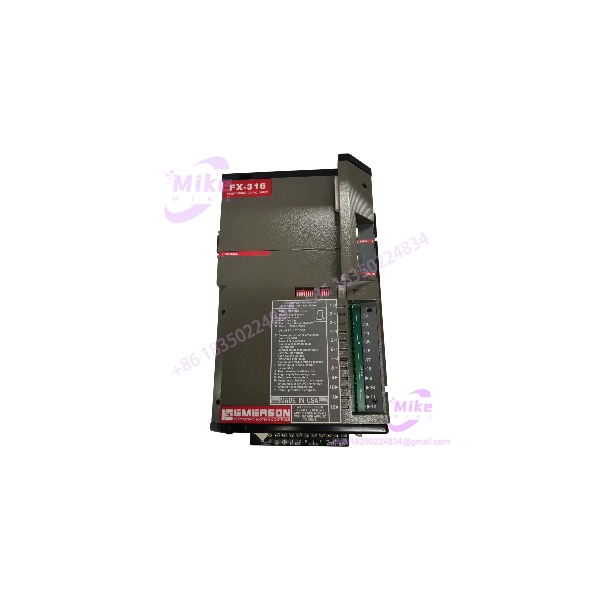
Emerson FX-316 | 230V Positioning Servo Drive
Dynamic Product Introduction
The Emerson FX-316 is a legacy positioning servo drive built for applications where the controller needs more than simple motor start/stop control. It combines power amplification, motor feedback, motion parameters, indexing functions, and machine I/O within a dedicated servo architecture. For the FX-316, the intended motor pairing is the DXM/E-316 family, with the documented combination providing 16 lb-in continuous torque, 32 lb-in peak torque, and motor speeds up to 4,000 RPM.
This distinction matters when sourcing one today. The FX-316 should not be treated as a generic 230 VAC servo replacement simply because the voltage and current appear similar. The resolver interface, motor constants, feedback wiring, motion parameters, and amplifier-to-motor matching all belong to the original FX/DX architecture. Emerson’s manual specifically documents resolver cabling between the FX-316 and the motor, including a 9-pin D-type connector at the amplifier.
For a maintenance department supporting older automation equipment, an exact FX-316 can therefore be considerably more useful than an apparently newer drive that requires a complete controls retrofit. Honestly, the value here is compatibility with an existing motion system—not simply the amplifier’s electrical rating.
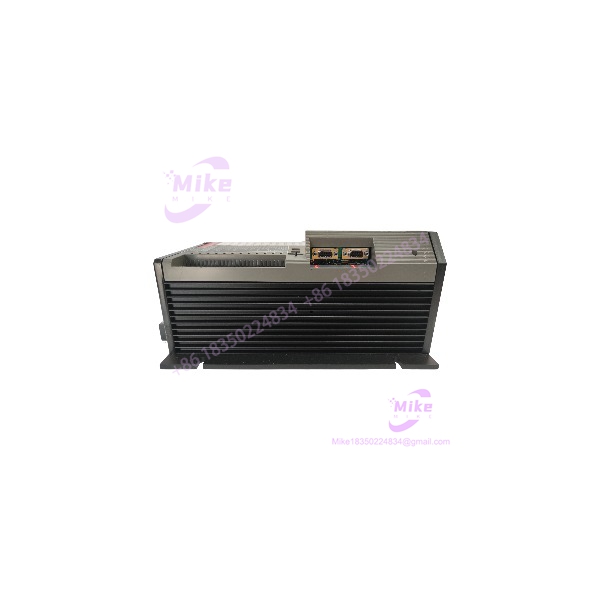
FX-316
Key Technical Specifications
- Manufacturer: Emerson Motion Control
- Series: FX Series
- Model: FX-316
- Drive Type: Positioning servo amplifier
- Input Voltage: 230 VAC nominal
- Continuous Amplifier Current: 4 A
- Peak Amplifier Current: 8 A
- Continuous Torque: 16 lb-in
- Peak Torque: 32 lb-in
- Matched Motor: DXM/E-316
- Maximum Speed: 4,000 RPM with the corresponding DXM/E-316 motor
- Feedback: Resolver
- Serial Interface: Optically isolated RS-423
- Protocol Compatibility: RS-423 interface is signal-compatible with RS-232C and RS-422
- Motion Functions: Positioning, indexing, velocity-related setup, I/O functions, and motion parameter configuration
- Logic AC Input Protection: Internal protection provided within the FX drive architecture
- Recommended External Bridge Fuse: 15 A
- Recommended External Logic Fuse: 5 A
- Typical AC Line Ampacity: 10 A for the FX-316
- Recommended Minimum AC Line Wire: 16 AWG for installations under 50 ft, subject to the actual installation and applicable electrical code
The original Emerson manual specifies a 15 A external bridge fuse and 5 A logic fuse for the FX-316, with typical AC line ampacity of 10 A. Emerson also specifically recommends external fusing rather than relying solely on the drive’s internal protection.
The FX-316’s serial interface is important during commissioning because the manual describes bidirectional communication with an external controller or computer. Motion parameters, I/O functions, operating modes, indexes, and setup parameters can be configured through this interface.
Global Sourcing & Live-Test SOP
For an FX-316, incoming inspection needs to cover the complete servo chain, not just the amplifier. A unit can pass a basic power-up test while still having a resolver interface problem, degraded output stage, configuration issue, or incompatibility with the intended motor.
1. Inbound identity verification
- Confirm the front nameplate reads FX-316.
- Record any additional Emerson part number or revision marking.
- Inspect the AC input terminals and power section for overheating.
- Examine the motor-output terminals for discoloration or loose hardware.
- Inspect the resolver connector for bent pins or mechanical damage.
- Check serial communication connectors and control terminals.
- Inspect the heatsink and cooling path for contamination.
- Photograph the complete unit before functional testing.
Do not substitute a visually similar FX-series model without checking the motor and electrical configuration.
2. Controlled power-up
Apply the appropriate AC supply through a controlled test arrangement.
Verify:
- Normal startup behavior
- Status indicators
- No immediate drive fault
- No abnormal current draw
- No unusual audible or thermal behavior
- Correct response from the control interface
The FX family uses different power and current ratings across models, so the FX-316’s documented 230 VAC configuration and protection requirements should be used for the test setup.
3. Resolver feedback verification
The resolver circuit deserves special attention.
The documented ECF feedback cable for the FX-316 uses a 9-pin D-type connector at the amplifier and an MS-style motor connector. The wiring carries resolver reference, cosine, sine, thermistor, and shield connections.
Check:
- Resolver connector integrity
- Cable continuity
- Shield termination
- Reference signal wiring
- Sine/cosine feedback wiring
- Motor thermistor circuit
- Correct motor-side connector
- Secure connector locking
A resolver wiring fault can make a healthy amplifier appear to have a motor or control failure.
4. Motor compatibility check
Before applying motion commands, verify the motor model.
The documented FX-316 pairing is the DXM/E-316 family. The manual lists the DXM/E-316 at 4,000 RPM maximum speed and 16 lb-in continuous torque / 32 lb-in peak torque when paired with the appropriate FX amplifier.
Do not assume that another DX motor can be substituted simply because its connector physically mates.
5. Motion and I/O test
Run controlled tests for:
- Enable/disable behavior
- Fault reset
- Motor direction
- Velocity command
- Position/index command
- Acceleration and deceleration
- End-of-index indication
- Machine I/O functions
- Resolver feedback
- Limit and inhibit inputs
- Stop behavior
The FX documentation includes programmable index functions and motion parameters, so the test should reproduce the actual operating mode whenever possible.
6. Serial communications test
Where the original machine depends on computer-based setup, confirm communication through the FX serial interface.
The documented interface supports bidirectional communication and configuration of motion parameters, I/O functions, operating modes, indexes, and setup parameters.
Record the communication hardware and software used during testing. With legacy servo systems, that information can be just as important as the amplifier itself.
7. Extended heat run
Operate the FX-316 under representative load conditions for an extended period, preferably around 24 hours for a production spare when the procurement SOP calls for a burn-in.
Monitor:
- Drive temperature
- Fault status
- Motor current
- Resolver stability
- Position repeatability
- Cooling behavior
- Intermittent communication faults
8. Final inspection record
Document the exact FX-316 model, revision, matched motor, resolver cable configuration, test software/interface, measured operating behavior, and any restrictions.
That record should remain attached to the spare’s procurement history.
Field Engineer’s Pitfall Guide
1. Do not buy the FX-316 by current rating alone.
A 4 A continuous rating does not make every 4 A servo amplifier a valid replacement. The FX-316 is part of a specific Emerson FX/DX motion architecture, including resolver feedback and matched DX motor characteristics.
I’ve seen legacy servo replacements fail at commissioning because the purchaser matched voltage and current but ignored feedback technology.
2. Resolver wiring is part of the drive system.
The FX-316’s ECF cable carries multiple resolver and thermal-monitoring signals. Emerson’s documentation specifies a dedicated 9-pin D connection at the amplifier.
Do not treat the feedback cable as an ordinary motor cable. Check the resolver pinout, shield, thermistor conductors, connector type, and cable length before commissioning.
3. Check external protection before applying power.
The original Emerson documentation calls for external fusing and specifies a 15 A bridge fuse and 5 A logic fuse for the FX-316. It also gives a typical 10 A AC line ampacity.
If a replacement drive arrives with an unknown installation history, do not simply reconnect the existing incoming wiring and assume the protection is correct. Verify the actual cabinet wiring and applicable electrical requirements first.
Intent-Driven FAQ
1. What is the Emerson FX-316?
The Emerson FX-316 is a 230 VAC positioning servo amplifier from the FX Series. It is designed for closed-loop motion control with compatible DX-series servo motors rather than serving as a conventional PLC or general-purpose AC motor drive.
2. What motor is normally matched with the FX-316?
The documented motor pairing is the DXM/E-316. The FX-316/DXM-E-316 combination is specified for up to 4,000 RPM, with 16 lb-in continuous torque and 32 lb-in peak torque.
3. What is the continuous current rating of the FX-316?
The FX-316 amplifier is rated at 4 A continuous current, with the documented amplifier table listing 8 A peak current.
4. Does the FX-316 use resolver feedback?
Yes. The Emerson documentation specifies resolver connections and an ECF feedback cable for the FX-316 through the larger FX drive models. The amplifier-side connector is a 9-pin D-type connector.
5. Can the FX-316 be configured from a computer?
Yes. The FX drive provides an optically isolated RS-423 serial interface that is signal-compatible with RS-232C and RS-422. Emerson documentation describes configuration of motion parameters, I/O functions, operating modes, indexes, and setup parameters through this interface.