

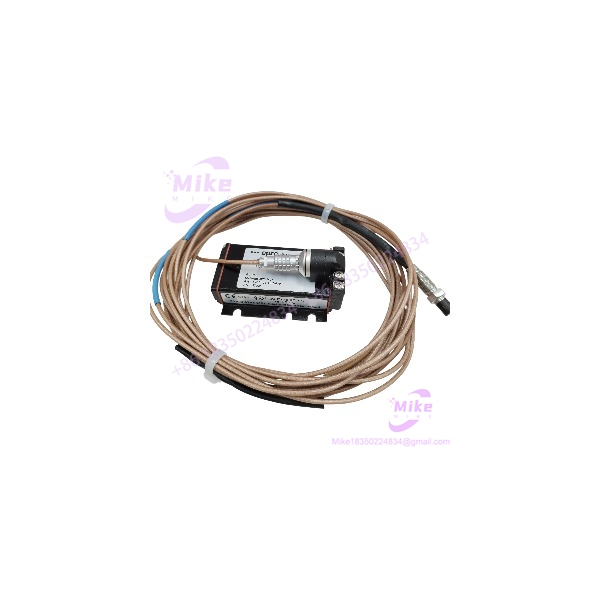
Description
Emerson Epro PR6423/10R-030-CN+CON021 | Eddy Current Sensor Kit, New
Architect’s Product Breakdown
The Emerson Epro PR6423/10R-030-CN+CON021 sensor combination forms a complete, high-precision measurement loop designed for critical rotating equipment monitoring, including steam turbines, large centrifugal gas compressors, and heavy gearboxes. Built with a reverse-mount mechanical housing, the PR6423/10R-030-CN probe tip measures high-frequency air-gap variations between its PEEK face and the target shaft. The paired CON021 signal converter conditions these raw electromagnetic fluctuations into a proportional, linear voltage output suitable for rack-mounted machinery protection systems.
Successfully deploying this sensor assembly requires strict adherence to system capacitance limits and ground topology standards. Because the high-frequency coaxial lead length (3.0 meters on this model) is integral to the total circuit tuning, cutting or splicing the cable will alter total loop capacitance and invalidate factory calibration curves. Field engineers must ensure that the CON021 driver module is mounted on a vibration-isolated DIN rail outside high-temperature bearing housing zones to maintain long-term signal stability and prevent measurement drift.
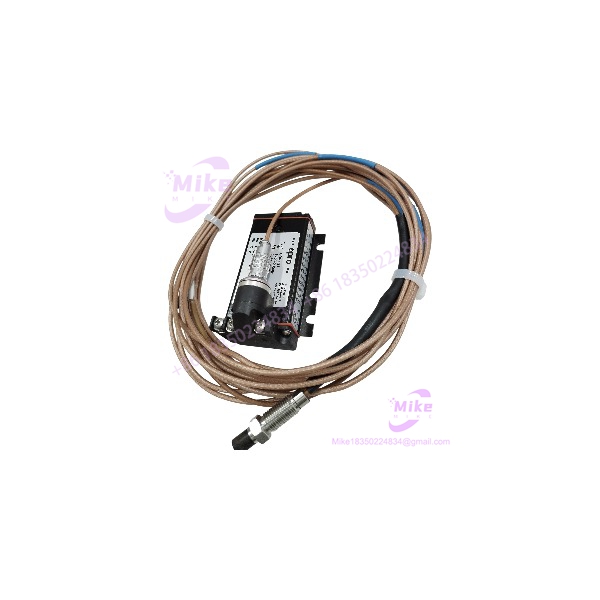
PR6423/10R-030-CN+CON021
Key Technical Specifications
| Parameter | Specification Details |
| System Components | PR6423/10R-030-CN Probe + CON021 Signal Converter |
| Probe Tip Diameter | 8 mm PEEK tip profile |
| Mounting Configuration | Reverse mount thread housing |
| Integrated Cable Length | 3.0 meters (30 dm) high-frequency coax |
| Supply Voltage | –24 VDC nominal (–18 VDC to –30 VDC operating range) |
| Sensitivity / Scale Factor | –8 V/mm (–203.2 mV/mil) nominal |
| Linear Measurement Span | 2.0 mm (nominal operating window) |
| Nominal Gap Voltage | –12 VDC (center of linear range) |
| Frequency Response | 0 Hz to 10,000 Hz (-3 dB bandwidth) |
| Operating Temperature | Probe: –35°C to +180°C |
Field Engineer’s Pitfall Guide (Unique Value)
- Coaxial Cable Splicing and Capacitance Shift: Modifying or splicing the integrated 3.0-meter coaxial lead to fit tight cabinet runs ruins total loop capacitance and shifts the calibration slope. I once spent two full days troubleshooting false vibration alarms on a turbine commissioning job, only to discover a site contractor had cut and terminal-blocked a probe lead, introducing severe high-frequency noise into the CON021 converter.
- Improper Grounding and Shield Loops: Grounding the signal shield at both the driver housing and the machine housing creates earth loops that superimpose 50/60 Hz hum onto the vibration signal. Always isolate the probe shield at the machine gland and ground strictly at the monitoring rack power supply end.
- Incorrect Resting Gap Setup: Failing to set the mechanical static gap to the nominal -12 VDC voltage point during installation pushes the sensor output near the saturation knees, leading to signal clipping during high dynamic vibration events.
QA & Testing SOP (Transparency)
- Visual & Origin Inspection: Verification of OEM factory seals, part number alignment, thread integrity, and Lemo connector condition.
- Live Test Environment: Bench testing the probe and CON021 converter on a micrometer target stand powered by a regulated -24 VDC power supply.
- Diagnostics & Calibration Verification: Verifying static gap voltages, dynamic linearity across the full 2.0 mm span, and high-frequency noise rejection.
- Documentation & ESD Packaging: Logging test results, placing protective caps over optical/coaxial tips, sealing in static-shielding bags, and packing inside custom foam.
Technical FAQ
- Can I shorten or extend the integrated 3.0-meter cable on the PR6423/10R-030-CN probe? No. Eddy-current systems are factory-calibrated to a specific total cable capacitance. Altering cable length shifts circuit resonance and completely invalidates measurement accuracy.
- What is the purpose of the reverse-mount option on this probe model? The reverse-mount design allows installation through internal brackets or tight bore holes where external threading access is blocked by surrounding machine casings.
- Does the CON021 converter require a separate ground isolation panel? The CON021 driver housing should be isolated from local machine earth to prevent ground loops; mounting on isolated DIN rail channels inside junction boxes is standard practice.
- Is the sensor system compatible with non-magnetic shaft materials? Standard factory calibration assumes a 42CrMo4 steel target; if measuring shafts made of stainless steel or monel, a custom calibration curve must be applied in the monitoring rack system.





