Description
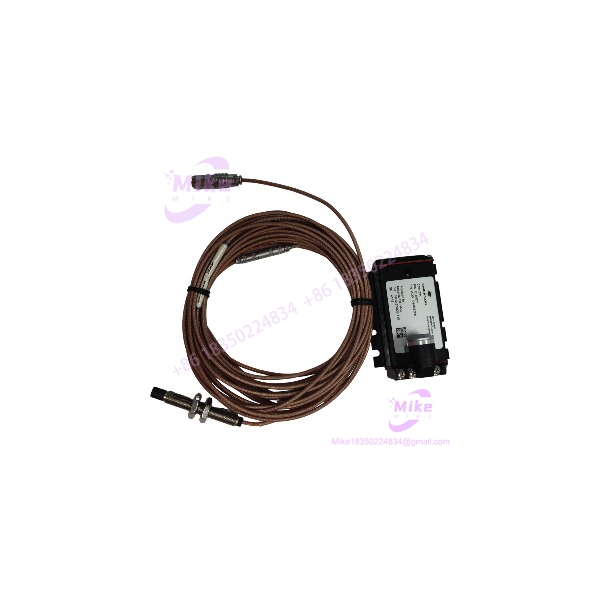
Emerson Epro PR6423/003-110+CON021 | Eddy Current Proximity System, New
Architect’s Product Breakdown
The Emerson Epro PR6423/003-110+CON021 pairing forms a complete, factory-tuned proximity measurement chain designed to protect critical turbomachinery, such as large steam turbines, boiler feed pumps, and high-pressure gas compressors. By combining the PR6423/003-110 8mm probe with its matched CON021 signal converter, this assembly converts tiny electromagnetic air-gap changes between the sensor tip and the target shaft into a proportional, highly linear voltage output. The resulting signal routes directly into machinery protection racks to flag rotor unbalance, shaft alignment errors, or oil whirl before mechanical breakdown occurs.
Deploying this matched system demands strict attention to overall loop tuning and field installation standards. Because the extended 11.0-meter integrated coaxial lead is an active capacitive component of the high-frequency driver circuit, shortening, cutting, or splicing the cable will destroy system impedance and invalidate factory calibration curves. Field engineers must ensure the CON021 driver is installed on an isolated DIN rail inside a dry local junction box while keeping high-frequency signal cabling physically separated from motor feeds and VFD outputs to eliminate noise pickup.
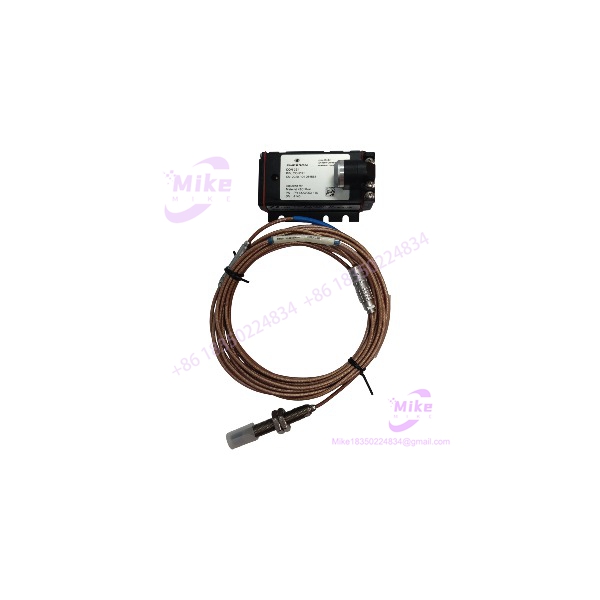
PR6423/003-110+CON021
Key Technical Specifications
| Parameter | Specification Details |
| System Components | PR6423/003-110 Probe + CON021 Signal Converter |
| Probe Tip Diameter | 8 mm PEEK profile |
| Integrated Cable Length | 11.0 meters high-frequency coaxial lead |
| Supply Voltage | –24 VDC nominal (–18 VDC to –30 VDC operating range) |
| Sensitivity / Scale Factor | –8 V/mm (–203.2 mV/mil) nominal |
| Linear Measurement Span | 2.0 mm operating window |
| Nominal Static Gap Voltage | –12 VDC (center of linear range) |
| Frequency Response | 0 Hz to 10,000 Hz (-3 dB bandwidth) |
| Operating Temperature | Probe: –35°C to +180°C |
| Enclosure Protection | IP66 (Probe Head) / IP20 (CON021 Module) |
Field Engineer’s Pitfall Guide (Unique Value)
- Coaxial Cable Splicing and Length Alterations: Trimming or splicing the 11.0-meter coaxial lead to neaten up long cable trays alters total circuit capacitance and destroys calibration accuracy. I once spent an entire 12-hour shift on a compressor train debugging erratic vibration spikes, only to discover a site contractor had cut two meters off an 11-meter lead to fit a terminal box, injecting severe high-frequency noise into the CON021 driver.
- Shield Ground Loops at Field Enclosures: Tying the coaxial shield to local earth at both the probe gland and the driver housing creates ground loops that inject 50/60 Hz power line noise into the vibration channel. Always maintain floating shield isolation at the machine entry point and ground strictly at the signal converter or monitoring rack power supply end.
- Improper Resting Gap Voltage Setup: Failing to adjust the static mechanical gap to the nominal -12 VDC midpoint during cold machine alignment will push the output voltage into non-linear saturation when the shaft undergoes thermal expansion under load.
QA & Testing SOP (Transparency)
- Visual & Origin Verification: Inspection of OEM packaging seals, thread structural integrity, PEEK tip encapsulation, and coaxial connector contacts.
- Live Test Environment: Bench testing the PR6423/003-110 probe and CON021 converter combination on a precision micrometer target stand powered by a regulated -24 VDC bench supply.
- Diagnostics & Linearity Check: Verifying static gap voltages, checking sweep linearity across the 2.0 mm operating span, and measuring signal noise floors.
- Documentation & ESD Packaging: Logging calibration verification data, installing protective caps over connectors, and sealing components inside static-shielding bags with custom protective packaging.
Technical FAQ
- Can I trim the 11.0-meter cable on the PR6423/003-110 probe to fit my junction box? No. The 11.0-meter cable length is an integral part of the total resonant circuit. Altering cable length changes system impedance and completely ruins measurement accuracy.
- Does synthetic lubricating oil inside the bearing housing interfere with the measurement? No, non-conductive mineral or synthetic lubricating oil spray does not disrupt the eddy-current electromagnetic field.
- What happens if my shaft material is stainless steel instead of carbon steel? Standard factory calibration is tuned against standard 42CrMo4 carbon steel targets; alternative metallurgy changes magnetic permeability, requiring custom scale factor adjustments inside your monitoring system.
- Can the CON021 signal converter output a direct 4-20 mA current loop? The standard CON021 converter outputs a proportional voltage signal; generating a 4-20 mA current loop requires a transmitter module or a dedicated rack channel card interface.