

Description
Emerson Epro PR6423/003-030 | Eddy Current Proximity Probe, New
Architect’s Product Breakdown
The Emerson Epro PR6423/003-030 sensor probe operates as a frontline measurement transducer designed to capture critical microscopic physical displacements inside industrial turbomachinery, such as large steam turbines, high-pressure centrifugal compressors, and boiler feed pumps. By establishing a high-frequency electromagnetic field at its PEEK-encapsulated tip, this sensor monitors air-gap distance fluctuations between the probe face and the rotating metallic shaft. These physical shifts are translated into voltage changes that feed into rack-mounted monitor cards, allowing plant engineers to detect rotor unbalance, oil whirl, or bearing wear before catastrophic failure occurs.
Successfully deploying this specific model demands meticulous attention to mechanical thread alignment and coaxial cable routing constraints within tight machinery casings. Because eddy-current systems rely on precise electrical impedance matching across the complete circuit loop, replacing a damaged probe requires pairing the exact sensor geometry with compatible signal driver units. Field technicians must also isolate the high-frequency lead from variable frequency drive lines and high-voltage motor cables to prevent electrical noise induction from distorting the vibration spectrum.
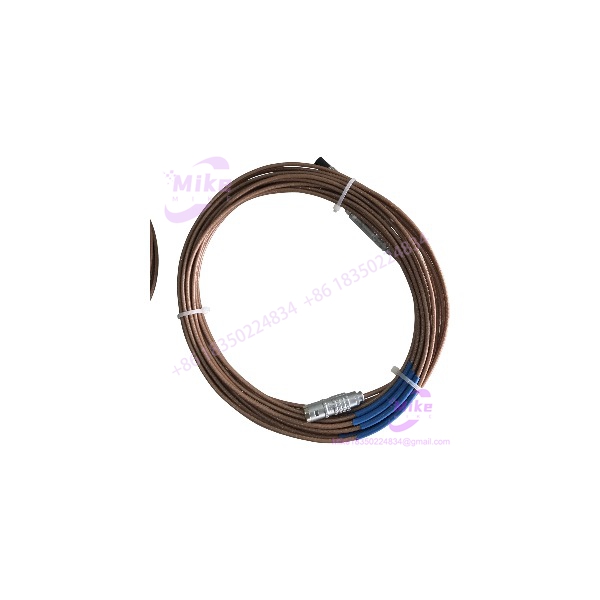
PR6423/003-030
Key Technical Specifications
| Parameter | Specification Details |
| Sensor Tip Diameter | 8 mm |
| Thread Specification | Standard thread housing configuration |
| Integrated Cable Length | 3.0 meters high-frequency coaxial lead |
| Sensitivity / Scale Factor | 8 V/mm (203.2 mV/mil) |
| Linear Measurement Span | 2.0 mm operating window |
| Nominal Static Gap Voltage | -12 VDC |
| Frequency Response | 0 Hz to 10,000 Hz (-3 dB bandwidth) |
| Supply Voltage | -24 VDC system power via signal converter driver |
| Operating Temperature | -35°C to +180°C (probe head environment) |
| Enclosure Protection | IP66 rated assembly when properly sealed |
Field Engineer’s Pitfall Guide (Unique Value)
- Coaxial Cable Splicing and Capacitance Alteration: Never cut, splice, or alter the length of the integrated coaxial lead. Changing the cable length modifies total circuit capacitance, shifting the calibration slope and causing severe measurement errors. I once spent an entire turnaround shift troubleshooting erratic vibration spikes on a compressor train, only to discover a contractor had repaired a nicked cable with a generic terminal block, injecting massive high-frequency noise into the monitoring channel.
- Incorrect Static Gap Adjustment: Failing to adjust the mechanical resting gap to the target -12 VDC midpoint during initial installation causes signal clipping when the rotor undergoes thermal expansion under load.
- Thread Sealing Compound Contamination: Applying liquid thread lockers or RTV sealants too close to the probe tip fouls the PEEK face, resulting in subtle DC voltage drift and false diagnostic alarms.
QA & Testing SOP (Transparency)
- Visual & Origin Verification: Inspection of OEM packaging, part number tags, thread casting integrity, and PEEK tip physical condition.
- Live Test Environment: Bench testing the probe on a calibrated micrometer target stand paired with a matching signal converter powered by a regulated -24 VDC bench supply.
- Diagnostics & Linearity Check: Verifying static gap output voltage, dynamic sweep response across the full linear range, and signal noise floor stability.
- Documentation & ESD Packaging: Archiving calibration verification data, placing protective caps over the Lemo connector, and sealing the unit inside static-shielding bags.
Technical FAQ
- Can I connect this probe directly to a standard PLC analog input card? No. Eddy-current probes generate high-frequency impedance shifts that require a dedicated signal converter driver card to output a scaled voltage or 4-20 mA signal.
- Does lubricating oil inside the bearing housing interfere with the measurement? No, non-conductive mineral or synthetic lubricating oil does not disrupt the eddy-current electromagnetic field.
- What happens if my shaft material is stainless steel instead of carbon steel? Standard factory calibration is tuned against carbon steel targets; alternative metallurgy changes the sensitivity slope, necessitating custom offsets in your monitoring system.
- Is this model backward compatible with older monitoring racks? Yes, provided the channel card supports standard 8 V/mm proximity inputs and matches the system power supply voltage requirements.





