


Description
Emerson Epro CON041 | Eddy Current Signal Converter
Architect’s Product Breakdown
The Emerson Epro CON041 functions as a high-precision signal converter designed to interface directly with industrial eddy current displacement probes (such as Epro PR6422, PR6423, PR6424, PR6425, and PR6426 series sensors). Deployed extensively across critical turbomachinery installations—including steam, gas, and hydro turbines, large industrial compressors, and feed pumps—this module accurately translates magnetic field variations into dependable data for radial/axial shaft displacement, vibration, eccentricity, and rotational speed measurements.
Maintaining signal linearity and minimal phase shift is vital in high-speed rotating equipment protection loops. Utilizing unverified or mismatched signal converters introduces calibration drift and voltage scaling errors that corrupt machinery health monitoring systems. Integrating the OEM-specified CON041 ensures strict impedance matching, stable dynamic performance, and seamless integration with rack-based monitoring frameworks.
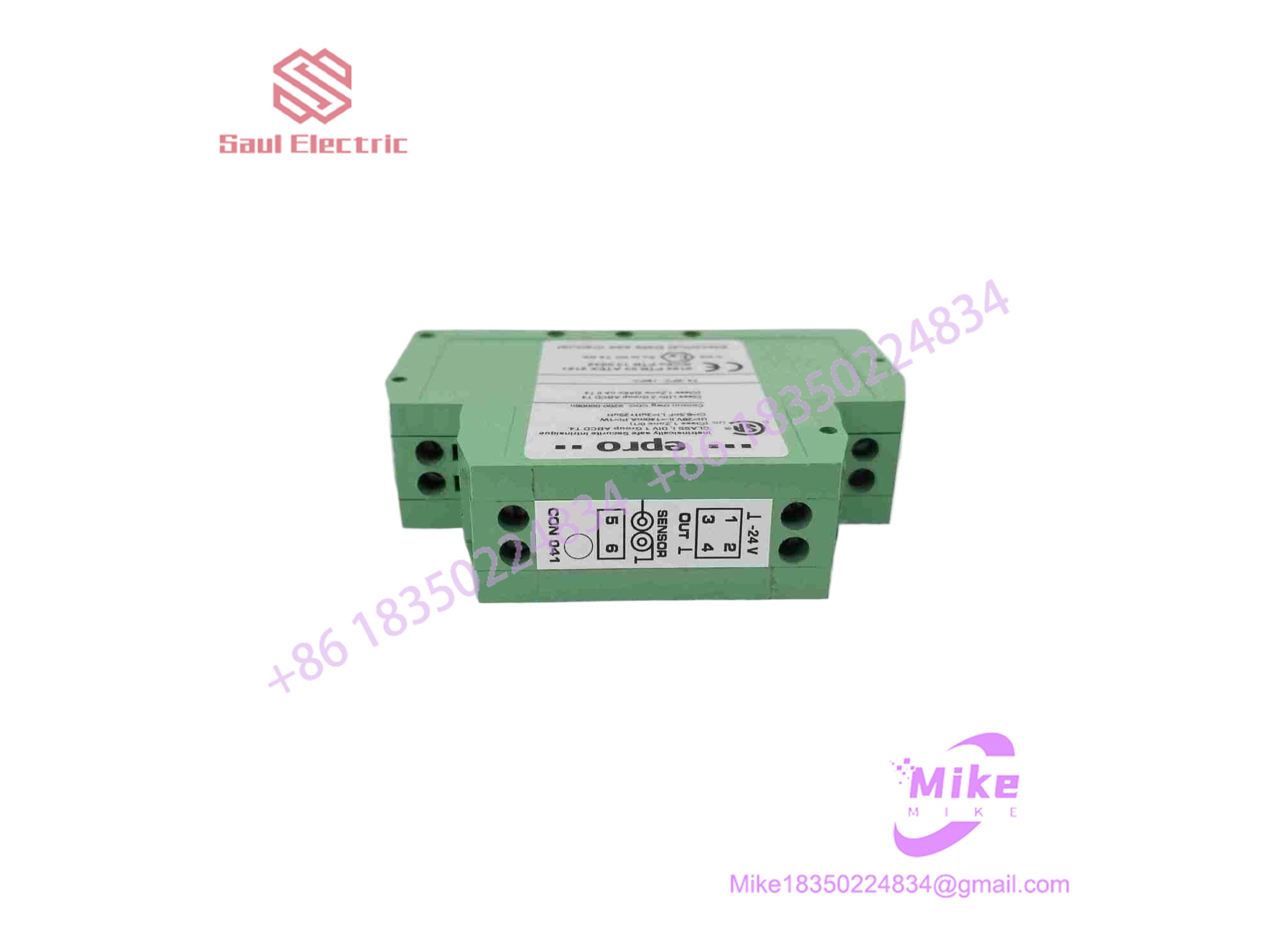
CON041
4. Key Technical Specifications
| Parameter | Technical Specification |
| System Compatibility | Epro eddy current sensors (PR6422, PR6423, PR6424, PR6425, PR6426) |
| Module Type | Eddy Current Signal Converter / Driver |
| Measurement Range | 1.0 mm to 24.0 mm (dependent on connected sensor type) |
| Frequency Response (-3 dB) | 0 to 20,000 Hz |
| Signal Rise Time | < 15\ \mus |
| Supply Voltage Range | -23V to -32V (Output Range -4V to -20V) or -21V to -32V |
| Housing Material | PA 6.6 industrial polymer |
| Operating Temperature | -30°C to +100°C (-22°F to +212°F) |
| Mounting Standard | DIN-rail mounting profile |
| Ingress Protection | IP20 |
Field Engineer’s Pitfall Guide (Unique Value)
- Warning: Extension Cable Length Matching: Ensure the total electrical length of the probe and extension cable matches the calibration design of the CON041 converter. Mixing mismatched cable lengths (e.g., pairing a 5-meter probe setup with a 1-meter calibrated driver) introduces severe linearization errors in your vibration readings.
- Warning: Power Supply Ripple: The CON041 relies on a stable negative DC supply voltage. Excessive power supply ripple or noise injected from nearby heavy inductive relay circuits will translate directly into background electrical noise on your shaft vibration waveforms, triggering false high-vibration alarms.
- Warning: Terminal Tightening Torque: Do not over-torque the screw clamp terminals when landing fine-stranded signal wires. Overtightening can shear copper strands or crack the terminal block housing, resulting in intermittent open-circuit faults under thermal cycling.
QA & Testing SOP (Transparency)
- Visual & Origin Inspection: Inspected for original Emerson/Epro manufacturing badges, correct housing integrity, and clean terminal connection blocks.
- Powered Bench Test: Energized on a controlled test rig using a regulated negative power supply to verify proper baseline voltage output and internal regulation.
- Static & Dynamic Calibration: Evaluated using a precision target simulation kit to confirm linear output response across standard displacement gaps.
- Packaging: Sealed in anti-static, moisture-barrier shielding bags protected with high-density foam inserts prior to shipment.
Technical FAQ
Can the CON041 be used with non-Epro eddy current probes?
No. The is electronically tuned to match the specific internal inductance, capacitance, and resistance curves of Epro sensor types (such as the PR6423 series). Using third-party probes will disrupt system linearity and destroy measurement accuracy.
Does the require calibration adjustments upon installation?
Generally, no. Because the probe, extension cable, and converter are factory-calibrated as a matched electrical chain, swapping out a failed converter with an exact OEM replacement part number restores correct system calibration without field adjustments.
What causes a sudden -24V rail saturation or zero-output fault code?
A saturated or zero output typically indicates a severed probe tip cable, an internal short-circuit in the high-frequency oscillator circuit, or an out-of-range target gap distance where the shaft has moved completely outside the linear measurement window.
Is the suitable for hazardous area installations?
The standalone unit is housed in an IP20 enclosure and must be installed within a secure local marshalling cabinet or control room environment, utilizing appropriate intrinsic safety (IS) barriers if the probe wiring extends into hazardous classified zones.





