


Description
EMERSON A6110 | AMS 6500 Shaft Relative Vibration Monitor, New Surplus
Architect’s Product Breakdown
The Emerson A6110 functions as a core measurement card within the AMS 6500 machinery health monitoring architecture. Designed for deployment in heavy industrial environments like power generation turbines, compressors, and large pumps, this module interfaces directly with non-contact eddy current displacement probes. It continuously evaluates the relative motion and position of rotating shafts against bearing housings, converting analog gap voltages into precise vibration metrics to prevent catastrophic mechanical failures.
Deploying or replacing an A6110 module requires meticulous configuration of alarm thresholds, delay timers, and signal scaling parameters via the system configuration software. Because this card handles safety-critical machinery protection loops, technicians must verify jumper settings, backplane pin alignments, and channel mapping before powering up the rack. Ensuring proper shielding on incoming proximity probe wiring is also vital to prevent ambient electrical noise from triggering false shutdowns.
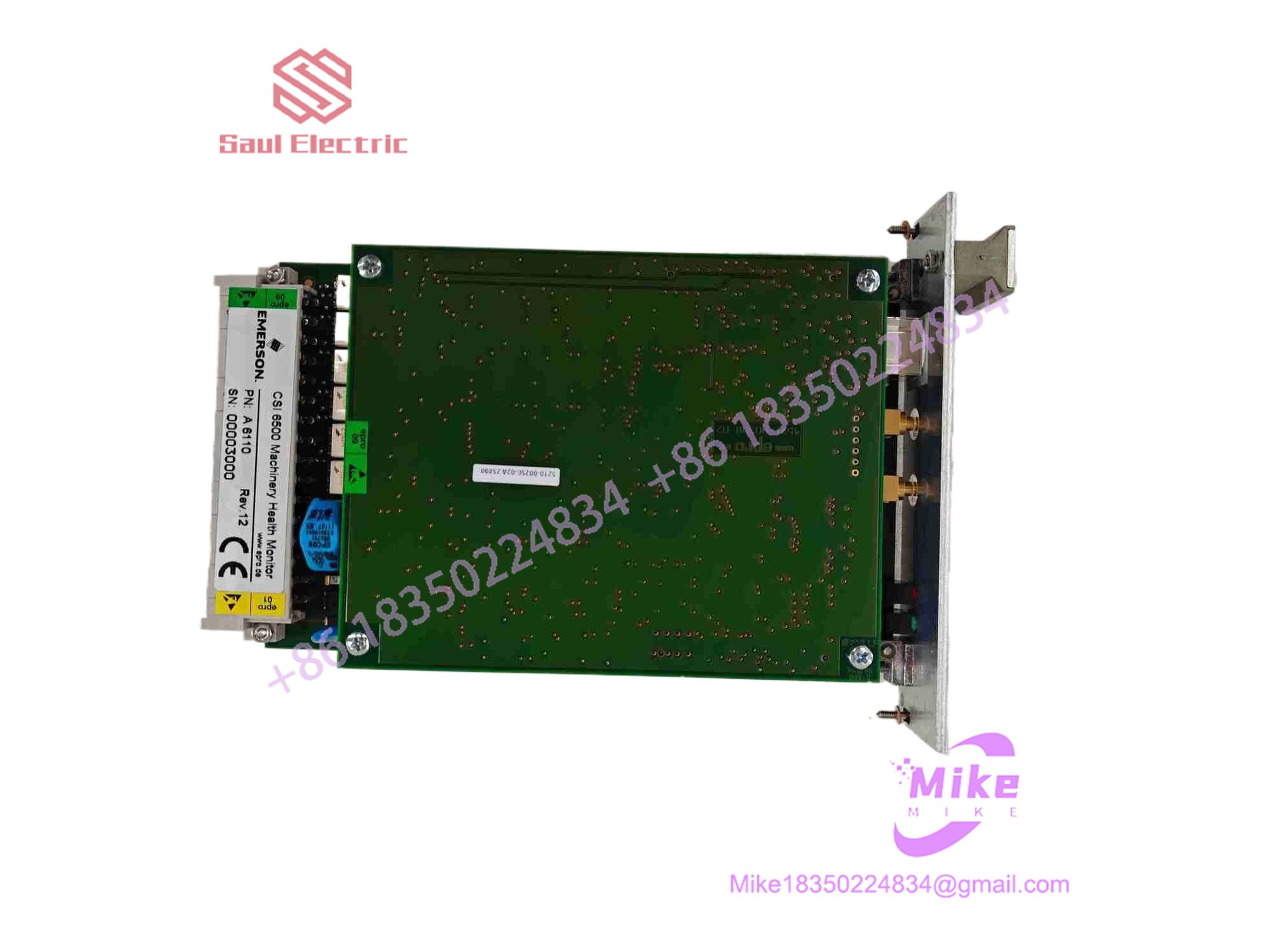
A6110
Key Technical Specifications
| Parameter | Specification |
| Manufacturer | Emerson |
| Part Number | A6110 (AMS 6500 Series) |
| Compatible System | Emerson AMS 6500 Machinery Health Monitor |
| Sensor Compatibility | Eddy Current Proximity Probes (e.g., PR642 series) |
| Number of Channels | Dual Channels (X/Y or combined mode) |
| Frequency Response | 0.1 to 5 kHz (-3 dB) |
| Sensor Power Supply | -26.7 V DC nominal, 20 mA nominal |
| Form Factor | 3U Eurocard (DIN 41494 compliant) |
| Operating Temperature | 0°C to +65°C (32°F to 149°F) |
Field Engineer’s Pitfall Guide
- Electrostatic Discharge (ESD) Hazards: Warning: The internal surface-mount components and processor gates on this monitor card are exceptionally sensitive to static charges. Always use a grounded ESD wrist strap and handle the PCB strictly by its extraction handles or edges.
- Hot-Insertion Rack Failures: Do not slide this module into an active rack without checking backplane alignment. I have seen maintenance techs bend backplane connector pins or cause voltage spikes that corrupt neighboring cards by attempting to force live modules into slots at an angle.
- Ignoring Proximity Probe Calibration Shifts: Swapping an A6110 card without verifying probe gap voltages and scale factors can distort vibration readings. Always cross-reference raw gap voltages (-VDC) at the front panel buffers before commissioning the loop.
QA & Testing SOP (Transparency)
- Visual & Structural Audit: Incoming cards are inspected under magnification for trace damage, corrosion, solder joint micro-fractures, and authentic OEM markings.
- Static Bench & Power Rail Check: Technicians verify internal power supply isolation, bus buffer integrity, and DC rail resistance to guarantee zero internal short circuits.
- Live Rack Simulation Testing: The module is inserted into a certified AMS 6500 test rack, connected to a signal simulator, and subjected to simulated vibration waveform inputs across both channels.
- Alarm & Analog Output Verification: Units undergo functional validation to confirm that 0/4-20 mA outputs, front-panel buffer tracking, and relay trip logic respond precisely to programmed thresholds prior to anti-static sealing.
Technical FAQ
Can the A6110 monitor be used with non-Emerson proximity probes?
While the card is engineered primarily for standard eddy current displacement sensors matching its power and input range (such as PR642 series transducers), signal compatibility must be verified regarding sensitivity (mV/mm or mV/mil) before deployment.
What causes a channel failure or “Not OK” status LED on the front panel?
An “Not OK” status typically indicates a broken probe cable, short-circuited sensor wiring, loss of supply voltage to the probe driver, or an unseated card edge connector.
Are the alarm trip limits stored locally on the card?
Configuration data and trip parameters are managed through the system rack architecture and configuration software, though local hardware settings depend on module jumpers and backplane bus communication.
Is component-level repair practical for a damaged module?
Due to the multi-layer surface-mount design and the safety-critical nature of machinery protection systems, field-level micro-soldering is strongly discouraged. Full module exchange or certified factory depot rebuilding is standard industry practice.





