Description
Emerson 5X00875G01 | 16-Branch Parallel Scan CPU Module New Surplus
Architect’s Product Breakdown
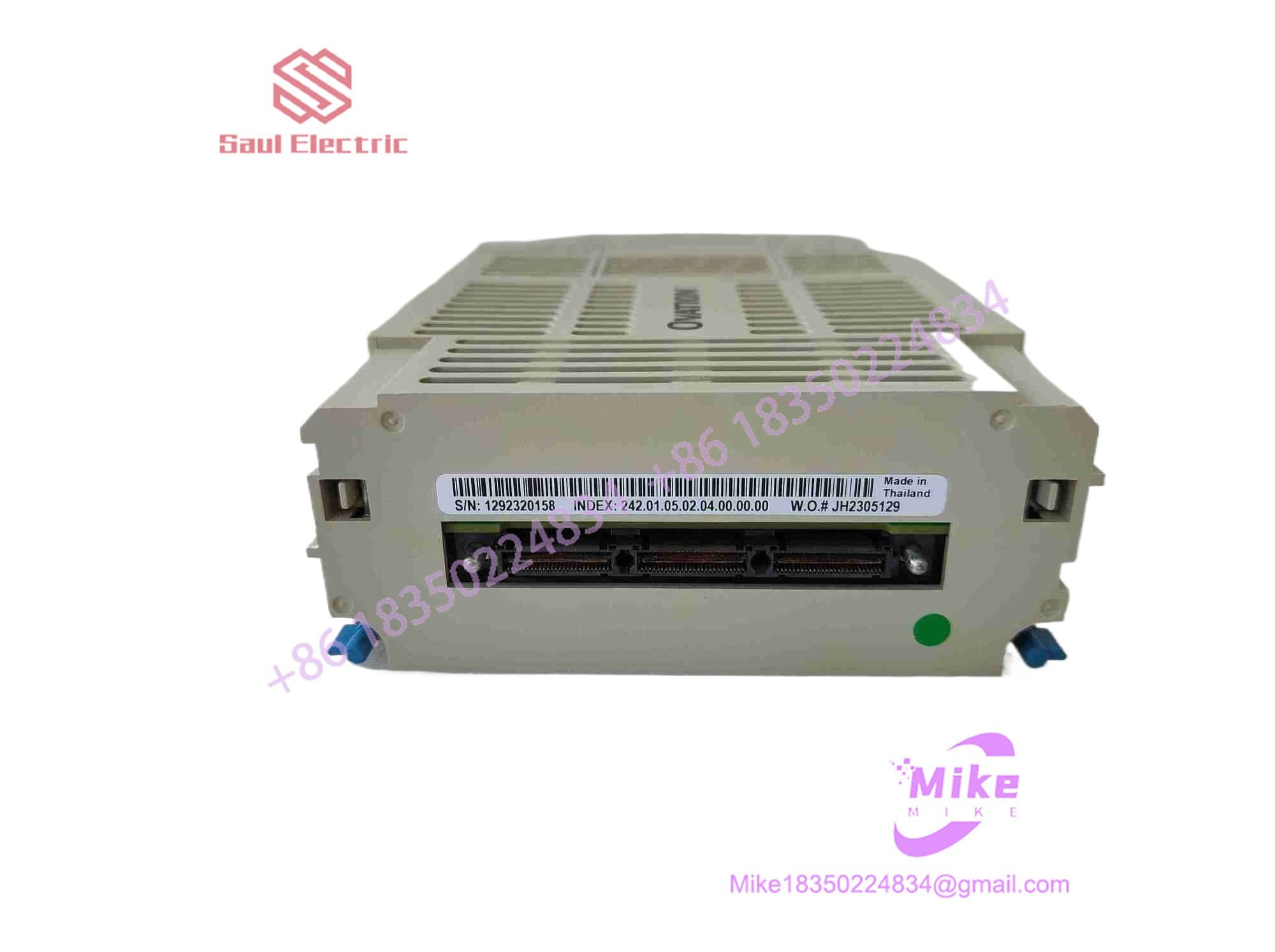
The Emerson 5X00875G01 is the core processing engine for the Ovation Controller 3000 (OCR3000) series. Unlike older architectures (such as the legacy OCR1100) that relied on separate CPU and I/O interface boards linked via ribbon cables, the 5X00875G01 consolidates the high-speed microprocessor and the Input/Output Interface Controller (IOIC) into a single module. This structural integration slashes backplane latency, reduces physical cabinet footprint, and eliminates edge-connector fail points inherent in multi-card controller stacks.
Designed specifically for demanding power generation, combined-cycle, and heavy chemical loops, the 5X00875G01 executes synchronous, parallel scanning across up to 16 local I/O branches simultaneously. While traditional DCS controllers scan I/O sub-racks sequentially—introducing microsecond phase delays between channel 1 and channel 64—the parallel engine on the 5X00875G01 captures all field points in a single scan cycle. This makes it indispensable for high-speed turbine governor control, burner management systems (BMS), and fast-acting pressure relief interlocks.
From an infrastructure perspective, the module natively supports bump-less, automatic failover when configured in a redundant controller pair. If the primary unit suffers a hardware fault or memory exception, the secondary partner takes over process execution within milliseconds without shedding field output state or dropping communication with upper-tier Ovation Enterprise Data Servers. Additionally, all internal firmware binaries executed on the 5X00875G01 utilize cryptographic signing to prevent unauthorized or corrupted code injection into critical control loops.
5X00875G01
Key Technical Specifications
| Parameter | Technical Specification |
| Manufacturer | Emerson Process Management / Westinghouse |
| Controller Series | Ovation OCR3000 Series |
| Integrated Architecture | Combined Processor + IOIC (I/O Interface Controller) |
| Local I/O Capacity | Up to 16 Branches (Parallel Scanning Engine) |
| Redundancy Support | Dual-Hot Standby with Bumpless Auto-Failover |
| Nominal Power Input | 24 VDC (Feed via Ovation Power Distribution System) |
| Security Architecture | Digitally Signed & Cryptographically Verified Firmware |
| Backward Compatibility | Direct upgrade path for OCR1100 applications |
| Cabinet Thermal Requirement | Ventilated Enclosure (Min 110 CFM Fan Forced Air) |
| Operating Temperature | -25°C to 60°C (-13°F to 140°F) Ambient |
| Compliance & Standards | CE Certified, IEC 60068-2-6/27 (Vibration/Shock) |
Field Engineer’s Pitfall Guide (Unique Value)
- THERMAL TRIP FROM BLOCKED VENTILATION: Do not mount the OCR3000 assembly in an unventilated enclosure. The high processing density of the integrated CPU/IOIC core generates significant thermal output. Emerson explicitly requires mounting in ventilated cabinets with ball-bearing fans pulling a minimum of 110 CFM across the module face. I’ve seen plant technicians disable cabinet door fans during summer ambient spikes; the 5X00875G01 will hit thermal protection limits, leading to intermittent controller resets and unannounced failovers.
- FIRMWARE REVISION MISMATCH IN REDUNDANT PAIRS: Never drop a replacement 5X00875G01 into a redundant rack without confirming firmware image signatures. If the new module carries a higher or lower base bootloader version than the active primary controller, the tracking handshake will fail. The secondary unit will remain stuck in “Offline / Inhibit” mode rather than establishing the synchronized memory mirror required for hot standby operation.
- FORCEFUL INSTALLATION ON BACKPLANE CABLE TRACKS: Inspect all 16-branch I/O interconnect cables before seating the unit. When connecting controller-to-ROP or backplane power cables (such as the 5A26137 series), ensure connector pins are completely straight and seated vertically. Misaligned copper pins on the branch interface ports can bridge the 24V bus or short out the high-speed local data bus, taking down communication across all connected sub-racks instantly.
QA & Testing SOP (Transparency)
- Visual & Architectural Inspection: Magnification check for thermal stress marks on the substrate, PCB trace integrity, connector pin straightness, and verification of original factory serial numbers and security seals.
- Power & Isolation Check: Insulation resistance testing across 24V power input terminals and ground planes at 500VDC to ensure complete dielectric separation.
- Live OCR3000 Test Bench Mounting: Module inserted into a live, dual-controller test rack running Ovation Developer Studio.
- 16-Branch Load & Redundancy Test: All 16 I/O branch communication paths fully loaded with simulated hardware. Forced primary-to-secondary failover executed 20 consecutive times to verify zero dropped scan cycles or memory sync errors.
- Firmware Verification & ESD Packaging: Verification of signed firmware image, reset to neutral factory defaults, and sealed in anti-static moisture barrier bags with high-density foam padding.
Technical FAQ
Can I replace an older OCR1100 controller directly with the 5X00875G01 OCR3000 module?
Yes, but it requires software/database configuration updates. While the 5X00875G01 is engineered to handle process applications originally deployed on OCR1100 systems, the physical layout differs. Because the 5X00875G01 integrates the CPU and IOIC into a single module, you will remove the old two-board set and update the hardware drop configuration inside Ovation Developer Studio to reflect the OCR3000 module type.
How does parallel scanning on the 5X00875G01 differ from standard I/O scanning?
Standard DCS controllers scan I/O modules sequentially down a multiplexed bus (Branch 1, then Branch 2, up to Branch 16). The 5X00875G01 features a parallel IOIC architecture that queries all 16 local I/O branches simultaneously. This eliminates cycle latency and ensures deterministic data collection across high-density I/O configurations.
Is the 5X00875G01 hot-swappable in a redundant system?
Yes. If your system uses a redundant dual-controller configuration (Partner A and Partner B), you can pull and replace a faulted 5X00875G01 module while the online partner maintains process control. Once the replacement module is inserted and powered up, it will download the active database and memory state from the primary controller automatically.
What power supply configuration does the 5X00875G01 require?
The module operates on a nominal 24 VDC bus, typically fed from dual-redundant Ovation power supply systems (such as the 5X00785 or 10-Amp/20-Amp distribution scheme). This ensures uninterrupted logic power even if one primary AC or DC power feed drops out.