


Description
Bently Nevada 135489-04 | 3500/40M Proximitor I/O Module Core Category
Dynamic Product Introduction
Interfacing field-mounted proximity probes and displacement transducers located in hazardous industrial environments with safety-critical monitoring racks requires specialized signal isolation hardware. The Bently Nevada 135489-04 operates as a 4-channel Proximitor I/O module engineered with integrated internal safety barriers and internal terminations. Unlike standard I/O cards that require bulky external zener barriers or galvanic isolators to satisfy hazardous area compliance, this module integrates intrinsic safety directly onto the board, streamlining cabinet wiring and saving valuable panel space.
Moving beyond non-isolated legacy hardware iterations, this internal-barrier module ensures clean signal transmission and superior common-mode noise rejection for radial vibration, axial position, and differential expansion monitoring loops. Field service data indicates that deploying verified replacement I/O cards instantly resolves loop ground faults, eliminates channel “Not OK” errors, and restores stable protection tracking on critical turbomachinery assets.
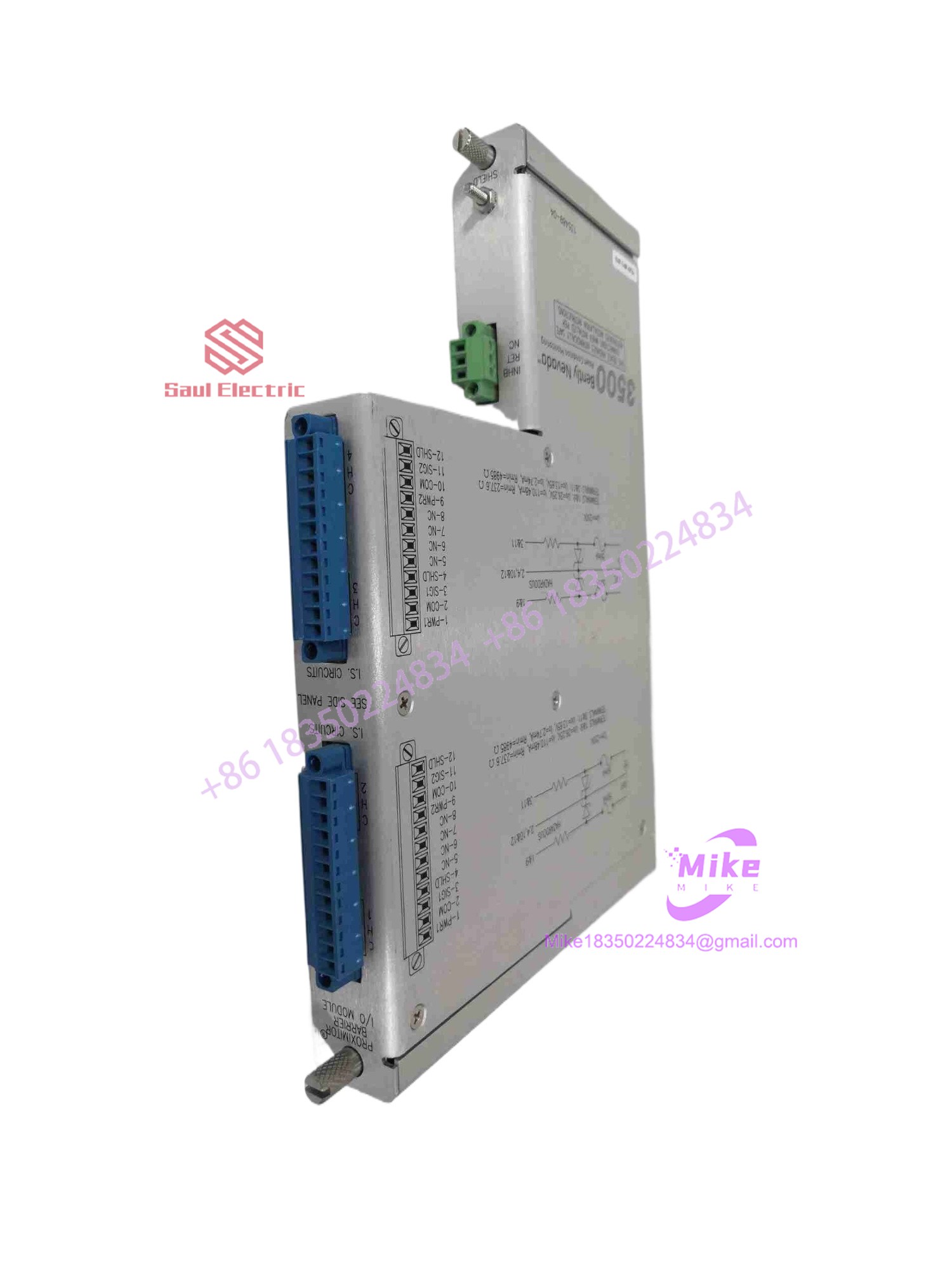
135489-04
Key Technical Specifications
- Module Architecture: Proximitor Displacement Input/Output Module with Internal Barriers (3500/40M Series)
- System Compatibility: Bently Nevada 3500 Series Machinery Protection System (paired with 3500/40M monitors)
- Channel Capacity: 4 independent input channels (configurable for radial vibration, axial position, eccentricity, or differential expansion)
- Intrinsic Safety Design: Built-in internal safety barriers for hazardous area signal conditioning (Zone 1 / Zone 2 compliance)
- Termination Type: Internal Terminations (direct wire landing on the rear module block)
- Measurement Accuracy: \pm 0.33\% of full scale for direct, gap, 1X, and 2X parameters
- Operating Temperature Range: -30^\circC to +65^\circC (-22^\circF to +149^\circF)
- Weight: ~0.20 to 0.46 kg (0.44 to 1.01 lbs)
Global Sourcing & Live-Test SOP (Transparency Core)
Deploying replacement safety-barrier I/O modules on active asset protection racks requires an uncompromising verification protocol to guarantee barrier integrity and signal scaling accuracy.
- Inbound Verification: Incoming modules are audited against original Bently Nevada manufacturing lots. Rear terminal blocks, internal safety barrier components, and backplane connector pins are inspected under optical magnification for pin bending, corrosion, or thermal wear.
- Live Simulation: The I/O module is mounted onto a dedicated 3500 test backplane matched with a calibrated 3500/40M front monitor card.
- Diagnostics: Technicians inject simulated displacement and vibration signals across all four channels through the internal barrier network, verifying voltage scaling accuracy, barrier leakage current limits, and zero signal distortion across a continuous thermal soak cycle.
- Final Prep: Once electrical logs clear baseline standards, terminal blocks are cleaned, protective covers are attached, and the module is sealed inside an anti-static moisture-barrier shield.
The Field Engineer’s Pitfall Guide
❗ Landing Field Sensor Wires Under Power: Tightening terminal screws on active hazardous-area loops while the 3500 rack backplane is energized can introduce transient voltage spikes or ground loops, triggering false machinery trips. (I’ve seen plants experience unwarranted shutdowns because technicians skipped isolation protocols.) Always drop local power before servicing wiring.
❗ Mixing Up Sensor Types in Software vs. Hardware: Failing to ensure that the 3500 rack software configuration matches the physical measurement setup wired into the internal barrier block results in severe scaling errors and channel faults. Always verify software programming matches field hookups.
❗ Ignoring Intrinsic Safety Grounding Requirements: Failing to tie the internal barrier ground bus to a dedicated, low-impedance certified intrinsic safety earth ground compromises the protection scheme and can violate hazardous area compliance standards. Always verify cabinet grounding continuity during installation.
Intent-Driven FAQ
Will swapping this 135489-04 I/O module require reprogramming the 3500 rack?
No. Because the 135489-04 is a passive/conditioning hardware I/O layer that routes and isolates signals for the front-layer 3500/40M monitor card, configuration settings and alarm setpoints stored in the rack software remain intact upon replacement.
Can this internal-barrier I/O module be replaced while the turbomachinery is running?
Hot-swapping rear I/O modules while associated machinery protection channels are online will result in a loss of sensor signals, triggering channel faults and potentially driving an unwanted system alarm or trip. Close coordination with operations is mandatory.
What causes channels on this module to register persistent “Not OK” status?
A “Not OK” status typically points to a severed field cable, an open proximity probe power supply loop, loose terminal screws on the 135489-04 block, or an internal fault within the barrier circuit. Checking loop resistance and barrier continuity isolates the fault.
Is the 135489-04 compatible with non-hazardous standard installations?
Yes. While the module features built-in intrinsic safety barriers designed primarily for hazardous locations, it functions completely in standard non-hazardous applications as long as proper system wiring practices are maintained.
What kind of warranty accompanies surplus or refurbished units?
Reputable industrial suppliers typically back tested surplus or refurbished Bently Nevada hardware with a standard 1-to-2 year replacement warranty, supported by a bench test report confirming signal transmission and barrier health.





