


Description
AO2000 LS25 ABB Laser Analyzer
ABB AO2000 LS25 Laser Analyzer Overview
Brand Background
ABB is a global leader in power, automation, and industrial measurement technologies. ABB’s Analytical Measurement division produces high-precision gas analyzers, continuous emission monitoring systems (CEMS), and process spectrographs designed to optimize plant combustion, ensure environmental compliance, and enhance operational safety across harsh industrial environments.
Model Overview: AO2000 LS25
The ABB AO2000 LS25 is an in-situ Tunable Diode Laser Absorption Spectroscopy (TDLAS) gas analyzer module. Functioning as an integrated component of ABB’s Advance Optima AO2000 continuous gas analyzer series, the LS25 is designed for direct, non-contact optical measurement of target gas concentrations across stacks, ducts, and process pipes.
Utilizing a cross-duct transmitter and receiver configuration, the LS25 measures gas absorption along a single line-of-sight path in real time, delivering high accuracy without cross-sensitivity to other background gases.
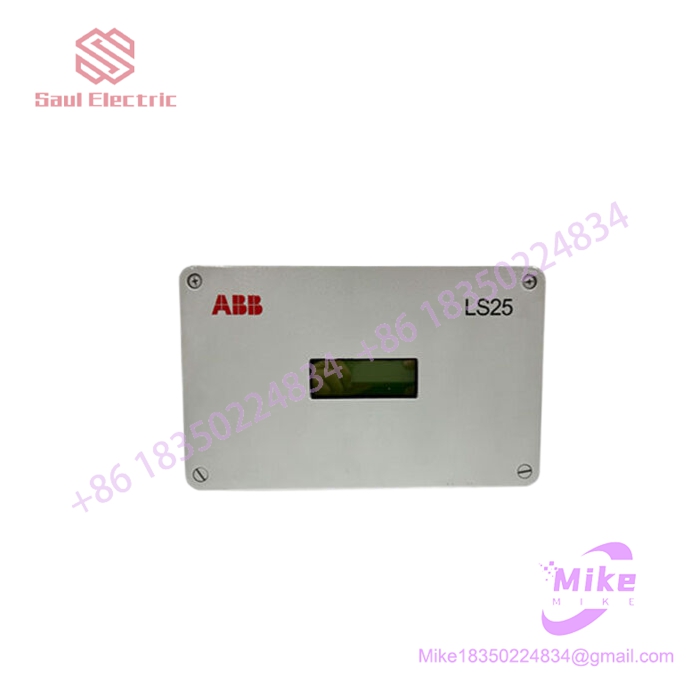
AO2000 LS25 ABB Laser Analyzer
Key Technical Specifications and Parameters
-
Measurement Principle: Single-line Tunable Diode Laser Absorption Spectroscopy (TDLAS) in the near-infrared (NIR) spectrum.
-
Measurable Gas Species: $O_2$, $CO$, $CO_2$, $NH_3$, $HCl$, $HF$, $H_2S$, $H_2O$, $NO$, $N_2O$, $HCN$, $CH_4$, and dual-gas combinations (e.g., $NH_3 + H_2O$, $HCl + H_2O$, $CO + CO_2$).
-
Measuring Ranges: Sub-ppm levels to high volume percentage ($\text{vol}\%$) ranges depending on path length and target gas.
-
Response Time ($T_{90}$): Rapid response, typically $< 2\text{ seconds}$.
-
Process Conditions:
-
Process Temperature: Up to $1500^\circ\text{C}$ (with optical alignment/cooling solutions).
-
Process Pressure: Up to $10\text{ bar}$ absolute.
-
-
Power Supply: $18\text{ to }36\text{ VDC}$ (approximately $20\text{ W}$ power consumption).
-
Ambient Operating Temperature: $-20^\circ\text{C to }+55^\circ\text{C}$.
-
Digital Communication & Networking: Ethernet, Modbus TCP/IP, PROFIBUS, or proprietary ABB network protocol connected via the central AO2000 display/control unit.
-
Hazardous Area Approvals: ATEX, IECEx, and CSA certified for Class I, Division 2 / Zone 1 and Zone 2 environments.
Operating Industries
The AO2000 LS25 is engineered for severe-duty industrial processes requiring high uptime and real-time gas monitoring:
-
Power Generation & Waste Incineration: Combustion efficiency optimization and flue gas emission monitoring.
-
Chemical & Petrochemical Processing: Process control in reactor loops, flare gas lines, and polymer manufacturing plants.
-
Steel, Metals & Mining: Blast furnace off-gas analysis, converter gas tracking, and direct reduced iron (DRI) processes.
-
Cement & Building Materials: Kiln inlet and calciner exit gas analysis ($CO, O_2, NO$).
-
Fertilizer & DeNOx Scrubbers: Selective Catalytic Reduction (SCR) and Selective Non-Catalytic Reduction (SNCR) slip monitoring ($NH_3$).
Common Usage Scenarios
-
Ammonia Slip Monitoring ($NH_3$)
Measuring residual ammonia downstream of SCR/SNCR DeNOx systems in power plants and incinerators to prevent ammonium bisulfate formation and comply with clean air mandates.
-
In-Situ Combustion Control ($CO / O_2$)
Real-time tracking of carbon monoxide and oxygen inside high-temperature boiler stacks to optimize fuel efficiency and lower emissions.
-
Dehalogenation & Corrosive Gas Monitoring ($HCl / HF$)
Monitoring trace levels of hydrogen chloride or hydrogen fluoride in chemical waste incinerators and wet scrubber outlets.
-
Explosion Prevention & Inerting Control ($O_2 / CO$)
Continuous monitoring of oxygen buildup in volatile organic solvent recovery lines, coal mills, and electrostatic precipitators (ESP) to eliminate explosion risks.





