


Description
Introduction to ABB FI820F 3BDH000031R1 Serial Fieldbus Module
ABB FI820F 3BDH000031R1 is a high-performance dual channel serial fieldbus communication module (Serial Fieldbus Module) in the ABB AC 800F distributed control system. It serves as a communication bridge between the main controller and serial field devices in the DCS architecture, and is the core communication component for data exchange between the system and external serial devices.
core positioning
The module itself does not collect on-site process signals, nor does it directly drive the actuator. Instead, it exists as a “serial communication processor” – converting control data sent by the main controller (such as PM802F CPU) into a communication format recognizable by the serial field device, and transmitting the on-site data collected by the serial device back to the main controller. It is designed specifically for connecting various serial fieldbus and serial protocol devices, and is a key interface layer component for implementing serial communication such as Modbus and Profinet in the AC 800F system.
Basic Parameters
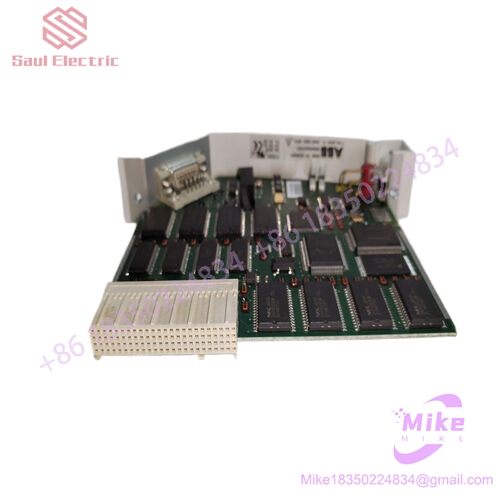
ABB SERIAL FI 820F FIELDBUS MODULE 3BDH000031R1
Material Number: 3BDH000031R1
Model: FI820F
Series: AC 800F Serial I/O Module
System: ABB AC 800F Distributed Control System
Channel configuration: 2 independent serial channels (dual channels)
Transmission rate: configurable up to 38.4 KBaud
Physical interfaces: RS485 (half duplex), RS422 (full duplex), RS232 optional, flexible switching through different connection cables
Analog input: 8 channels, capable of receiving 0-30V DC voltage signals
Analog output: capable of outputting 0-20mA DC current signal
Communication protocol: The standard protocol is Modbus, and it also supports mainstream industrial communication protocols such as Profinet, EtherNet/IP, EtherCAT, etc
Working voltage: 24V DC (supporting a wide range of 21.6V to 31.2V)
Electrical isolation: Isolation between channels and buses ≥ 1500V
Protection level: IP20, suitable for installation inside control cabinets
Working temperature: -40 ° C to+70 ° C (suitable for harsh industrial environments)
Storage temperature: -40 ° C to+85 ° C
Size: Approximately 125mm x 155mm x 28mm (net size)
Weight: Approximately 0.145kg
Installation method: DIN rail installation, supports hot plugging (inserting or removing modules) during operation
Redundancy support: Can be operated redundantly with the second AC 800F
Main functional features
Dual channel independent processing: Built in two completely independent serial communication channels, which can simultaneously connect two different serial fieldbuses or protocols without interfering with each other. Two channels can be connected to different types of device combinations, such as one channel connected to RS485 devices and the other channel connected to RS232 devices, greatly improving the flexibility of system communication.
Multi protocol physical interface switching: Switching between RS485, RS422, and RS232 physical interfaces can be achieved by replacing the connecting cable, without the need to replace the module itself, reducing spare parts inventory and engineering change costs.
High reliability design: All interfaces are electrically isolated, effectively suppressing the impact of on-site electromagnetic interference on the control system. During operation, it can be hot swappable and replaced, and maintenance can be completed without cutting off the system power supply, reducing the risk of downtime. Supporting redundant operation, when combined with the second AC 800F, it can achieve communication link redundancy and uninterrupted operation at a single point of failure.
Intelligent signal processing: Processing serial data at a high-speed sampling rate, with built-in adaptive filtering and error detection mechanisms, it can maintain stable communication in industrial environments with strong electromagnetic noise, reducing the risk of communication interruption caused by external anomalies.
Loop monitoring and fault diagnosis: Supports the detection of communication interruptions, power outages, frame errors, and other anomalies. Fault information can be reported to the main controller through the system bus for quick identification of communication faults. Equipped with operation indicator lights and communication status indicator lights, it can quickly determine the working status of modules and communication links on site.
Parameterized configuration: Supports online configuration of communication parameters (baud rate, data bits, stop bits, verification methods, etc.) through ABB’s dedicated industrial control software, with real-time configuration taking effect and reducing downtime for debugging.
Start self check: Automatically check the electrical ID of the module when powered on, and do not enter the running state when it does not match the configuration, to prevent communication abnormalities caused by mismatches.
Comparison with products in the same series
FI830F (3BDH000032R1) is a Profibus DPv1 fieldbus module that focuses on high-speed bus communication at the industrial Ethernet level and is suitable for Profibus communication with remote I/O stations. The core positioning of FI820F is “serial I/O communication module”, focusing on serial protocols such as RS232/RS485/RS422, with higher channel density (dual channel+8-channel analog I/O), suitable for scenarios that require simultaneous connection of multiple serial instruments, frequency converters, PLCs, and other devices. FI810F is a single channel serial module with half the number of channels. FI840F (3BDH0000033R1) is an FF HSE high-speed Ethernet fieldbus module positioned at a higher end. FI820F is irreplaceable in scenarios that require medium scale serial communication and analog I/O integration.
Typical application scenarios
Power industry: Modbus communication between generator set auxiliary equipment and serial instruments (such as electricity meters and protection devices) to achieve data acquisition and remote control.
Chemical industry: The connection between DCS systems and serial devices such as on-site frequency converters and intelligent valve positioners reduces the wiring length from the site to the control room.
Water treatment: RS485 serial data transmission between pump station and remote SCADA terminal.
Manufacturing industry: Communication link between production line control system and multiple serial devices (barcode readers, printers, weighing instruments).
Metallurgical industry: Remote I/O station serial communication deployment for equipment such as blast furnaces and rolling mills.





