


Description
ABB RXEDK 2H 1MRK000841-KA relay
1MRK000841-KA is a Profibus DP redundant fiber link module launched by ABB, which belongs to industrial grade communication relay equipment. Its core function is to achieve redundant interconnection, long-distance extension, and network self-healing protection of Profibus DP bus through fiber optics. There is also a 1MRK000841-RA version in the same series, which has similar functions. KA is the standard configuration, and RA is the enhanced configuration.
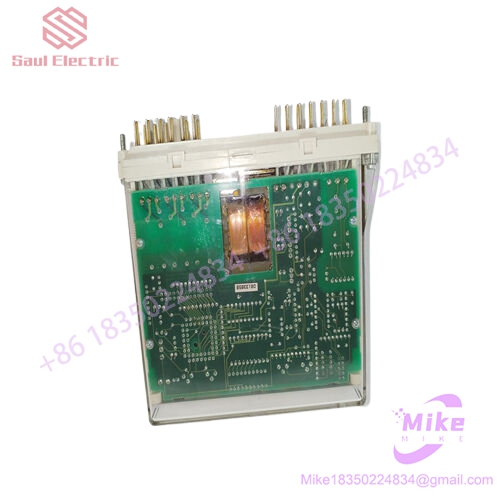
ABB RXEDK 2H 1MRK000841-KA relay
core positioning
Profibus DP redundant fiber optic repeater enables flexible conversion between single bus and redundant dual bus, supporting various topology structures such as point-to-point, chain, star, redundant ring network, etc. It is a key communication node for DCS and PLC system communication high availability architecture.
core functionality
In terms of redundancy and conversion, it supports logic independent dual Profibus DP bus electrical interfaces, which can achieve electrical interface backup or single device access to dual redundant bus systems. In point-to-point mode, connect two Profibus DP bus segments through optical fiber. The dual port chain network supports up to 200 Profibus DP bus segment connections. In the redundant mode of dual port ring network, when a fiber optic failure occurs, the system reconstructs the network link within 10ms to achieve self-healing protection, and automatically recovers after troubleshooting. Adopting ABB’s proprietary ring network protocol CI Ring, it does not require setting up or root nodes, and can quickly complete network ring formation and ring removal, plug and play without configuration.
In terms of electrical interface, the 9-pin Sub-D connector has pin definitions that comply with the Profibus DP protocol specification. Supports all 10 standard communication rates: 9.6 kbit/s、19.2kbit/s、45.45kbit/s、93.75kbit/s、187.5kbit/s、500kbit/s、1.5Mbit/s、6Mbit/s、12Mbit/s, Support automatic recognition or dip switch settings. The signal delay of the electrical port is less than or equal to 11 bits. Equipped with 4000V lightning protection, 1.5A overcurrent protection, and 600W surge protection. This machine does not have a terminal resistor and needs to be connected externally.
In terms of fiber optic interfaces, multi-mode wavelengths are 850nm and 1310nm, and single-mode wavelengths are 1310nm and 1550nm. The multi-mode transmission distance is 2km, the single-mode transmission distance is 20km, and further distances are optional. The transmission fiber supports multimode 50/125um, 62.5/125um, 100/140um, and single-mode 8.3/125um, 9/125um, and 10/125um. Fiber optic interface types SC, FC, ST are optional, and SC optical interface is standard. The bit error rate of the optical line is less than the negative 9th power of 10. The signal delay of the optical port is less than or equal to 1.6us per node.
In terms of electrical parameters, dual power redundant input DC 9 to 36V, typical DC24V, power consumption less than 4W. It has DC1500V voltage isolation and reverse protection functions, and industrial terminal interface. Relay alarm output, fiber optic link failure and power failure alarm, contact capacity DC48V per 1A, industrial terminal interface.
In terms of hardware, the external dimensions are 132mm by 105mm by 52mm, with a net weight of 800g. It has an IP30 protection level, a corrugated aluminum reinforced chassis, and a 35mm DIN rail installation. The working temperature ranges from negative 10 degrees Celsius to positive 70 degrees Celsius, and the wide temperature range can be selected from negative 40 degrees Celsius to positive 85 degrees Celsius. Relative humidity less than or equal to 90% without condensation. through EN55022、EN61000-4-2、EN61000-4-3、EN61000-4-4、EN61000-4-5、EN61000-4-6、EN61000-4-8、EN61000-4-11 Waiting for full EMC certification.
Application industry
The power utility industry includes remote communication and distribution network automation for substations of power supply companies in various provinces, cities, and counties under the State Grid Southern Power Grid. In the petroleum and petrochemical industry, SCADA monitoring is used for refining plants and oil fields of PetroChina, Sinopec, and CNOOC. The main communication link and process control communication for non-ferrous and ferrous metal mines in the mining and metallurgical industry. The cement and building materials industry uses DCS communication for large cement groups such as Conch China Resources. Medium voltage power distribution monitoring in the paper industry, pulp mills, and paper mills. SCADA for traction substations and distribution stations of subway and light rail in the rail transit industry. In the data center industry, variable frequency communication is used for cooling water pumps and refrigerators in large data centers. Constant pressure water supply communication for municipal pump stations and water supply pipelines in the municipal engineering industry. Grid monitoring and distributed energy management for renewable energy industry, wind farms, and photovoltaic power plants.
Usage scenario
Firstly, the remote control redundant communication of the substation is deployed as an OCC controller in the substation, converting the single cable bus into redundant dual bus A/B and extending it to the remote I/O cabinet through optical fiber. Any fault in the circuit automatically switches to ensure uninterrupted communication.
Secondly, the communication of the main station in the distribution network is deployed in the ring main unit and switch station, and inter station communication is achieved through dual optical port ring network redundancy, in conjunction with station protection to achieve fault direction judgment and selective tripping.
Thirdly, SCADA for oil and gas pipeline networks is deployed in unmanned pipeline valve rooms, uploading pressure, flow rate, and valve status to the central control room through optical fibers. Single mode optical fibers support transmission distances of over 20km, adapting to the long-distance distribution requirements of pipelines.
Fourthly, the monitoring of wind and photovoltaic power stations is deployed on the wind turbine and inverter sides to collect power generation and meteorological data, which are uploaded to the centralized control center through Profibus DP. The CI Ring network protocol enables on-site equipment interconnection and self-healing.
Fifth, remote sensing of pump stations and water management is deployed in municipal pump stations and reservoir gates. The water level, flow rate, and pump group status are uploaded to the central control room through fiber optic links. The multi-mode fiber optic transmission distance of 2km meets the coverage requirements of most pump stations.
Sixth, DCS communication for industrial production lines is deployed in high-power equipment distribution cabinets such as mining crushing stations and cement mills. Motor operation data is collected through Profibus DP and uploaded to the factory DCS through fiber optic aggregation, replacing traditional copper cables to reduce wiring costs.
Seventh, the dual bus redundancy is converted to a single bus, and the redundant bus is converted to a single cable connected to the slave equipment on the slave side, reducing wiring costs while retaining the redundancy capability on the master side.
one-sentence summary
1MRK000841-KA is an industrial grade redundant fiber optic repeater developed by ABB for the Profibus DP bus. It features a dual port ring network self-healing and multi topology flexible networking with CI Ring proprietary protocol as its core, supporting 200 cascaded network segments and 20km single-mode transmission. It is widely used in industries such as power utilities, petroleum and petrochemical, mining and metallurgy, cement and building materials, rail transit, data centers, municipal water affairs, and renewable energy, covering core scenarios such as substation remote control, distribution network master station, oil and gas pipeline SCADA, wind and photovoltaic monitoring, pump station water telemetry, and industrial production line DCS communication.





