


Description
ABB RTAC-01 PULSE ENCODER INTERFACE MODULE
ABB RTAC-01 is an interface module launched by ABB for variable frequency drive systems, with two main application versions. One is the ACS800 series dedicated pulse encoder interface module, with the official main model manual number 3ABD 00009810 REV A. The second is the remote I/O adaptation and communication module used for medium voltage frequency converters such as ACS1000 or ACS6000. The following is a complete introduction to the official main models, taking into account the medium voltage version.
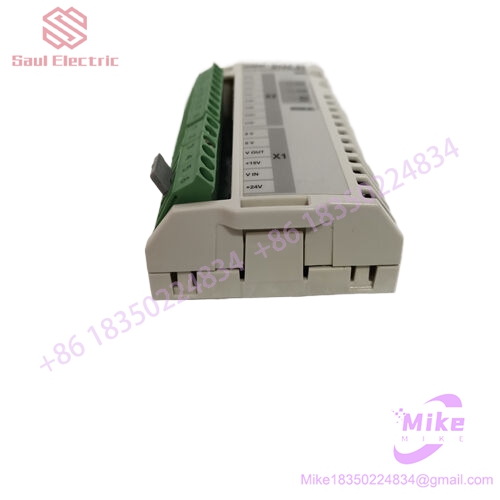
ABB RTAC-01 PULSE ENCODER INTERFACE MODULE
core positioning
The ACS800 dedicated pulse encoder interface module, also known as the Remote Terminal and Adapter Card, provides a standardized interface for digital pulse encoders to obtain accurate speed and position feedback of the motor shaft, i.e. angle feedback. It is a key component for ACS800 to achieve high-precision vector control and servo level performance. The medium voltage version is positioned as a remote I/O adaptation and communication gateway, solving the problem of remote transmission and anti-interference of control signals for medium voltage frequency converters.
Core function, ACS800 pulse encoder version
In terms of encoder interface, it provides three sets of differential input channels: A+/A -, B+/B -, and Z+/Z -. The A/B channels are used for speed and direction detection, while the Z channel uses one pulse per revolution for positioning. All input channels are completely isolated from logic circuits, power supply, and ground. The signal level requirement is 1 greater than 7.6V and 0 less than 5V (for a 15V power supply) or 1 greater than 12.2V and 0 less than 8V (for a 24V power supply), with a maximum signal frequency of 200kHz. When the transmission unit rotates forward, channel A leads channel B by an electrical angle of 90 degrees.
The encoder power supply is provided by the module itself, and 15V DC default or 24V DC is selected through the jumper settings of terminals 4/5/6, with a maximum output power of 5W. If the encoder power consumption exceeds 5W, it depends on the maximum speed of the motor, the number of pulses per revolution of the encoder, the cable length, and the distributed capacitance, and requires external power supply. It supports both active and passive mode configurations.
In terms of installation, the module is inserted into the slot marked SLOT1 or SLOT2 on the RMIO board, fixed with plastic clips and two M3 by 8mm screws. The screws also serve as the grounding for the cable shielding layer and the GND connection for the module. The signal and power are automatically transmitted through a 38 pin connector. Compatible with ACS800 standard application version ASXR7000 and above.
Core parameters, medium voltage remote I/O version
The applicable systems are medium voltage frequency converters such as ACS1000 and ACS6000. 8 digital inputs, 24V DC, optically isolated. There are 6 digital outputs, and relay or transistor outputs can be configured. Analog input 2 channels, 0 to 10V or 4 to 20mA, 12 bit resolution. Analog output 2 channels, 4 to 20mA, 12 bit resolution. The communication interface supports Profibus DP and Modbus RTU depending on the firmware, and supports fiber optic links. The maximum transmission distance for cables is 100m, and for optical fibers it is over 1km. Isolation voltage between input and output and to ground greater than or equal to 2.5kV AC. The working temperature ranges from 0 degrees Celsius to 55 degrees Celsius. Protection level IP30, 35mm DIN rail installation. Certification includes CE, IEC 61800-5-1, UL, cUL.
Application industry
In the power utility industry, the frequency conversion speed regulation of wind turbines and water pumps in power plants and substations under the State Grid Southern Power Grid. In the petroleum and petrochemical industry, the variable frequency drive of oil pumps and compressors in the refining plants of PetroChina, Sinopec, and CNOOC. The mining and metallurgical industry uses variable frequency speed regulation for ball mills and crushers in non-ferrous and ferrous metal mines. In the cement and building materials industry, the cement mills and fans of large cement groups such as Conch China Resources are controlled by frequency conversion. Variable frequency speed regulation of medium voltage motors in the paper industry, pulp mills, and paper mills. Variable frequency control for pump stations and conveyor belts in the food and beverage industry, dairy beer and beverage factories. The frequency conversion speed regulation of ventilation fans and water supply and drainage pumps in the rail transit industry, subway and light rail. In the data center industry, variable frequency energy-saving is used for cooling water pumps and refrigerators in large data centers. Constant pressure variable frequency control for municipal pump stations and water supply pipelines in the municipal engineering industry. Variable frequency drive for auxiliary equipment in the renewable energy industry, wind farms, and photovoltaic power plants. Variable frequency control of high-power propulsion motors for marine oil platforms and ships in the ship propulsion industry.
Usage scenario
Firstly, ACS800 high-precision servo control. In situations where precise speed and position feedback is required for printing machines, CNC machine tools, robot joints, etc., the RTAC-01 pulse encoder module is connected to an incremental encoder and combined with DTC control to achieve fully closed-loop vector control, with positioning accuracy reaching the pulse level.
Secondly, remote I/O expansion of medium voltage frequency converters. Deploy RTAC-01 remote I/O module in ACS1000 or ACS6000 transmission cabinet, extend 8DI/6DO/2AI/2AO to the on-site operation panel or PLC cabinet, and achieve remote centralized control of key start stop, emergency stop, and reset signals.
Thirdly, mine crushers and cement mills are driven. The operating status of the equipment is collected through digital input of the medium voltage version, and the temperature and vibration of the bearings are monitored through analog input, which is uploaded to DCS via GOOSE or Modbus.
Fourth, a constant pressure water supply system. RTAC-01 collects pressure sensor signals from the pipeline network, ranging from 4 to 20mA, and adjusts the output frequency of the frequency converter in real-time after PID calculation to maintain constant pipeline pressure.
Fifth, anti surge control of refinery compressors. Cooperate with intrinsic safety I/O modules in explosion-proof areas to achieve soft start and anti surge closed-loop control of compressors.
Sixth, monitoring of wind, solar and photovoltaic power stations. Deploy the medium voltage version RTAC-01 on the wind turbine and inverter sides, collect power generation, inverter status, and meteorological data, and upload them to the centralized control center through Profibus DP or Modbus TCP to meet the bidirectional power flow and remote monitoring needs of new energy stations.
Seventh, ship propulsion system. Integrating a pulse encoder module into the ship propulsion frequency converter to achieve precise closed-loop control of propeller speed and pitch angle.
one-sentence summary
RTAC-01 is an interface module from ABB for variable frequency drive systems. The ACS800 version is a dedicated interface for pulse encoders, supporting 15V or 24V power supply and 200kHz high-speed differential input. It is the core feedback channel for achieving high-precision vector control. The medium voltage version is a remote I/O adaptation and communication gateway, equipped with 8DI/6DO/2AI/2AO, Profibus DP, and Modbus multi protocols. It is widely used in industries such as power utilities, petroleum and petrochemical, mining and metallurgy, cement and building materials, papermaking, rail transit, data centers, and renewable energy, covering core scenarios such as servo level precise positioning, medium voltage transmission remote I/O expansion, constant pressure water supply closed-loop control, compressor anti surge, and remote monitoring of new energy stations.





