


Description
WOODWARD ESDR4 | Current Differential Protection Relay
Product Introduction
Generator protection is not an area where a generic overcurrent relay is an adequate substitute. The protected machine needs to distinguish an internal winding or phase fault from a fault elsewhere on the power system. WOODWARD ESDR4 addresses that requirement using current-differential protection — comparing currents entering and leaving the defined protection zone and initiating tripping when the differential condition exceeds the configured characteristic.
The ESDR4 provides configurable generator-protection parameters rather than a fixed trip point. Woodward documentation specifies a generator nominal-current setting range of 5 to 6,000 A, CT-ratio configuration from 10 to 6,000/x A, differential-current release settings, adjustable pickup delays, discrete control inputs, and relay outputs. This makes the unit relevant to legacy generator switchgear and protection panels where maintaining the original protection architecture is preferable to an unverified retrofit.
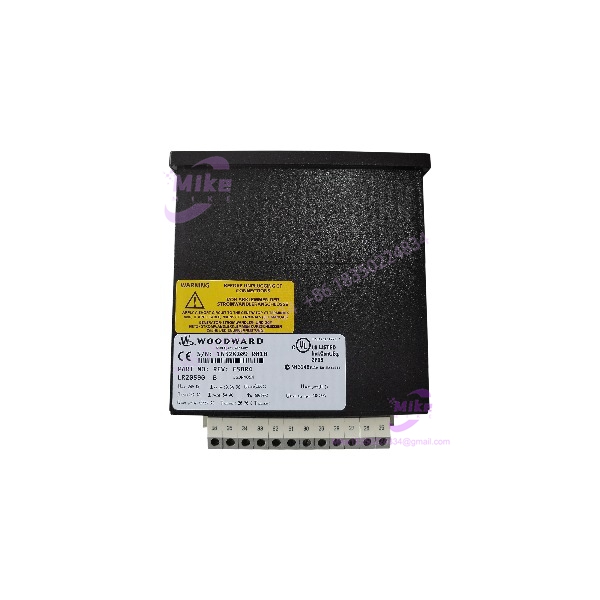
esdr4
Key Technical Specifications
- Manufacturer: Woodward
- Model: ESDR4
- Product Family: ESDR 4
- Product Type: Current differential protection relay
- Primary Function: Generator differential-current protection
- Protection Zone: Defined by the associated CT/transducer arrangement
- Protection Principle: Differential current measurement
- Generator Nominal Current Setting: 5–6,000 A
- Current Transformer Ratio Setting: 10–6,000/x A
- Differential Release Limit, Is/In: 50–300% setting range
- Differential Release Limit, Id/In: 5.0–40.0% setting range
- Differential Pickup Time: 0.04–3.00 seconds
- Discrete Inputs: 18–250 VAC/DC
- Relay Outputs: Maximum 250 VAC
- Mounting Options: Front-panel and DIN-rail versions exist within the ESDR4 family
- User Interface: Parameter configuration and display functions
- System Application: Generator and electrical-machine protection
- Documentation: Woodward Manual 37137B
The documented ESDR4 product family includes several hardware variants. Woodward-related product records identify front-panel and DIN-rail configurations, with product numbers including LR20021, LR20616, 8441-1105, 8441-1010, and LR20590 depending on the specific configuration. These should be treated as variant identifiers rather than interchangeable substitutes.
Application Scenarios & Pain Points
Generator internal-fault protection
The is designed to detect faults within the defined generator protection zone. When the measured differential current exceeds the configured protection characteristic, the relay can initiate the required trip response.
Legacy generator switchgear
Older generator installations often contain protection equipment that is no longer available through normal OEM production channels. Woodward documentation confirms that belongs to an older product generation, making verified replacement stock useful for maintenance planning.
CT-based protection systems
The relay relies on current-transformer/transducer measurements, so correct CT ratio configuration is fundamental. A replacement relay with incorrect settings can produce either nuisance trips or inadequate protection — neither is acceptable on a generator.
Protection-panel refurbishment
During switchgear refurbishment, keeping the original differential-protection philosophy can reduce engineering changes. The ‘s configurable CT ratio, generator-current settings, differential thresholds, and trip timing allow the replacement to be matched to the established protection scheme.
Troubleshooting unexplained generator trips
A differential relay should not be blamed immediately when a generator trips. CT polarity, wiring continuity, phase identification, CT saturation, parameter settings, and actual machine faults all need to be separated systematically.
QA & Live Testing SOP
We treat the WOODWARD as protection equipment, not ordinary automation hardware. Functional verification has to be performed with controlled test conditions.
Step 1 — Identity verification
We record the model, complete product number, hardware version, serial number, mounting configuration, and existing parameter settings.
Step 2 — Parameter capture
Before removing an installed unit, we document the CT ratio, generator nominal current, differential-current limits, trip delays, relay configuration, and other customer-specific settings. These values are part of the protection system — losing them can create a commissioning problem even when the replacement relay itself is healthy.
Step 3 — Input and wiring inspection
The CT/transducer circuits are checked for correct phase identification, continuity, polarity, and termination. Discrete input wiring and trip contacts are also inspected.
Step 4 — Controlled electrical test
The relay is powered using the correct documented supply arrangement and monitored for startup condition, display behavior, and alarm status.
Step 5 — Secondary injection / protection test
Where appropriate test equipment is available, simulated current conditions are applied to verify differential measurement, warning thresholds, trip thresholds, and time delays.
Step 6 — Output verification
The relay outputs are checked against the intended breaker-trip, alarm, and ready-for-operation circuits. The trip circuit should be tested under controlled commissioning procedures rather than by improvising a live generator test.
Step 7 — Final QC
The verified unit is protected against ESD, shock, moisture, and contamination. The final test record should include the exact hardware identification and configured protection parameters.
Field Engineer’s Pitfall Guide
❗ Do not confuse with an electronic speed governor. Some secondary industrial websites incorrectly describe as an engine speed regulator. Woodward’s own documentation identifies as a Current Differential Protection Relay.
❗ CT polarity matters. Differential protection depends on comparing currents correctly. A reversed CT or incorrect phase assignment can create a false differential current and cause nuisance tripping.
❗ Record the original parameters before replacement. The allows configuration of CT ratio, generator nominal current, differential-current limits, and trip timing. A replacement with factory/default settings is not automatically ready for service.
❗ Do not assume all hardware variants are interchangeable. The family contains different mounting and product-number configurations. Match the complete Woodward part number and physical configuration before procurement.
Intent-Driven FAQ
Q: What is WOODWARD ?
A: is a Woodward Current Differential Protection Relay designed primarily for generator and electrical-machine protection.
Q: Is a generator controller?
A: No. It is specifically a protection relay. Its job is to detect differential-current conditions within the protected zone and initiate the appropriate protection response.
Q: What current range can be configured for?
A: Woodward documentation specifies a generator nominal-current setting range of 5 to 6,000 A, with CT-ratio settings from 10 to 6,000/x A.
Q: What is the differential-current setting range?
A: The documented release limit for differential current, Id/In, is 5.0% to 40.0%, while the Is/In release limit is adjustable from 50% to 300%.
Q: What are the discrete input ratings?
A: The manual specifies 18–250 VAC/DC for the discrete inputs.
Q: What voltage can the relay outputs handle?
A: The documented relay-output circuit specifies a maximum of 250 VAC. The actual connected load and circuit design must still comply with the relay’s application requirements.
Q: Is WOODWARD obsolete?
A: Yes. Woodward’s historical product-rationalization documentation identifies among the older H8-based protection products affected by component obsolescence, while current Woodward-related replacement documentation lists newer protection products as alternatives.
Q: Can a newer protection relay directly replace ?
A: Not without an engineering review. A modern relay may provide equivalent protection functions, but CT inputs, wiring, trip logic, communications, mounting, parameterization, and protection coordination must all be checked before substitution.





