


Description
Woodward 9907-167 | 505E Digital Steam Turbine Governor Core Category
Dynamic Product Introduction
Upgrading an aging extraction-steam turbine architecture requires a control platform capable of handling stringent speed profiles and multi-valve crossover schedules without hunting. The Woodward 9907-167 operates as a ruggedized 505E digital governor designed to manage industrial prime movers via configurable software blocks rather than complex hardwired analog loops. Unlike obsolete pneumatic or first-generation electronic controllers prone to component drift, this microprocessor unit executes precise, repeatable valve positioning under fluctuating plant utility demands.
Moving beyond basic single-valve variants, this 505E iteration brings enhanced communication flexibility and tighter loop stability for complex extraction and admission configurations. Field deployment history proves that dropping in this controller eliminates thermal calibration drift while ensuring smooth synchronization across continuous industrial power skids.
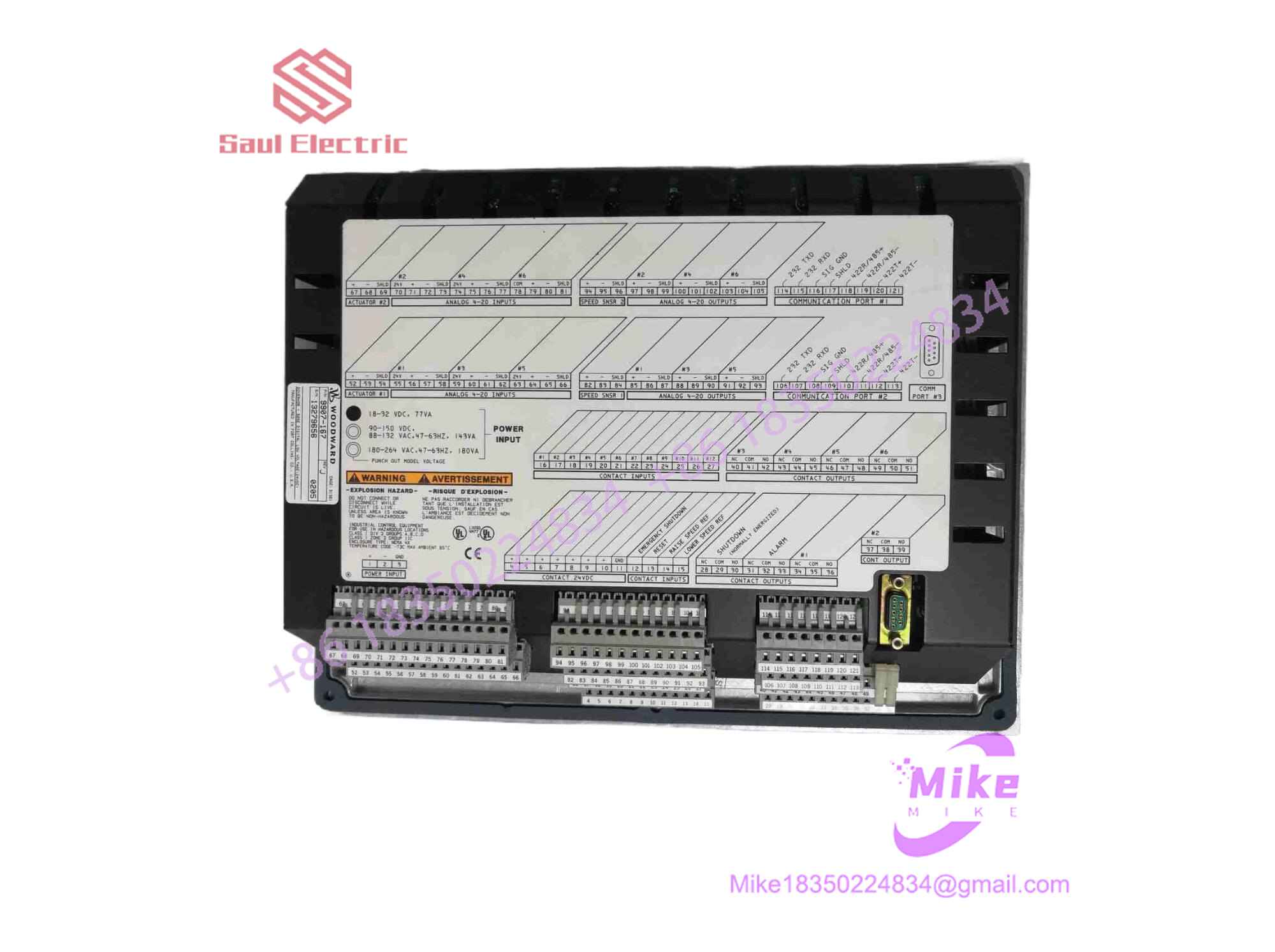
9907-167
Key Technical Specifications
- Input Supply Voltage: +24 VDC nominal auxiliary power feed
- Processor Architecture: Advanced embedded digital microprocessor core
- Operating Temperature Range: -40^\circC to +85^\circC industrial ambient tolerance
- Enclosure Protection: Ruggedized construction (up to IP67 protection ratings for environmental resilience)
- Communication Protocols: Integrated Modbus and CANbus network interfaces
- Input/Output Interfaces: 16 programmable I/O channels for discrete and analog signals
- Control Features: Isochronous speed control, critical speed band avoidance, and split-range extraction regulation
- Diagnostics: Built-in self-diagnostic functions and error-logging routines
- Application Scope: Power generation, oil & gas compression, and marine turbine automation
- Weight: ~4.1 kg (9 lbs)
Global Sourcing & Live-Test SOP (Transparency Core)
Deploying replacement digital governor hardware on critical steam assets requires a rigorous, multi-point verification protocol to prevent unexpected controller lockouts.
- Inbound Verification: Incoming units are audited against official OEM manufacturing lots. Terminal blocks and communication ports are inspected under optical magnification for pin corrosion, dust accumulation, or thermal stress.
- Live Simulation: The 505E controller is mounted on a dedicated test rack powered by an isolated 24 VDC supply, tied to a signal generator simulating magnetic pickup (MPU) turbine frequencies and 4–20 mA process loops.
- Diagnostics: Technicians execute full keypad and display matrix tests, verify Modbus/CANbus packet handshakes, test analog I/O calibration accuracy across all channels, and run a 24-hour thermal soak cycle under continuous power.
- Final Prep: Once diagnostic configuration logs pass factory baselines, volatile memory is cleared, software configuration states are archived, and the unit is packaged in an ESD-safe moisture-barrier bag.
The Field Engineer’s Pitfall Guide
❗ Failing to Backup Site Configuration Files Before Swapping: Pulling an active 505E controller without uploading the site-specific service configuration file via the front port leaves the replacement unit with blank or default factory logic blocks. (I’ve seen plants lose an entire startup window because a technician swapped the box without saving the custom PID and valve calibration parameters.) Always extract the active configuration file first.
❗ Unshielded Signal Cabling on MPU and 4–20 mA Loops: Running speed pickup or analog feedback cables alongside high-voltage motor feeds without continuous shielded twisted-pair grounding induces severe electrical noise, causing erratic speed readings and unexpected turbine trips. Always terminate shields strictly at the designated cabinet ground stud.
❗ Ignoring Power Supply DC Ripple: Feeding this processor from an unconditioned auxiliary battery bus carrying excessive high-frequency ripple voltages will destabilize internal logic power rails, leading to random controller reboots. Always verify DC bus cleanliness with a True-RMS meter prior to landing power lines.
Intent-Driven FAQ
Will swapping this 9907-167 controller erase my custom turbine control logic?
Yes, the hardware module itself ships without your site’s unique configuration. While the operating system firmware resides in flash memory, your specific PID settings, speed ranges, and valve linearization curves must be reloaded from your backup configuration file using Woodward service software.
Can this controller be hot-swapped while the steam turbine is running?
No. Unsealing or replacing a 505E controller governing an active steam valve network will immediately sever control, dropping actuator outputs to zero and tripping the turbine. Always bring the turbine to a safe, stopped state and de-energize the +24 VDC supply before servicing.
What causes the unit to display an internal watchdog or CPU fault on startup?
A persistent watchdog or CPU error usually points to a corrupted configuration checksum, a failed internal memory IC, or unstable power supply voltage during boot-up. If reloading the configuration file via the service port does not clear the fault, internal board-level hardware degradation is the root cause.
Is the 9907-167 compatible with standard plant DCS architectures?
Yes. Featuring native Modbus and CANbus communication ports alongside programmable discrete and analog I/O points, the 505E integrates cleanly with most third-party distributed control systems and supervisory control networks.
What kind of warranty accompanies surplus or refurbished 9907-167 units?
Reputable industrial suppliers typically back tested surplus or refurbished automation components with a standard 1-to-2 year replacement warranty, backed by an independent bench test report confirming communication port health and analog channel accuracy.





