


Description
Woodward 9907-028 | SPM-A Synchronizer 50/60Hz Core Category
Dynamic Product Introduction
Tie-in synchronizing errors can twist generator shafts or blow station switchgear if a breaker closes outside acceptable envelope parameters. The Woodward 9907-028 operates as an SPM-A synchronizer node engineered to calculate real-time slip frequency and phase differences between an incoming generator source and an energized bus. Unlike complex software-driven automation controllers that require intricate programming scripts just to execute basic permissive signals, this hardware-centric unit uses dedicated analog comparison circuitry for reliable, zero-latency closing triggers.
Stepping away from units requiring automated bus-matching peripherals, this specific non-voltage-matching iteration streamlines retrofits where bus and generator voltages are pre-regulated by external transformer taps or manual AVR controls. Field operational history proves that deploying this synchronizer eliminates out-of-phase breaker closure spikes, protecting prime mover gearboxes and alternator windings across continuous industrial generation plants.
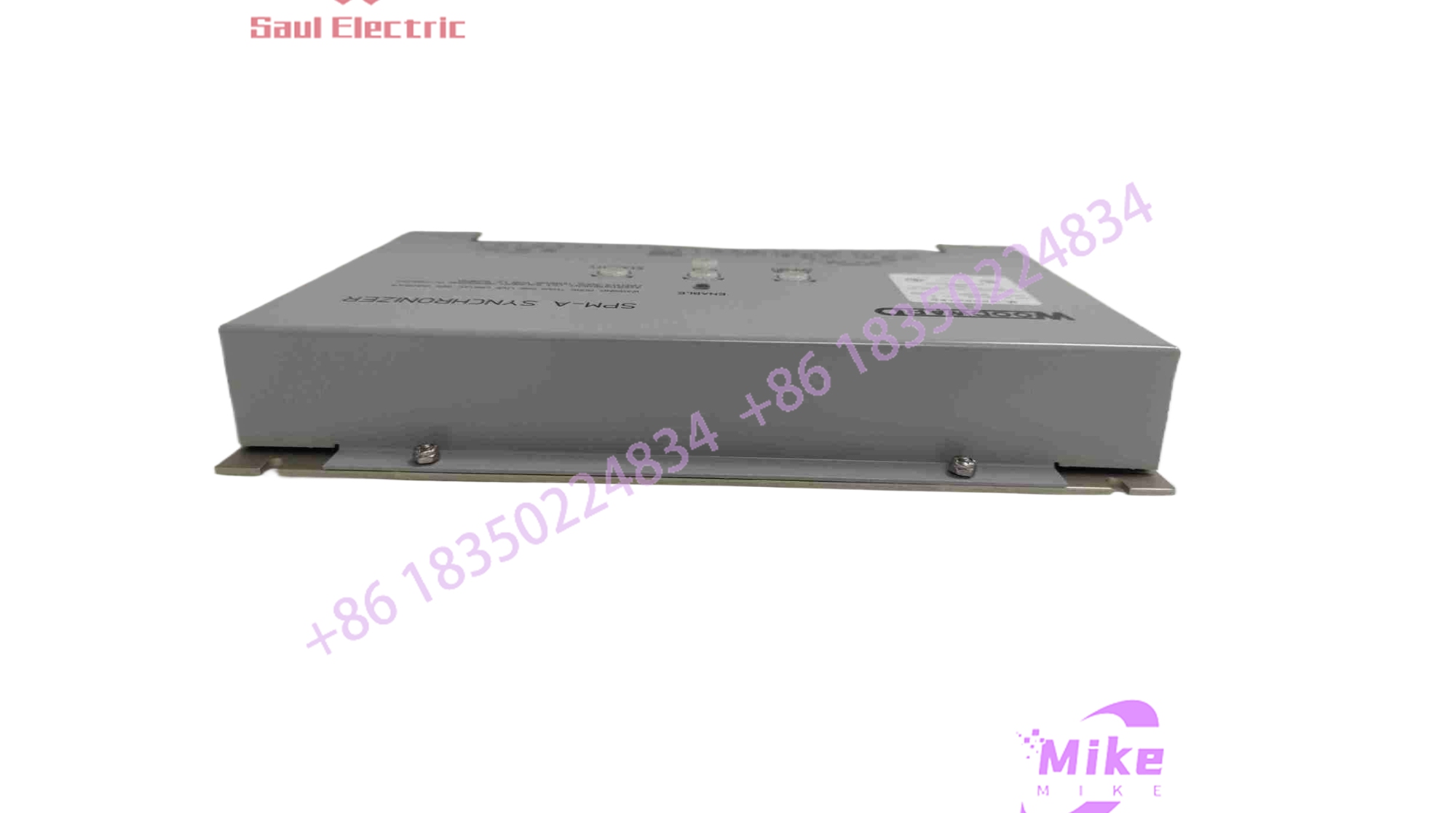
9907-028
4. Key Technical Specifications
- Voltage Input: 115/230 VAC RMS (Selectable via internal configuration)
- Frequency Rating: 50/60 Hz
- Phase Angle Permissive Window: \pm 10^\circ
- Voltage Matching Function: None (Non-voltage matching variant)
- Power Consumption: Maximum 5 watts
- Outputs: High-impedance, low-impedance, and EPG governor bias output lines
- Voltage Tolerance: \pm 10^\circ system variation limits
- Operating Temperature Range: -40^\circC to +70^\circC industrial ambient tolerance
- Enclosure Type: Switchgear rack-mountable modular chassis
- Weight: ~1.36 kg (3 lbs)
Global Sourcing & Live-Test SOP (Transparency Core)
Acquiring surplus or replacement synchronizer hardware requires a strict validation workflow to ensure absolute phase-angle trip accuracy before installation on live switchgear.
- Inbound Verification: Incoming units undergo traceability checks against original OEM production lots. Terminal blocks are inspected under optical magnification to detect micro-corrosion, contact pitting, or unverified modifications.
- Live Simulation: The synchronizer is mounted on a specialized test rack connected to dual isolated variable AC voltage sources simulating bus and generator feeds with adjustable slip frequency.
- Diagnostics: Phase angle coincidence windows are tested using an oscilloscope to verify that closure relay contacts trip precisely within the \pm 10^\circ envelope. Units undergo a 24-hour thermal soak test under continuous signal pulsing to detect timing drift.
- Final Prep: Once relay actuation thresholds clear calibration, internal jumper settings are logged, and the unit is sealed in an ESD-safe moisture-barrier bag.
The Field Engineer’s Pitfall Guide
❗ Disregarding Potential Transformer (PT) Phase Rotation Errors: Connecting bus and generator PT feeds with mismatched phase rotation sequences (e.g., ABC vs. ACB) will trick the synchronizer into reading a permanent 120-degree phase shift, preventing the close permissive relay from ever firing. (I’ve seen plants sit dead on the bus for hours during commissioning because a technician assumed cabinet wiring colors matched phase polarity.) Always verify rotation with a digital phase meter before landing wires.
❗ Overlooking the Absence of Voltage Matching: Assuming this 9907-028 variant will automatically trim the AVR voltage setpoint will result in failed synchronization sequences, as this model lacks internal voltage-matching hardware. Bus and generator voltages must be balanced manually or via a separate regulator loop prior to initiating sync.
❗ Unshielded Control Wiring to Breaker Close Coils: Running synchronizer output permissive lines alongside high-current motor control or ignition wiring without continuous shielded twisted-pair cables can pick up stray transients, causing erratic breaker trip commands. Always ground cable shields strictly at a single cabinet earth stud.
Intent-Driven FAQ
Will swapping this 9907-028 synchronizer require reprogramming firmware logic?
No. The SPM-A series is a hardware-configured analog control unit. There is no software flash memory or custom logic to load; operation is determined entirely by physical terminal wiring and internal configuration jumpers.
Can this synchronizer be hot-swapped on an active switchgear panel?
No. Unsealing or replacing a synchronizer connected to live generator and bus potential transformers risks exposing personnel to hazardous voltages and can send false trip or close signals to the breaker rack. Always isolate local PT feeds and control power before servicing.
What causes the unit to refuse to issue a breaker close command during parallel tie-in?
Failure to issue a close command typically stems from slip frequency being set too high, a phase angle window mismatch, or a missing governor bias connection preventing the speed matcher from pulling the generator into exact sync slip. Verify that generator frequency is drifting slowly toward the bus frequency.
Is the 9907-028 compatible with both 50 Hz and 60 Hz electrical grids?
Yes. The unit is engineered to accommodate standard 50 Hz or 60 Hz system frequencies, though internal frequency selection jumpers or range scaling must match your local utility standard.
What kind of warranty accompanies surplus 9907-028 units?
Reputable industrial suppliers typically back tested surplus or refurbished automation components with a standard 1-to-2 year replacement warranty, backed by an independent bench test report confirming phase-angle closure accuracy within the \pm 10^\circ window.





