


Description
Woodward 9905-144 | 2301A Full Authority Speed Controller Core Category
Dynamic Product Introduction
Swapping out a failing governor node on an active turbine skid demands hardware you can trust on the first spin. The Woodward 9905-144 operates as a frontline electronic control module designed to govern diesel engines, gas engines, and industrial turbines without digital latency. Unlike modern programmable automation controllers that require complex software toolchains just to tweak a deadband, this analog-centric unit relies on accessible front-panel potentiometers for direct, on-the-fly calibration.
Shifting away from obsolete iterations, this forward-acting 2301A variant delivers tighter loop stability and cleaner signal isolation for mA-level speed setting inputs. Field measurements show a marked reduction in steady-state speed drift under fluctuating heavy loads, establishing it as an essential drop-in asset for continuous power generation plants and remote compressor stations.
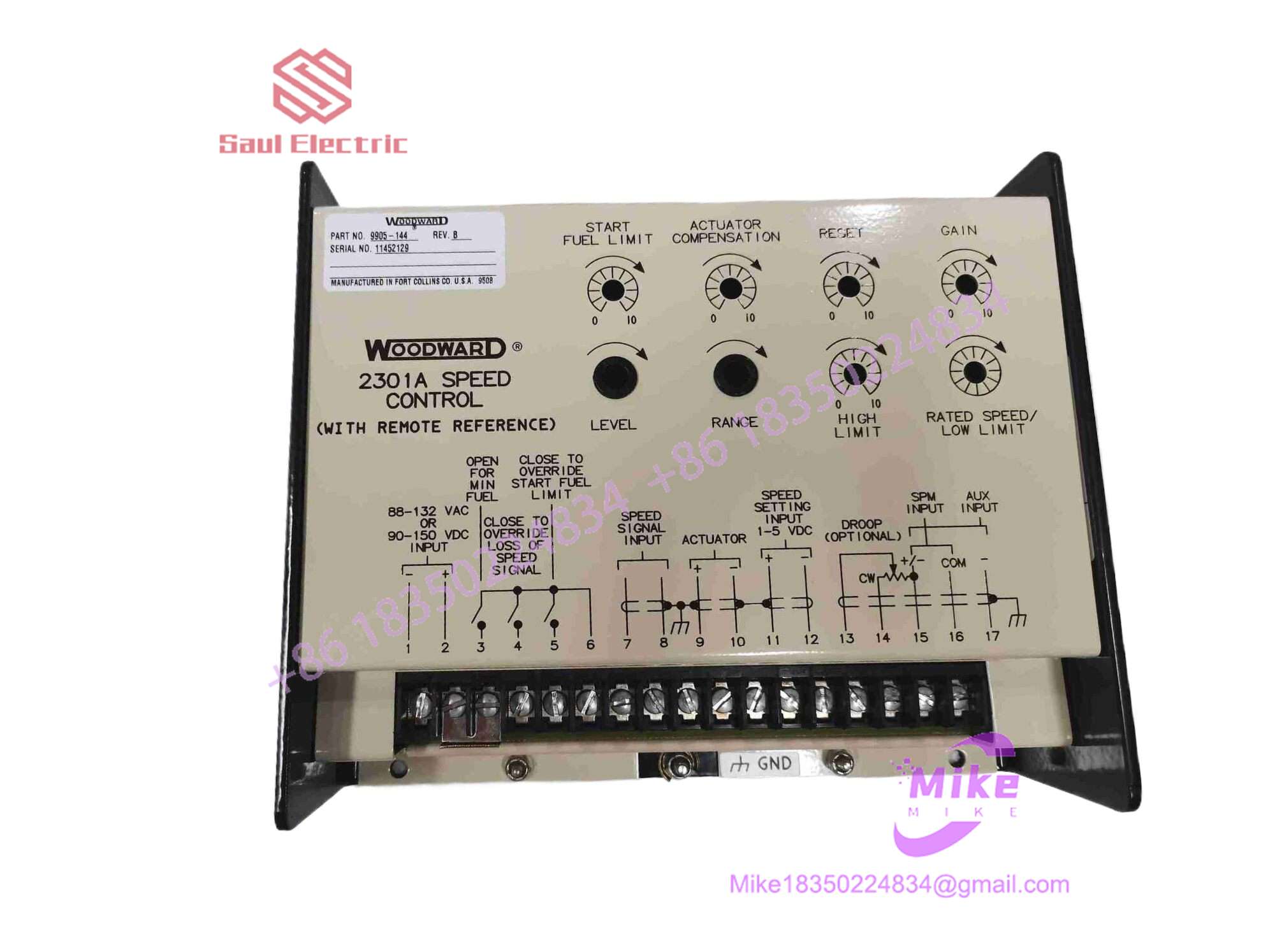
9905-144
Key Technical Specifications
- Supply Voltage: 10 to 40 VDC (Low-voltage DC architecture)
- Actuator Output Current: 0 to 200 mA (Compatible with 35-ohm coils standard)
- Control Modes: Isochronous (constant speed) and Droop (via external potentiometer)
- Speed Setting Input: 4–20 mA or 1–5 VDC process demand
- Magnetic Pickup (MPU) Range: Selectable frequency ranges via internal configuration
- Enclosure Type: Sheet metal chassis, single printed circuit board layout
- Operating Temperature Range: -20°C to +70°C (-40°C to +85°C extended ambient tolerance variants)
- Vibration Tolerance: Approximately 4 G (5 to 500 Hz)
- Dimensions: 387.35 mm x 180.975 mm x 63.5 mm (15.25 in x 7.125 in x 2.5 in)
- Weight: ~1.13 kg (2 lbs 8 oz)
- Optional Interface: SPM-A Synchronizer and Load Sensor compatibility
Global Sourcing & Live-Test SOP (Transparency Core)
Acquiring surplus or replacement turbine hardware requires rigorous verification to eliminate infant mortality risks in the field.
- Inbound Verification: Every unit undergoes customs and OEM documentation audits. Serial numbers are cross-referenced against known factory lots to isolate grey-market or counterfeit sub-assemblies.
- Live Simulation: Technicians mount the board onto an authentic Woodward test rack equipped with a calibrated MPU signal generator and inductive load simulator to mimic live turbine dynamics.
- Diagnostics: Inputs are subjected to full-scale 4-20mA sweeps. The actuator output is monitored under a sustained 24-hour heat run to flush out thermal drift or component fatigue. Handshake responses with optional synchronizers are verified via oscilloscope.
- Final Prep: Once parameters clear calibration, firmware revision stamps (where applicable) or analog trim positions are recorded, and the unit is packaged in an ESD-safe, moisture-barrier bag before dispatch.
The Field Engineer’s Pitfall Guide
❗ Ignoring the Forward vs. Reverse Actuator Voltage Offset: Replacing a reverse-acting unit with this forward-acting 9905-144 without resetting the actuator potentiometer can cause dangerous fuel overfeeding on startup. Always adjust the base potentiometer strictly counterclockwise during initial setup, bringing it up to required voltage thresholds incrementally.
❗ Floating Shield Terminations on MPU and Speed Reference Lines: Leaving signal cable shields ungrounded at one end—or accidentally grounding both ends—introduces severe electromagnetic interference from nearby variable frequency drives or high-voltage lines, triggering erratic speed spikes.
❗ Overlooking Backplane Power Ripple: Feeding this controller from a noisy, unconditioned auxiliary power supply causes internal reference voltage fluctuations. (I’ve seen plants lose two days of production because a failing power supply injected a 50mV ripple, tricking the PID loop into hunting continuously.) Always verify DC bus cleanliness with a True-RMS digital multimeter before landing power wires.
Intent-Driven FAQ
Will I lose my calibration settings if I swap this unit out during a maintenance outage?
Because the 9905-144 is an analog-hybrid 2301A architecture, configuration relies heavily on physical front-panel potentiometers and internal DIP switches rather than software memory. You must manually record your GAIN, RESET, and fuel limit potentiometer turns before swapping; otherwise, the replacement unit will boot with default factory dynamics.
Is this module safe for hot-swapping on a live running turbine?
No. Hot-swapping a speed controller governing active fuel or steam valves introduces an immediate risk of unmanaged prime mover runaway or catastrophic shutdown. Always bring the prime mover to a controlled stop and de-energize the 10–40 VDC supply before touching terminal blocks.
Can I run this controller in an isochronous setup without an SPM synchronizer?
Yes. Isochronous mode functions independently to maintain a constant prime mover speed as long as the engine or turbine can satisfy the active load. An SPM synchronizer is only required if you are automating parallel tie-ins with a live bus grid.
What causes the unit to trigger minimum fuel protection unexpectedly?
This behavior usually stems from a degraded magnetoresistive or magnetic pickup (MPU) signal. If the air gap between the MPU tip and the flywheel gear teeth shifts—or if metallic debris bridges the sensor—the controller senses a sudden loss of speed feedback and cuts output to minimum fuel as a safety precaution.
What kind of warranty accompanies surplus or replacement stock?
Tested surplus and refurbished units typically carry an independent provider warranty (such as a standard 1-to-2 year vendor guarantee), given that original factory OEM warranties often lapse on discontinued analog inventory lines. Ensure your supplier provides individual bench-test calibration sheets with purchase.





