


Description
Woodward 8273-140 | 2301D Digital Load Sharing & Speed Control
Architect’s Product Breakdown
The Woodward 8273-140 operates as a core variant within the 2301D digital governor family, designed to provide exact speed and real-load sharing control for diesel, gas, and dual-fuel engines or steam turbines. Moving past the limitations of analog predecessors, this unit relies on a digital microprocessor architecture to maintain strict frequency regulation and eliminate thermal drift over extended operational campaigns. It handles complex multi-unit load sharing across isolated or utility-parallel switchgear buses with deterministic precision.
Commissioning or replacing this specific part number demands careful attention to configuration files. The hardware interfaces through Woodward’s Watch Window software via a front-panel serial port, allowing engineers to tune PID loops, set ramp rates, and define discrete input/output behaviors. Because terminal layouts across 2301D variants share standard physical footprints, checking jumper settings and software revision compatibility is mandatory before dropping it into an active cabinet.
Field reliability is high, but the unit demands clean power inputs and strict adherence to signal shielding guidelines. Integrating the 8273-140 into legacy sites provides an immediate pathway to modernizing control dynamics without requiring a complete redesign of existing cabinet internal mounting rails or actuator interfaces.
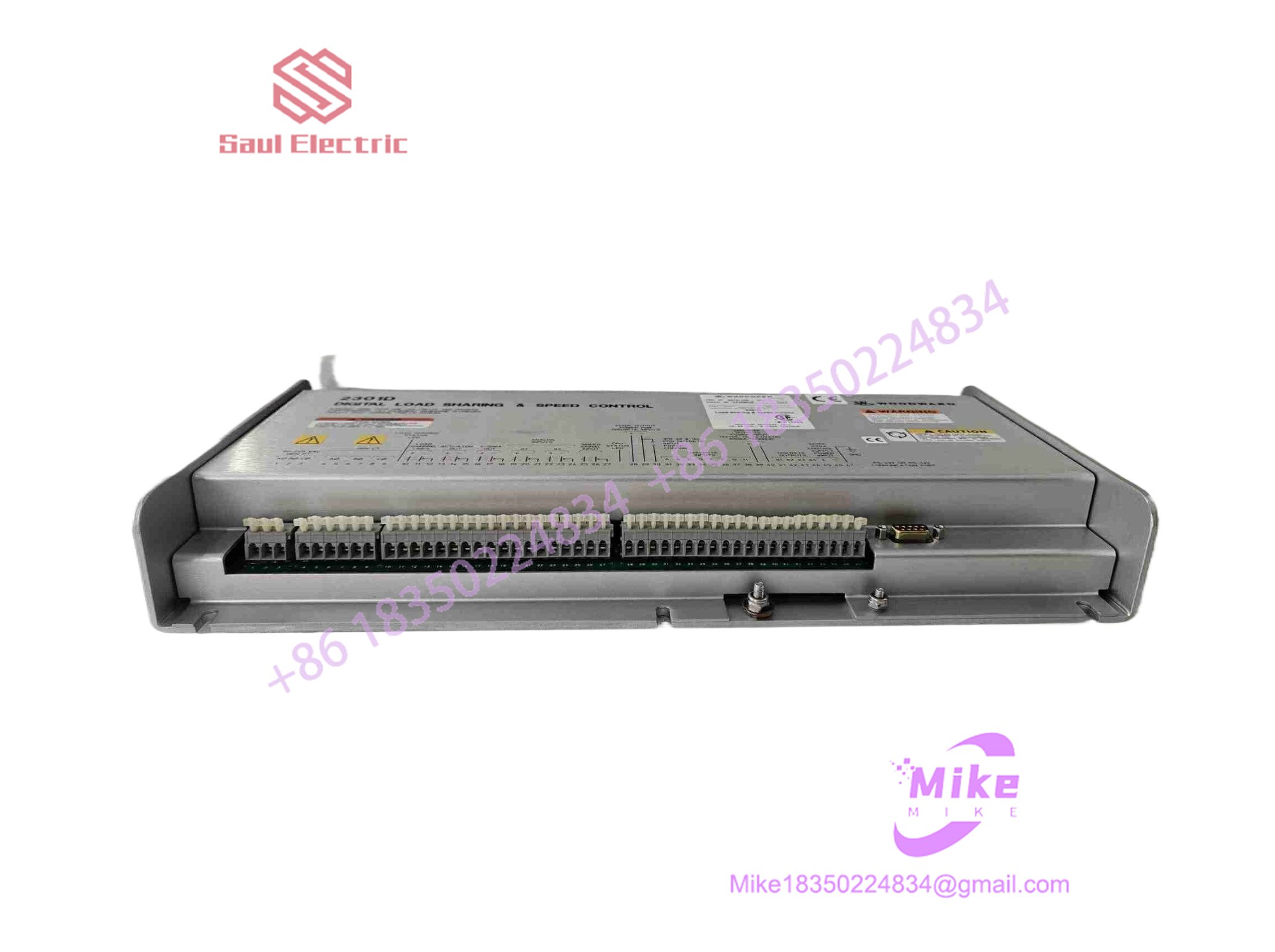
8273-140
Key Technical Specifications
| Parameter | Technical Specification |
| Operating Voltage | 18 to 40 VDC (Nominal 24 VDC) |
| Max Power Consumption | < 20 W |
| MPU Frequency Range | 100 to 20,000 Hz |
| Discrete Inputs | 8 channels (fully configurable) |
| Discrete Outputs | 4 configurable relay driver outputs |
| Analog I/O | Configurable analog inputs and outputs |
| Communication Ports | RS-232 and RS-422 (Front port interface) |
| Operating Temperature | -40°C to +70°C (-40°F to +158°F) |
| Enclosure Protection | Chassis mounted, IP20 rated |
| Physical Weight | 1.75 kg (approx. 3.86 lbs) |
Field Engineer’s Pitfall Guide
- WARNING: Software Version Lockouts. Attempting to pull or push configuration files to an 8273-140 using an ancient revision of Watch Window will result in communication drops. Verify your service tool package matches the firmware generation before attempting online tuning.
- WARNING: MPU Ground Faults. Grounding the magnetic pickup signal shield at both the controller and the engine housing creates a ground loop, introducing severe noise into the speed tracking loop. Tie the shield strictly to the cabinet ground bus bar only.
- WARNING: Actuator Current Limits. Misconfiguring the driver output parameters for the attached proportional actuator can lead to thermal overload or sluggish valve response. Double-check output scaling against your specific actuator data sheet.
QA & Testing SOP (Transparency)
- Visual & Origin Verification: Inspection of OEM tamper seals, serial number tags, and connector pin integrity against factory specifications.
- Bench Power & Handshake: Units are mounted to a live test bench, powered via an isolated 24 VDC source, and verified for correct processor boot behavior and serial port communication handshakes.
- I/O Simulation: Technicians inject calibrated frequency signals to test speed tracking accuracy across the entire operating band, alongside verifying all discrete and analog input/output channels.
- Final Packaging: Non-volatile memory states are cleared where required, and the hardware is enclosed in anti-static packaging surrounded by high-density shock-absorbing foam.
Technical FAQ
Can I hot-swap this module while the prime mover is running?
No. Removing the 8273-140 while the engine is online drops the control output to zero, instantly cutting fuel supply and tripping the unit. Perform all hardware replacements during scheduled outages.
Do I need specialized software to program a replacement unit?
Yes. You must use Woodward’s Watch Window software and an appropriate serial cable to upload the pre-saved configuration file or tune the PID loops for the specific engine dynamics.
Are configuration parameters saved during a complete power failure?
Yes. All tuning constants, calibration curves, and control logic configurations are stored in non-volatile flash memory, ensuring parameters persist through total auxiliary power loss.
Is the 8273-140 pin-compatible with older analog 2301 units?
No. While physical mounting dimensions are similar, the terminal wiring assignments and internal architecture differ significantly from legacy analog hardware. Re-pinning and software setup are required.





