


Description
Woodward 9907-029 | SPM-A Synchronizer with Voltage Matching Core Category
Dynamic Product Introduction
Tying a generating asset into an energized utility bus requires absolute synchronization control to prevent severe shaft torsion or catastrophic switchgear flashovers. The Woodward 9907-029 operates as an advanced SPM-A synchronizer variant engineered to actively trim both prime mover speed and automatic voltage regulator (AVR) setpoints. Unlike basic phase-matching nodes that assume pre-regulated bus parity, this unit incorporates native voltage-matching loops to pull generator voltage levels directly into alignment before issuing a close command.
Stepping past non-voltage-matching legacy cards, this hardware platform ensures compliance with strict grid interconnection codes without relying on complex PLC software routines. Field performance records confirm that deploying this controller minimizes transient power surges during parallel tie-ins, securing long-term mechanical integrity across continuous power generation skids.
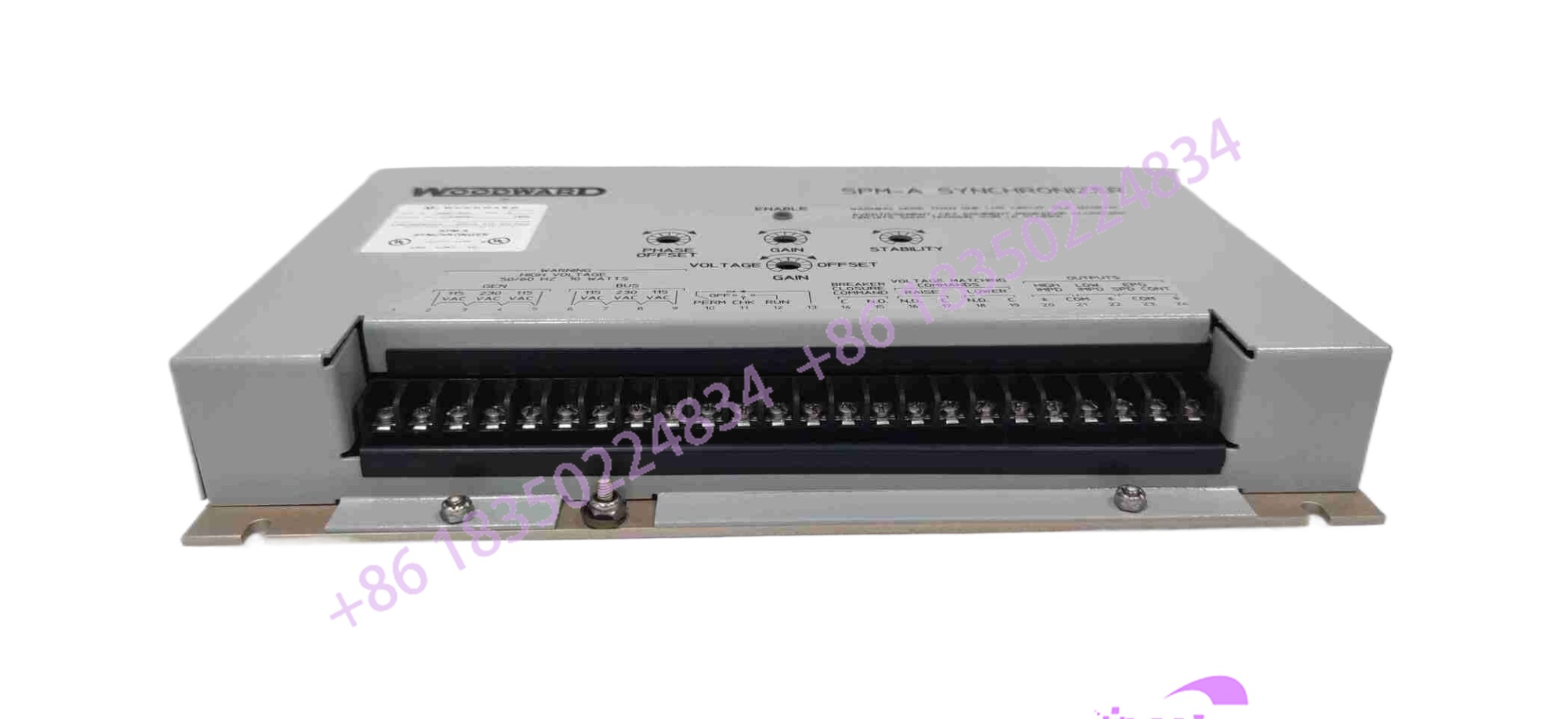
9907-029
Key Technical Specifications
- AC Voltage Inputs: 115 or 230 VAC RMS (\pm 10\%), 50/60 Hz (Bus and Generator feeds)
- Power Consumption: Maximum 5 Watts
- Phase Angle Window: \pm 10^\circ permissive closure threshold
- Voltage Matching Feature: Integrated (\approx 1\% match window)
- Governor Outputs: High-Impedance, Low-Impedance, and EPG direct bias lines
- Relay Output Ratings: Resistive (10 A @ 28 VDC, 3 A @ 115 VAC); Inductive (6 A @ 28 VDC, 2 A @ 115 VAC)
- Operating Temperature Range: -40^\circC to +70^\circC industrial ambient tolerance (extended spec variants up to +66^\circC operational)
- Enclosure Type: Sheet metal back-panel mounting chassis
- Dimensions: Approximately 315 \times 210 \times 44 mm
- Weight: ~2.0 kg (4.4 lbs)
Global Sourcing & Live-Test SOP (Transparency Core)
Deploying replacement synchronizer hardware on live switchgear requires an uncompromised verification routine to guarantee absolute trip timing precision.
- Inbound Verification: Incoming modules are audited against official OEM production lots. Terminal strips are inspected under optical magnification to detect micro-corrosion, pitting, or unauthorized board-level repairs.
- Live Simulation: Technicians mount the chassis onto a dedicated test bench connected to dual isolated variable AC sources simulating bus and generator lines with independently adjustable frequency and voltage outputs.
- Diagnostics: Voltage-matching feedback loops and phase-angle coincidence windows are tested using a digital storage oscilloscope to verify that the breaker close relay trips strictly within the \pm 10^\circ envelope. Units undergo a 24-hour thermal soak under active signal pulses.
- Final Prep: Once relay actuation thresholds clear calibration benchmarks, internal jumper settings are logged, and the unit is sealed inside an ESD-safe moisture-barrier bag.
The Field Engineer’s Pitfall Guide
❗ Mismatched Potential Transformer (PT) Polarity or Phase Rotation: Connecting bus and generator PT feeds with reversed polarity or mismatched phase rotations (e.g., ABC vs. ACB) will cause the internal voltage and phase comparators to misread grid conditions, locking out the close permissive relay indefinitely. (I’ve seen plants sit offline for hours during commissioning because a technician assumed cabinet wiring color codes matched phase orientation.) Always verify rotation using a digital phase meter before landing lines.
❗ Overlooking the Voltage Matching Loop Polarity: Reversing the polarity of the voltage-matching output connection to the AVR will cause the controller to drive generator voltage away from the bus target instead of toward it, resulting in an endless hunting loop. Always trace and verify the AVR trim signal wiring path.
❗ Unshielded Interconnect Wiring on Governor Bias Lines: Running synchronizer bias lines alongside high-current control wiring without continuous shielded twisted-pair cables introduces severe electrical noise, causing erratic governor adjustments during the synchronization phase. Always ground shields strictly at a single cabinet earth point.
Intent-Driven FAQ
Will swapping this 9907-029 synchronizer require reprogramming firmware logic?
No. The SPM-A product line relies entirely on hardwired analog circuitry and internal configuration jumpers. There is no software flash memory or custom application logic to download; system behavior is dictated completely by terminal connections and physical adjustments.
Can this synchronizer be hot-swapped on an active switchgear panel?
No. Replacing a synchronizer wired directly into live potential transformers and breaker trip circuits exposes personnel to hazardous high voltages and risks sending false close commands to the switchgear. Always isolate local PT feeds and control power prior to servicing.
What causes the module to refuse to issue a breaker close command?
A refusal to close typically stems from slip frequency being set too high, an unadjusted voltage differential outside the 1% matching threshold, or a broken governor bias loop preventing the unit from pulling the generator into exact synchronization. Ensure the generator frequency is actively drifting toward the bus frequency.
Is the 9907-029 compatible with both 50 Hz and 60 Hz electrical grids?
Yes. The unit accommodates standard 50 Hz or 60 Hz systems, provided internal frequency configuration jumpers and scaling are set to match your local utility grid frequency standard.
What kind of warranty accompanies surplus 9907-029 units?
Reputable industrial suppliers typically back tested surplus or refurbished automation hardware with a standard 1-to-2 year replacement warranty, backed by an independent bench test report confirming phase-angle closure accuracy and voltage-matching loop response.





