


Description
Schmersal AZM160-22YP | Solenoid Safety Interlock Switch
Product Introduction
When a high-inertia production spindle or robotic cell continues to spin after a stop command is issued, opening the safety gate prematurely can result in catastrophe. The Schumacher—correctly designated Schmersal AZM160-22YP—is not a standard panel limit switch; it is a heavy-duty solenoid interlock engineered to mechanically lock safety guards shut until internal monitoring confirms zero kinetic energy remains—though configuration requires careful attention to auxiliary release options.
Encased in a rugged, double-insulated thermoplastic housing, this unit combines physical guard locking with positive-break contact monitoring. It uses a robust solenoid-actuated blocking bolt that secures the actuator key under power, protecting operators from accidental exposure to unmitigated industrial hazards.
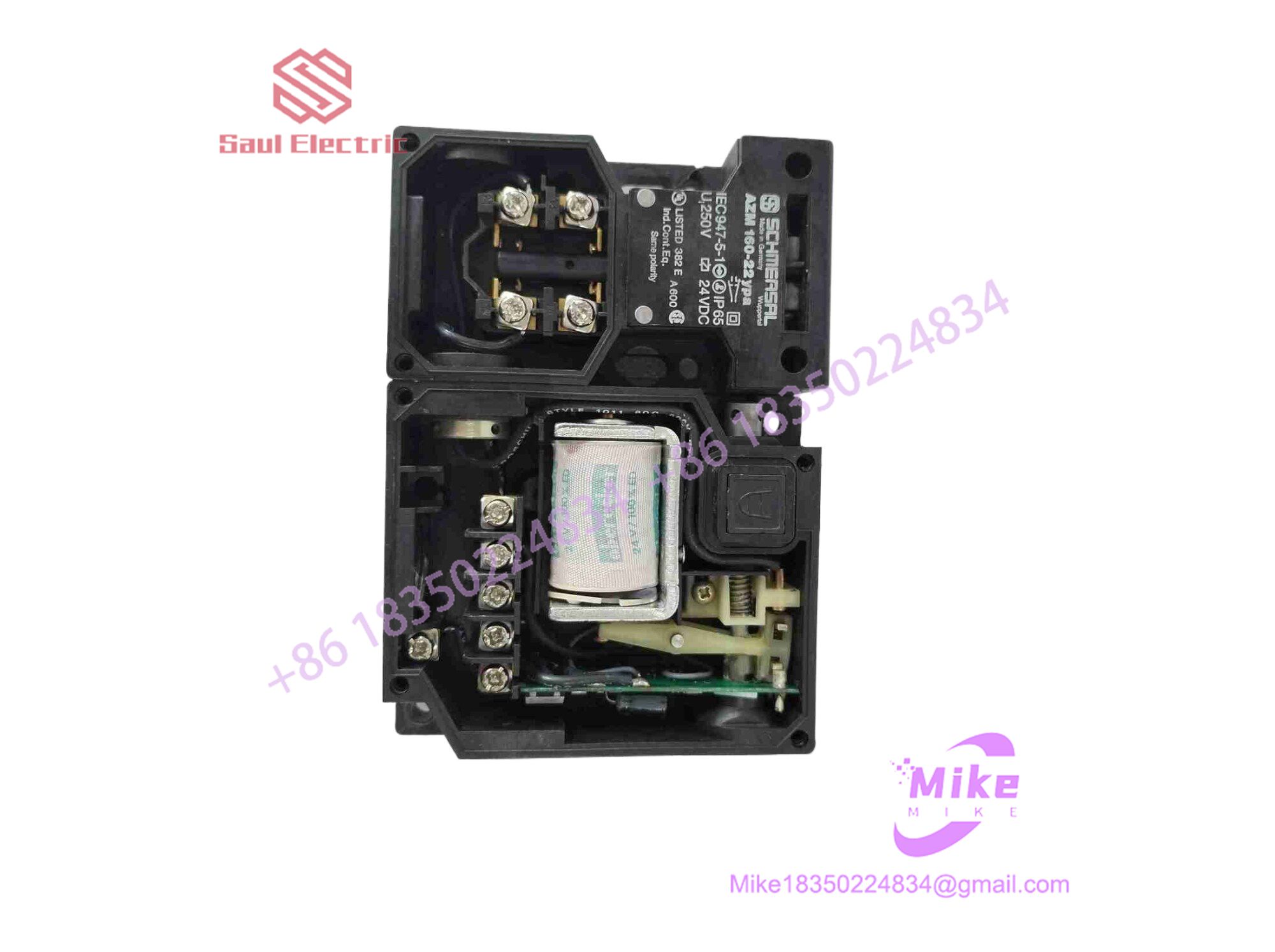
AZM160-22YP
Key Technical Specifications
| Parameter | Value |
| Enclosure Material | Glass-fibre reinforced thermoplastic, self-extinguishing |
| Holding Force (F_{max}) | 2,000 N |
| Contact Composition | 2 Normally Closed (NC) / 2 Normally Open (NO) |
| Actuation Principle | Power-to-lock or Power-to-release variants (Model dependent) |
| Cable Entry / Connections | Multiple metric/PG wiring compartments or plug-in connector options |
| Mechanical Life | > 1,000,000 operations |
| Latching Force | 30 N (adjustable ball latch options up to 150 N) |
| Enclosure Protection | IP67 |
Application Scenarios & Pain Points
- High-Inertia CNC Milling Enclosures: Spindles taking minutes to spin down after a safety stop require reliable guard locking. The AZM160-22YP holds the access door shut under a 2,000N clamping force, keeping operators safe until the drive controller flags a complete standstill.
- Automated Packaging Cell Interlocks: High-speed pick-and-place lines can cause severe impact injuries if entered mid-cycle. Integrating this switch into the safety circuit ensures power is immediately cut the moment an unauthorized unlock is attempted.
- Preventing Accidental Lock-Ins: Maintenance teams servicing large mixing vats face grave risks if a system cycles accidentally. The integrated manual release mechanism allows safe egress and lockout during setup phases.
QA & Live Testing SOP (Trust Signal)
Because safety interlocks form the final layer of plant personnel protection, every surplus unit undergoes strict bench validation. We test the internal solenoid coil for continuity and operational voltage pull-in thresholds. Using a multi-meter and actuation jig, we verify that the positive-break NC contacts open cleanly prior to any mechanical release of the locking pin, and we check that the auxiliary NO feedback contacts transition precisely in sequence.
Field Engineer’s Pitfall Guide
- ❗ Misaligned Actuator Entry: Do not hard-mount the actuator key rigidly without structural play. Guard doors sag over time; if the key strikes the housing throat off-center, it will wear down the thermoplastic guide and cause permanent binding.
- ❗ Power-to-Lock vs. Power-to-Release Confusion: Verify your safety circuit architecture before wiring. Using a power-to-lock variant where safety regulations require power-to-release (or vice versa) can trap operators during a sudden plant power loss.
- ❗ Over-Torquing Terminal Screws: The internal terminal block is housed in a compact thermoplastic compartment. Overtightening mounting or wire screws will crack the internal plastic partitions, compromising insulation ratings.
Intent-Driven FAQ
- Can I manually unlock the AZM160-22YP if the machine loses main electrical power?
Yes. The unit features a manual emergency release mechanism accessible via a triangular key or auxiliary tool, allowing the guard door to be opened during a power outage or maintenance scenario.
- What is the difference between power-to-lock and power-to-release?
Power-to-lock means the solenoid must be energized to lock the guard (often used for process protection). Power-to-release means the solenoid must be energized to unlock the guard (standard for personnel safety against run-down hazards).
- Are replacement actuator keys interchangeable?
The switch housing is designed to accept various standard Schmersal actuator profiles (such as straight or angled keys), but they must be securely fastened using tamper-proof screws to prevent bypassing.
- What do the 2NC/2NO contact designations control?
The Normally Closed (NC) contacts are strictly utilized in the safety chain to monitor guard closure and locking status. The Normally Open (NO) contacts are typically routed to the PLC as standard auxiliary telemetry to indicate door status.
- Is the AZM160 series still actively supported by Schmersal?
While newer electronic safety concepts exist, many variants of the physical AZM160 series remain widely utilized, though sourcing exact sub-versions often relies on established industrial surplus and automation replacement channels.





