

Description
Phoenix Contact PLC-RSC-24UC/21 | Relay Module, New Surplus
Architect’s Product Breakdown
The Phoenix Contact PLC-RSC-24UC/21 (Part Number 2966184) functions as an ultra-slim, 6.2mm electromechanical interface relay designed for heavy-duty industrial automation applications. Combining a screw-connection terminal base with a plug-in miniature power relay, this unit delivers galvanic isolation between sensitive PLC input/output cards and noisy field actuators or sensors. The universal coil circuit accepts both 24V AC and 24V DC input signals without external adaptation, simplifying parts inventory across mixed-signal control panels.
Integrating this assembly into control cabinets eliminates the space penalties typically associated with traditional interposing relays. Plug-in bridging bars (FBST series) can link power supplies across multiple adjacent bases, drastically cutting down internal cabinet wiring labor. When a relay eventually reaches its mechanical wear limit, the integrated plastic retaining and ejector lever allows technicians to swap out the plug-in switching element in seconds without disconnecting any field wiring from the base terminal block.
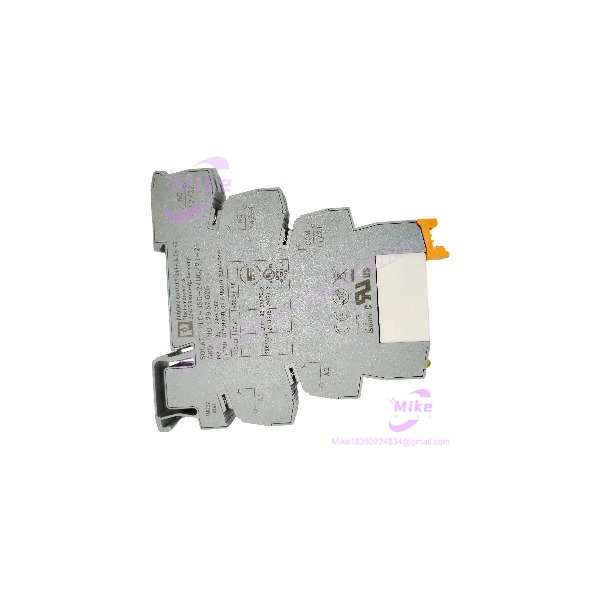
PLC-RSC-24UC
Key Technical Specifications
- Manufacturer Part Number: 2966184
- Model Designation: PLC-RSC-24UC/21
- Nominal Input Voltage (U_N): 24V AC/DC (50/60 Hz)
- Typical Input Current: 11 mA
- Contact Type: 1 PDT (Single Pole Double Throw / Changeover contact)
- Contact Material: AgSnO (Silver Tin Oxide) for standard power switching
- Max Switching Voltage: 250V AC/DC
- Limiting Continuous Current: 6A
- Connection Technology: Screw Connection (26 to 14 AWG)
- Housing Width: 6.2 mm ultra-compact profile
- Operating Temperature Range: -40°C to +60°C
Field Engineer’s Pitfall Guide (Unique Value)
- Warning: Mismatching Contact Material for Low-Energy Signals. Using the standard silver tin oxide (AgSnO) contacts of the PLC-RSC-24UC/21 to switch low-level PLC analog or pulse signals (< 5V, < 10mA) will cause an insulating oxide layer to form over time, resulting in erratic signal readings. Use the gold-plated contact variant (suffix
/21AU) for dry circuit or low-energy telemetry switching. - Warning: Overlooking AC Inductive Kickback. When driving high-inductive loads like small AC solenoids or contactors, failing to add external RC snubbers or freewheeling suppression across the load will prematurely pit and weld the relay contacts shut.
- Warning: Overtightening Terminal Screws. The M3 clamping screws on these 6.2mm bases demand a controlled torque of 0.6 Nm to 0.8 Nm. Excessive torque snaps the internal terminal cage and wrecks the housing block.
QA & Testing SOP (Transparency)
- Visual & Structural Check: Verification of housing integrity, screw terminal thread smoothness, and insertion pin straightness.
- Coil Voltage Response Test: Applied 24V AC and 24V DC independently to terminals A1/A2 to confirm reliable relay pickup and dropout thresholds.
- Contact Resistance & Switching Verification: Automated continuity testing across common (11), normally open (14), and normally closed (12) contacts under simulated load.
- LED Status Validation: Inspection of internal green status indicator illumination during coil energization.
- Anti-Static Packaging: Sealed in industrial protective bagging prior to dispatch.
Technical FAQ
- Can the plug-in relay be replaced without removing the base terminal block? Yes. The integrated plastic lever unlatches and ejects the plug-in relay directly from the socket while all field wiring remains securely attached to the screw terminals.
- What is the difference between PLC-RSC-24UC/21 and PLC-RSC-24DC/21? The
/24UCmodel accepts both AC and DC 24V signals on its coil, whereas the/24DCvariant is strictly limited to 24V DC input coils. - Can I bridge the power supply across multiple relay modules? Yes. Plug-in pluggable bridge combs (such as FBST 500-PLC) insert into the upper bus slots of adjacent modules to distribute 24V power rapidly without jumper wires.
- Is this module rated for hazardous locations? Standard commercial stock is rated for general industrial environments; specific ATEX/IECEx certified variants must be specified if installed inside Class I, Div 2 hazardous zones.





